
Vestibular Therapy for Concussion: What to Expect
October 20, 2026

Vestibular therapy is a form of rehabilitation that retrains the parts of your brain and inner ear that control balance, eye movement and your sense of where you are in space. If dizziness, a spinning feeling, blurry vision or unsteadiness hasn’t faded after a concussion, it is one of the best-studied tools for getting your footing back. It works best when it is matched to your specific problem, started at the right time and adjusted as you improve.
If you are living with this right now, take a breath. Dizziness after a head injury is frustrating and sometimes frightening, but it is common, it has identifiable causes, and there are clear steps you can take.
Your vestibular system includes the inner ear’s balance organs and the brain pathways that interpret their signals. It works with your eyes and the sensors in your neck, muscles and joints to keep the world steady when your head moves. When you turn to check a blind spot and the road doesn’t blur, that is your vestibular system working.
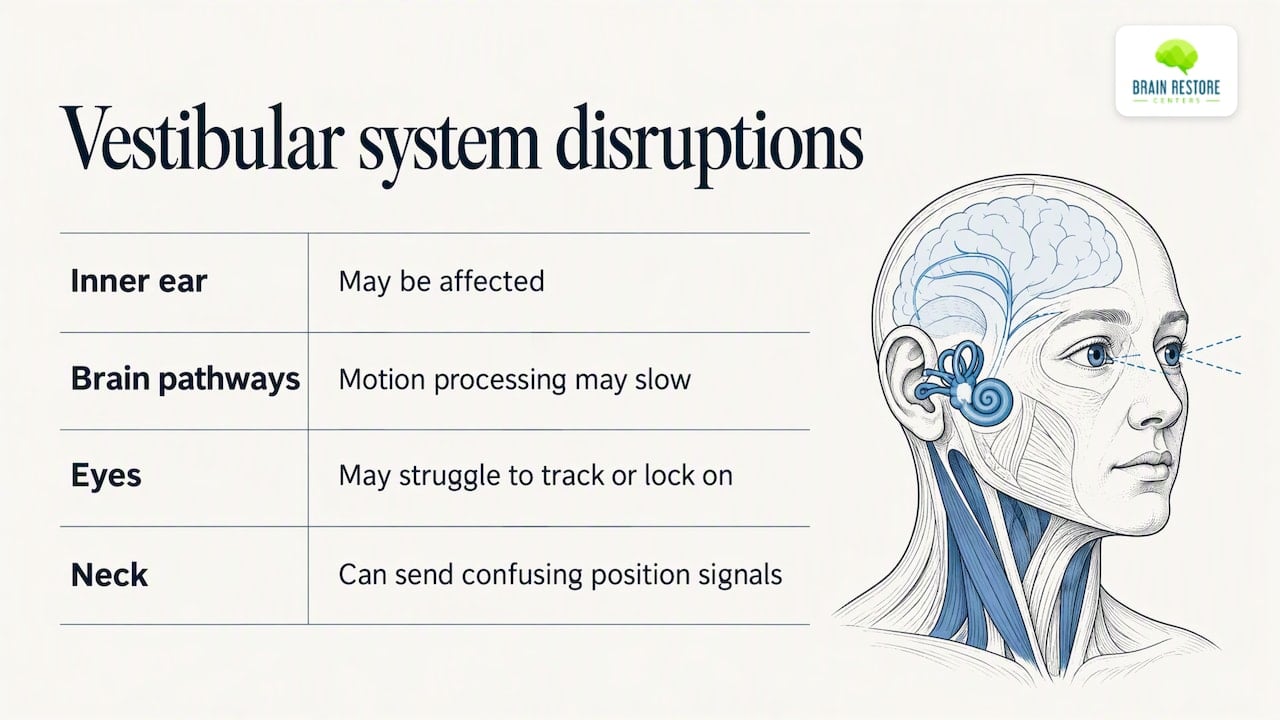
A concussion can disturb any part of that chain. The inner ear may be affected, the brain’s processing of motion may slow down, the eyes may struggle to track or stay locked on a target, and an injured neck can send confusing position signals. The result is a cluster of symptoms the CDC lists for concussion: feeling unsteady when walking, nausea, lightheadedness, or a sense that the room is spinning or moving.
This is also why one person’s dizziness differs from another’s. Some people feel it mostly when they turn their head. Others notice it in grocery store aisles, on screens, or in scrolling traffic. Each pattern points to a different weak link, and that matters for treatment.
You may be a candidate for an evaluation if, after a concussion, you notice:
These symptoms can also come from other causes, including inner ear conditions unrelated to your injury, medication effects, or blood pressure changes. That is one reason a proper evaluation matters before exercises begin. If you have vertigo without a head injury, our guide to vertigo treatment in Meridian covers that path.
Get urgent care first if you have a worsening headache, repeated vomiting, confusion, seizures, weakness or numbness, slurred speech, or you become increasingly drowsy. Go to an emergency department or call 911. Those are not signs to treat with exercises.
The old advice to lie in a dark room until you feel perfect has faded. The CDC’s materials describe a short initial rest, then a gradual, symptom-limited return to activity, and they recommend talking with your doctor about treatments such as vestibular therapy when dizziness or balance problems persist. Our article on why cognitive rest matters after concussion explains how to rest well without staying inactive for too long.
A practical way to think about it:
The CDC’s clinician materials also note that limited evidence suggests early vestibular physical therapy may benefit patients with dizziness. The word “limited” is worth keeping in mind. It is a reasonable option, not a guarantee.
A good assessment looks at the whole system rather than just asking where it hurts. Expect some or all of the following:
The goal is to find your deficits, not to prove you are sick. Clinicians call the resulting plan “impairment-based,” meaning the exercises target what the testing found. A retrospective analysis in PubMed of multimodal, impairment-based physical therapy for post-concussion syndrome, combining vestibular and eye-movement work, neck rehabilitation and sub-symptom-threshold exercise, found the approach safe and feasible. It is a retrospective study, so it shows practicality rather than proof of benefit.
Most programs draw from a handful of building blocks.
| Target | Example exercise | What it trains |
|---|---|---|
| Gaze stability | Keeping your eyes on a fixed word while turning your head side to side | The reflex that holds vision steady during movement |
| Habituation | Repeating a mildly provoking movement, such as turning from lying to sitting | Reducing the brain’s over-reaction to a motion |
| Balance | Standing with feet together, then in tandem stance, then on softer surfaces | Using vision, inner ear and body sensation together |
| Eye tracking | Following a slowly moving target, then switching between two targets | Smooth, accurate eye movement |
| Dual-task and real-world | Walking while counting, turning your head in a hallway, shopping aisles | Holding up under everyday demands |
If you want specifics, see our guides on vestibular exercises matched to your diagnosis, home oculomotor exercises for concussion and balance training after concussion. Use them as education, and ask your clinician before starting any of them on your own.
The best programs aren’t static. As symptoms ease, therapy should shift from basic habituation toward busier, more demanding tasks like walking in crowded places or doing two things at once. Feeling fine sitting at home is only the first milestone. Recovery means your system holds up in the grocery store, at your desk and on the sidewalk.
There is a stubborn myth that you must push through severe dizziness to get better. Sound programs do the opposite. Exercises are set so they don’t cause a significant worsening of symptoms. A mild, short-lived increase can be part of the process. But if home exercises trigger a sudden, new or lasting flare, such as ringing in the ears or severe pain, stop and contact your clinician so the intensity or frequency can be adjusted. That guidance is consistent with the randomized trial of exercise dose in vestibular rehabilitation, which reported adverse events in roughly 20% of participants, a good argument for professional supervision.
Honesty builds trust, so here is where the evidence stands.
The fair summary: vestibular therapy is a reasonable, low-risk option with supervision, with the clearest benefit in near-term symptoms. It is not a cure-all, and a short trial that isn’t helping should be reassessed rather than extended indefinitely.
After a concussion, many people start avoiding anything that makes them dizzy. They stop driving, skip the store, or hold their head still. It feels protective, but it can keep the brain from relearning movement and can feed anxiety.
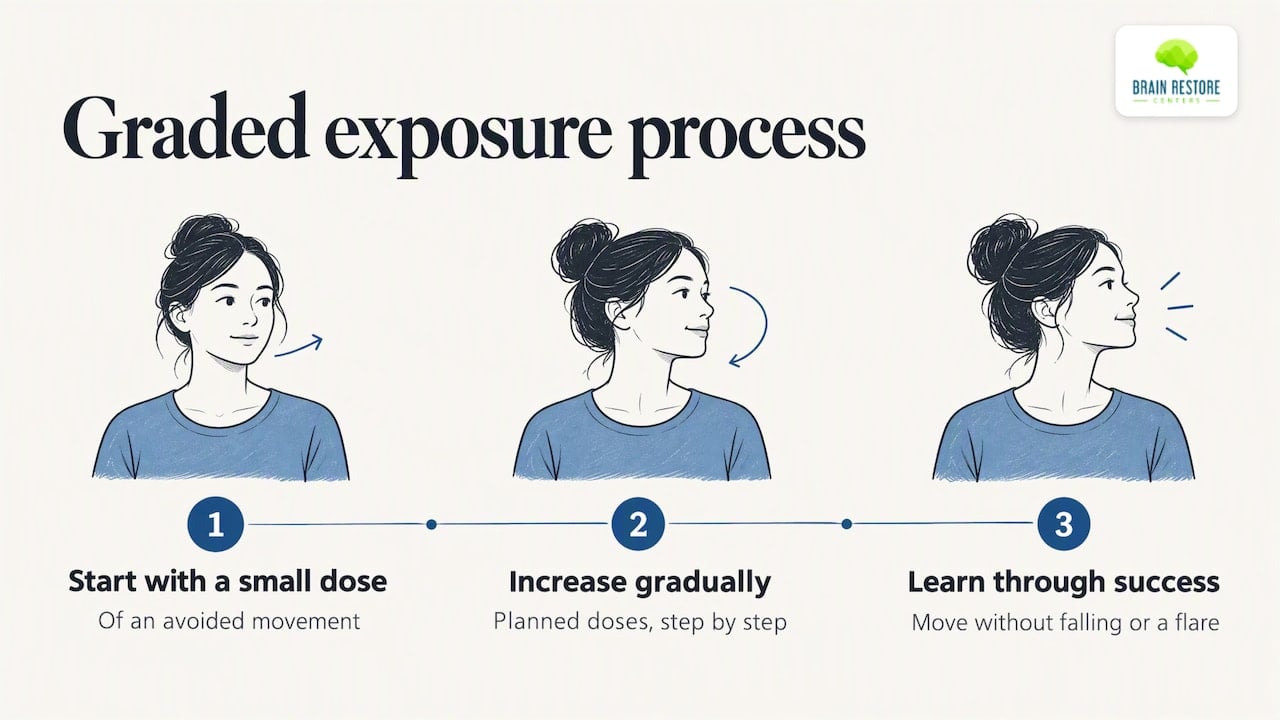
Skilled clinicians use graded exposure: small, planned doses of the movement you’ve been avoiding, increased step by step. This is part of what the impairment-based therapy literature emphasizes about the link between physical and psychological recovery. Each success shows your brain that you can move without falling or having a catastrophic flare. If anxiety, low mood or sleep trouble have crept in alongside dizziness, mention them to your care team. They are part of the picture, not a side issue.
There is plenty of free exercise guidance online, and some of it is helpful for understanding what therapy involves. But doing it blind has downsides. Without testing you may choose the wrong exercises, push too hard, or miss a neck or inner ear problem that needs another approach. Self-guided work is best when a clinician has set the plan and you are following it at home.
Home tools can support balance work too. If you are curious about equipment, this guide to using vibration plates for balance safely explains the basics. After a concussion, check with your clinician before adding any device that shakes or challenges your balance.
It also helps to think about the rest of your recovery. Our concussion recovery checklist for adults and guide to safe exercise after head injury help you pace sleep, activity and screen time. If headaches travel with your dizziness, see how to manage headaches after a concussion. And if you’re planning your return to your job, our staged return-to-work plan can help.
At our clinic in Meridian, we see dizziness and balance trouble as one piece of a larger brain-health picture. A concussion rarely affects only one system. Eye movement, neck function, sleep, mood, focus and energy all influence each other, so we look at them together instead of chasing a single symptom.
That is why we favor personalized, multidisciplinary care. Our team brings together chiropractic, functional medicine and brain-based therapies, and our clinicians have more than 50 years of combined experience. When someone says they feel “off” months after a bump on the head, we don’t tell them to wait it out. We take the symptoms seriously, work out what is driving them, and build a plan with realistic steps and clear checkpoints.
What we’d most like you to know: feeling stuck does not mean you are stuck. Recovery is rarely a straight line, but the brain is built to adapt, and the right input at the right dose gives it something to adapt to. Go at a pace that keeps you steady, and don’t go it alone.
— Chad
If dizziness, brain fog or balance problems have followed a concussion, a Brain Health Consultation is a good place to start. We’ll listen to your story, look at what’s driving your symptoms, and talk through a personalized plan for your recovery. You can learn more on our Brain Restore Program page or book an appointment. If neck pain is part of the picture, our chiropractic care evaluation may be worth adding.
There is no single number, because results depend on the type of dysfunction, timing and the quality of the plan. A 2023 meta-analysis found meaningful short-term gains on symptom and screening measures, but not clear differences in dizziness handicap at two months. Ask your clinician which measures they will track so you can see your own progress.
Follow your therapist’s instructions, but in general avoid pushing past your symptom limit, and don’t schedule demanding tasks right afterward if sessions leave you tired. A mild, short-lived flare can be normal. If symptoms spike suddenly or last, stop the exercises and contact your clinician to adjust the program.
The tools overlap, but the plan differs. Vertigo from a positional inner ear problem is often treated with specific repositioning maneuvers, while concussion-related dizziness usually involves eye movement, balance, neck and visual-motion sensitivity together. An evaluation sorts out which applies to you.
It varies. A structured trial protocol, for example, planned eight sessions over six weeks with daily home exercises. Therapy shouldn’t be open-ended: if you are not improving after a reasonable trial, your plan should be reassessed.
Questions about your next step?
Our Meridian team can help you understand the evaluation process and which care options may fit your needs.
Schedule a Brain Health ConsultationPrefer to speak with our team? Call 208-639-1397


