
Shoulder Pain Without Surgery: Care Options and When to Seek Help
October 13, 2026

Most shoulder pain can be managed without surgery using staged conservative care: rest and activity modification, ice and heat, medications, targeted injections when needed, and, most importantly, structured physical therapy. For most atraumatic shoulder conditions, a trial of structured conservative care for 6 to 12 weeks is reasonable before surgery enters the conversation.
TL;DR:
- Use ice for 20 minutes at a time during the first 48–72 hours after injury or flare; apply heat before exercise for stiffness, not swelling.
- NSAIDs can ease pain briefly, but use the lowest effective dose, check prescription interactions, and avoid opioids for chronic shoulder pain.
- A corticosteroid injection may ease pain for weeks and help stalled therapy, but repeated injections can weaken tendons and should not replace exercise.
- Seek prompt care for fever, unexplained weight loss, night pain that prevents sleep, or progressive weakness, numbness, or tingling down the arm.
Short-term rest calms an irritated shoulder, but prolonged immobilization often backfires, leaving the joint stiffer and weaker than before. A sling can help for a few days after an acute flare or injury, but wearing one for weeks tends to create new problems instead of solving the original one.
The goal is simple: quiet the pain enough that you can participate in rehab, not avoid movement altogether.
Cold works best in the first 48 to 72 hours after a flare or injury, when swelling and sharp pain dominate. Heat suits a stiff, tight shoulder that aches more than it stings, since it loosens tissue and primes the joint for movement.
Both are supporting tools. Their real job is making it easier for you to move and exercise, not replacing the exercise itself.
Oral NSAIDs like ibuprofen or naproxen, along with topical anti-inflammatory gels, offer modest short-term relief that can make daily function and early exercise more tolerable. They are not a long-term fix, and they carry real risks: gastrointestinal irritation, kidney strain, and cardiovascular concerns with extended or high-dose use, especially for people with existing heart, kidney, or stomach conditions.
Opioids are not recommended for chronic shoulder pain, a position reflected in guideline-based pathways that favor exercise, education, and short-term analgesics over long-term opioid use for ongoing shoulder complaints, according to the primary care shoulder pain guidelines.
Corticosteroid injections reduce pain for a matter of weeks, which is often exactly the window needed to tolerate and progress through physical therapy. They are not a standalone cure, and the relief typically fades once the medication wears off.
Repeated, frequent injections carry a documented downside: they can weaken tendon tissue over time, so clinicians generally limit how often they repeat them rather than defaulting to another shot whenever pain returns.
If one piece of conservative care matters most, it is this one. Structured, exercise-based rehabilitation is described as the cornerstone of non-operative shoulder care, and for conditions like subacromial pain, outcomes with a well-run program can match those seen after surgery in many trials, according to a recent narrative review of non-operative shoulder management.
A well-built program usually moves through three connected goals: restoring pain-free motion, rebuilding control around the shoulder blade, and progressively strengthening the rotator cuff and surrounding muscles. For a stiff posterior capsule, your therapist may add targeted stretching to free up internal rotation.
Most programs combine supervised sessions with a consistent home exercise routine, since consistency between visits often decides how quickly you improve. Guideline-based pathways commonly set an initial rehabilitation block at six weeks, extending for another six weeks when early progress appears, which lines up with the broader 6 to 12 week window clinicians use to judge whether conservative care is working.
Track progress with concrete markers rather than pain alone: how high you can reach without compensating, how much weight you can lift overhead, how your shoulder feels after a full day of normal activity. Realistic functional goals might include reaching a top shelf without shrugging, sleeping through the night without waking from pain, or returning to a sport-specific motion at a comfortable intensity.
Pro Tip: Keep a simple weekly log of pain level, range of motion, and the exercises completed. It gives you and your therapist an objective picture of progress instead of relying on memory.
Beyond the core treatments, several adjunct therapies come up often. Evidence on platelet-rich plasma (PRP) injections remains mixed, and hyaluronic acid injections show variable results depending on the study and joint involved. Extracorporeal shock wave therapy and laser therapy generally carry weaker supporting evidence than structured physical therapy, and spinal decompression is typically considered adjunctive rather than a primary treatment for shoulder pain, according to the same non-operative management review.
Give structured conservative care a genuine trial, typically 6 to 12 weeks, before concluding it has not worked. Seek evaluation sooner if pain worsens despite rest and basic care, or if you notice any red flags.
Subacromial and rotator cuff related pain accounts for roughly 44% to 65% of outpatient shoulder complaints, which is part of why a conservative-first approach is the default starting point for most people walking into a clinic with shoulder pain.
We build shoulder care around a staged pathway rather than a single fix. We start with an evaluation to identify what is actually driving your pain, then move into a rehab plan matched to that stage, adding in-clinic adjuncts where they make sense.
Shoulder pain does not always start in the shoulder. Chronic inflammation, metabolic imbalances, and nutritional gaps can slow tissue healing and keep pain lingering longer than expected, even when the mechanical problem itself is minor. A functional medicine approach looks at these broader contributors alongside the local joint issue.
This might mean reviewing how diet and inflammation interact, checking for metabolic patterns that could be hampering recovery, or looking at hormonal and nutritional factors that affect connective tissue repair. The aim is not to replace mechanical treatment of the shoulder itself. It is to address what might be slowing your recovery underneath it.
For someone whose shoulder pain seems to drag on despite consistent rehab, a functional medicine lens can surface factors a purely mechanical exam might miss. This is also where the picture connects: chronic systemic inflammation that affects joint healing often shows up alongside other complaints, like fatigue or sluggish recovery from minor injuries elsewhere in the body.
We bring this perspective into our broader care model, using functional medicine evaluation as a complement to hands-on shoulder rehab rather than a replacement for it. It fits naturally alongside physical therapy, especially for shoulder pain that has lingered for months without a clear mechanical explanation.
A generic set of shoulder exercises printed from a handout rarely matches what your shoulder actually needs. Pain presentation, joint mechanics, strength deficits, and daily demands differ from person to person, and a program that ignores those differences often stalls out well before the 6 to 12 week mark.
A customized, progressive program starts with where you are, not where a standard protocol assumes you should be. Early phases focus on calming pain and restoring basic motion. Middle phases build strength and control around the shoulder blade and rotator cuff. Later phases return you to the specific movements your work, sport, or daily life require, whether that is reaching overhead at a job site or swimming laps.
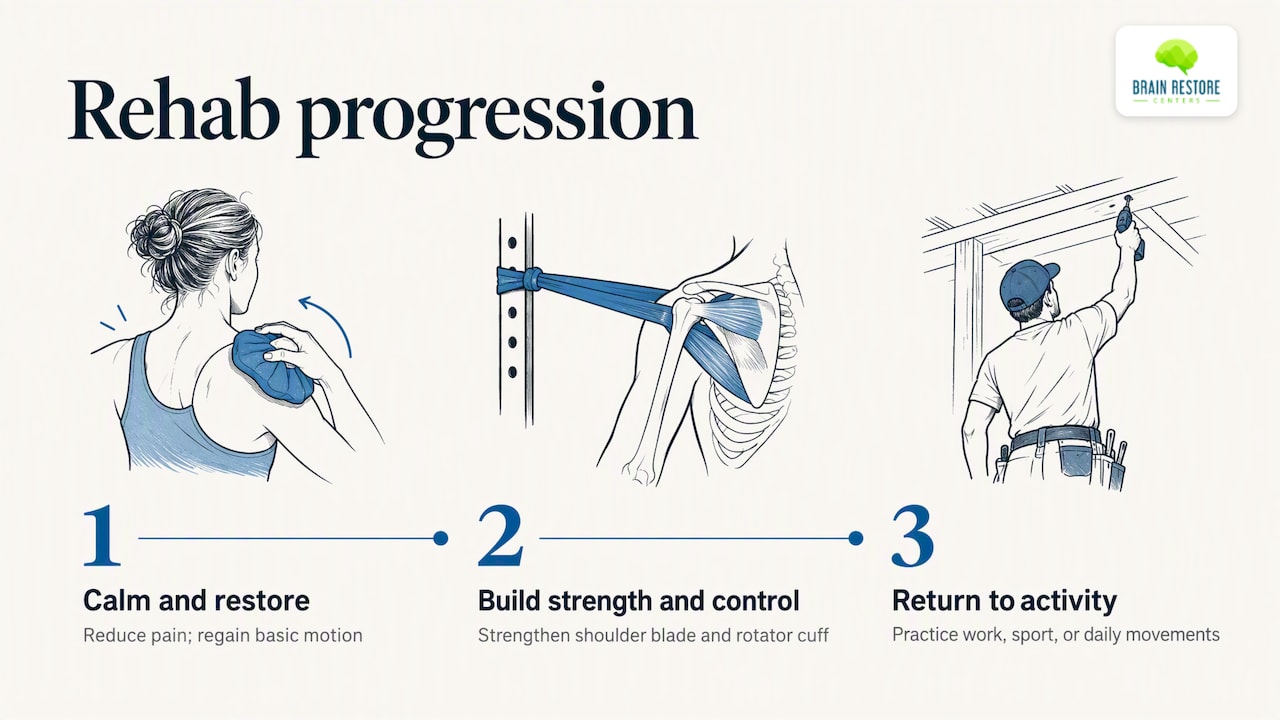
Progression matters as much as the exercises themselves. Advancing too quickly re-aggravates tissue that has not caught up yet, while advancing too slowly leaves strength and confidence behind. A program built to reassess and adjust every few weeks, rather than one set in stone from day one, tends to produce steadier gains.
This is the model we use in our own rehab planning: start with an honest assessment, build a plan around your specific deficits, and adjust the program as your shoulder responds rather than sticking rigidly to a generic timeline.
Not all shoulder pain comes from the joint or surrounding muscles. Numbness, tingling, or a burning sensation radiating down the arm can point to nerve involvement, often originating in the neck rather than the shoulder itself. Progressive weakness, especially weakness that does not track with how much pain you are feeling, is another signal worth taking seriously.
A neurological evaluation becomes worth pursuing when symptoms include numbness or tingling that extends past the shoulder into the forearm or hand, weakness that seems out of proportion to pain levels, or pain that changes with neck position or movement rather than shoulder movement. These patterns suggest the nerve pathway, not just the shoulder joint, needs a closer look.
Catching nerve involvement early matters because treating it like a purely mechanical shoulder problem can delay the right care and allow symptoms to progress. If your shoulder pain comes with any of these nerve-related signs, mention them specifically when you see a clinician so the evaluation can include the neck and nerve pathway, not just the shoulder itself.
Not every shoulder problem calls for the same starting point. The right first step depends on how your symptoms present, not a one-size-fits-all checklist.
Sudden, severe pain after a fall or impact points toward an initial evaluation for possible fracture or dislocation before anything else. Gradual onset pain with overhead activity often suggests impingement-type pain, where activity modification and rotator cuff strengthening typically lead. Stiffness that limits motion in multiple directions, especially without a clear cause, often points toward frozen shoulder, which usually benefits from a stage-specific approach rather than aggressive early stretching. Pain paired with numbness or weakness down the arm shifts the picture toward nerve involvement, as covered above, and warrants evaluation of the neck alongside the shoulder.
Severity and duration matter too. A flare that is mild and recent often responds to rest, ice, and gentle movement alone. Pain that has persisted for months despite basic care usually needs a structured, supervised program rather than more time and home remedies. Choosing the right starting point, rather than guessing, shortens the path to actual improvement.
The clearest lesson across the evidence is that passive treatments buy you time, but exercise is what rebuilds the shoulder. I’d encourage you to treat physical therapy as the main event, not a backup plan, and to set clear functional goals with your clinician so progress has a target, not just a feeling.
— Chad
If shoulder pain has lingered despite rest, ice, and over-the-counter medication, a staged, multidisciplinary plan built around your specific presentation can move things forward faster than another round of home remedies alone.
Schedule an initial chiropractic evaluation with our team to get a plan built around your shoulder, not a generic handout.
This article is general information, not a substitute for advice from a qualified doctor. Consult a qualified healthcare professional about your own circumstances before acting on anything here.
The overhead and rotational motion of removing a shirt often aggravates subacromial impingement or rotator cuff irritation, both common causes of pinching pain with overhead reach. If this motion consistently triggers sharp pain, it is worth having your shoulder mechanics assessed rather than just avoiding that movement.
The rotator cuff, made up of the supraspinatus, infraspinatus, teres minor, and subscapularis, stabilizes and rotates the joint. The deltoid provides the bulk of overhead lifting power, while the scapular stabilizers, including the trapezius and serratus anterior, anchor the shoulder blade so the arm has a stable base to move from.
Shoulder blade pain often responds to scapular stabilization exercises, posture adjustments, and addressing any underlying rotator cuff weakness that forces the shoulder blade muscles to overcompensate. Heat before stretching and targeted strengthening, built into a structured program, typically bring more lasting relief than stretching alone.
Shoulder pain after laparoscopic surgery usually comes from residual gas irritating the diaphragm and referring pain to the shoulder, and it typically resolves on its own within a few days. Walking, warm compresses, and over-the-counter pain relief as advised by your surgical team can help the gas resolve more comfortably while you wait it out.
Most guideline pathways recommend a structured conservative trial of 6 to 12 weeks, sometimes extending to 3 to 6 months for certain conditions, before surgery becomes part of the conversation. If you are not seeing meaningful improvement by the end of that window, that is the point to discuss imaging or specialist referral with your clinician.
Questions about your next step?
Our Meridian team can help you understand the evaluation process and which care options may fit your needs.
Schedule a ConsultationPrefer to speak with our team? Call 208-639-1397


