
HSA Funds for Neurofeedback: 5 Records to Keep for IRS Review
October 20, 2026

Yes, you can generally use HSA funds for neurofeedback, but only when it is provided as treatment for a diagnosed medical condition and documented as medically necessary. The IRS standard ties qualified expenses to diagnosing, treating, or preventing disease. If you are ever audited, the burden of proving that necessity falls on you.
TL;DR:
- Get a licensed provider’s diagnosis, written treatment plan, and Letter of Medical Necessity stating why neurofeedback is needed and its planned frequency and duration.
- Request itemized invoices with service dates, provider details, plain descriptions, and billing codes; practitioner guidance lists 90901, with 90875 or 90876 for combined psychotherapy.
- Evidence for neurofeedback remains promising but limited, so an individualized protocol supervised by a qualified clinician gives stronger support than general brain training.
- Insurance coverage varies, and you cannot use HSA funds for an amount an insurer paid; retain denial letters for unreimbursed expenses.
- Keep invoices, payment records, the annual HSA distribution form, and trustee confirmations together; nonqualified distributions can become taxable income and may carry an additional penalty.
The legal test comes from Section 213 of the tax code. An expense qualifies when it is for the diagnosis, cure, mitigation, treatment, or prevention of disease. The IRS FAQs on medical expenses add that you must be prepared to substantiate medical necessity if asked. That wording matters for neurofeedback, because a brain-training session bought for general wellness sits on very different ground than a treatment plan for a diagnosed condition.
Publication 969 explains the payoff and the catch. HSA distributions are tax-free only when used for qualified medical expenses, and recordkeeping and Form 1099-SA reporting apply. Your HSA trustee does not review each purchase for you, so the record is yours to build. The Form 8889 instructions point back to the same Pub. 502 standard for what counts.
The kinds of evidence worth keeping include:
Keep everything together in one folder, paper or digital, so you are not hunting for it later.
The IRS cares about purpose and medical necessity. It does not ask whether a device carries a particular clearance. A practitioner-focused review on PubMed notes that the clinical status of EEG neurofeedback is still evolving, and that a structured, clinically driven approach is what supports its use as a legitimate treatment. In other words, an individualized plan supervised by a qualified clinician is what carries weight.
The evidence itself is a mixed picture. A health technology review on NCBI Bookshelf describes mixed but promising randomized trial results for conditions such as PTSD, generalized anxiety disorder, and ADHD, while noting limited evidence overall and few formal guidelines.
The takeaway: the review calls the evidence promising but limited, which is why an individualized, clinician-supervised protocol matters so much for substantiating the expense.
Two quick scenarios show how this plays out:
If your situation falls in between, ask your clinician how the diagnosis and plan will be documented before you pay.
Ask for these items before or alongside your first session:
Pro Tip: Ask the billing office to format invoices the way your HSA trustee typically expects: dates, codes, provider details, and a plain description of the service on one page.
You have two common routes. You can pay at the point of sale with your HSA debit card, or you can pay out of pocket and request reimbursement from your trustee later. Both are widely used, and the second gives you time to gather your documents first. Follow your trustee’s own procedures for submitting a request.
Whichever route you choose, keep these on file:
The stakes are real. Publication 969 explains that distributions are tax-free only when used for qualified medical expenses. A distribution used for something that does not qualify can become taxable income and may carry an additional penalty. Keep your records with your tax documents, and check current IRS guidance for recordkeeping requirements.
Coverage for neurofeedback varies widely by payer and by state. According to BrainFutures, insurers may accept or deny neurofeedback CPT codes case by case, and Medicare generally does not treat it as medically necessary. Our own overview of how clinics use CPT codes to pursue coverage walks through what that process looks like.
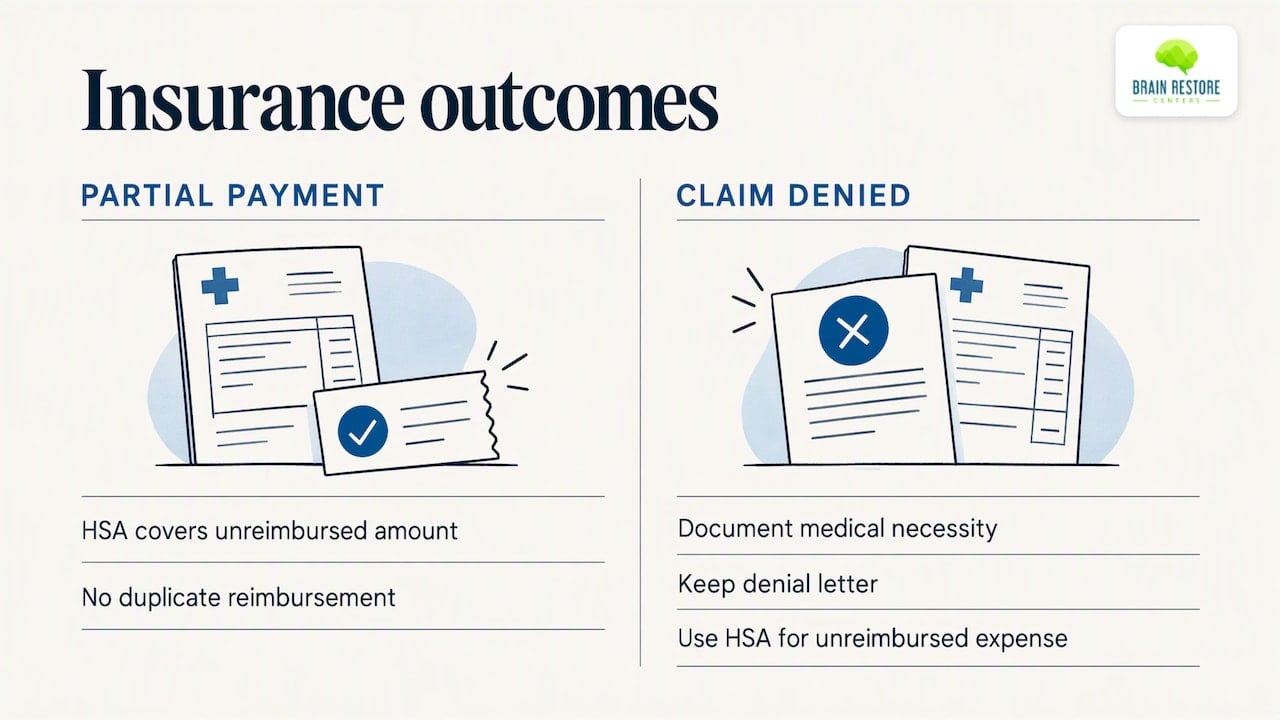
The overlap rule is simple. If an insurer pays for part of a session, you cannot also reimburse that same amount from your HSA. If the insurer denies the claim, you can still document medical necessity and use HSA funds for the unreimbursed expense. Keep the denial letter with your records.
This is where the GA modifier shows up in practice. As the ISNR update explains, providers sometimes use it to show that a payer has determined a service is not medically necessary, so the patient bears the cost while the service stays documented. A GA-modified invoice is a paper trail, not a verdict on your HSA eligibility.
Pro Tip: Photograph or scan each invoice when you receive it, and name the file with the provider so it is easy to find later.
Knowing what to expect from your course of care helps here too. Our guide to how many neurofeedback sessions people typically need can help you and your clinician write a realistic plan.
We think the paperwork should be as clear as the treatment plan. At our clinic, we provide neurofeedback when care is clinically appropriate. We can discuss your care with you. If you are unsure what you will need, ask us before your first visit. A short conversation up front is far easier than reconstructing records later.
— Chad
We want you to leave each visit knowing what documentation you will receive. When it is clinically appropriate, we can discuss what we can provide.
Schedule a brain health consultation and ask us to confirm what you will receive.
This article is general information, not a substitute for advice from a qualified doctor. Consult a qualified healthcare professional about your own circumstances before acting on anything here.
It can be, when it treats a diagnosed condition. The IRS ties eligibility to the diagnosis, treatment, or prevention of disease, so keep your diagnosis and invoices together.
Sometimes. Coverage varies by payer and state, and insurers may accept or deny neurofeedback codes case by case, according to BrainFutures. Ask your plan directly and keep any denial letter.
For HSA purposes, device clearance is not the deciding factor. The IRS looks at the treatment’s purpose and medical necessity, so a diagnosis and a clinician’s plan matter most.
Researchers describe the effects carefully. A clinical review on PubMed says the evidence base is still evolving, so results depend on the condition, protocol, and clinical oversight.
Questions about your next step?
Our Meridian team can help you understand the evaluation process and which care options may fit your needs.
Schedule a Brain Health ConsultationPrefer to speak with our team? Call 208-639-1397


