
Functional Medicine for Autoimmune Disease: What Helps and What Doesn't
October 22, 2026


Functional medicine can be a useful partner in autoimmune care. It looks for the triggers and stressors that keep your immune system overactive, such as gut health, stress, sleep, diet and environmental exposures. It does not replace your rheumatologist, endocrinologist or neurologist, and it does not cure autoimmune disease. If you are living with fatigue, joint pain, brain fog or a diagnosis that feels like it never fully settles, this guide explains what a functional approach can realistically offer and where its limits are.
In an autoimmune disease, the immune system, which normally protects you from infection, attacks your own tissue. In lupus, for example, the immune system attacks healthy parts of the body and can affect many organs.
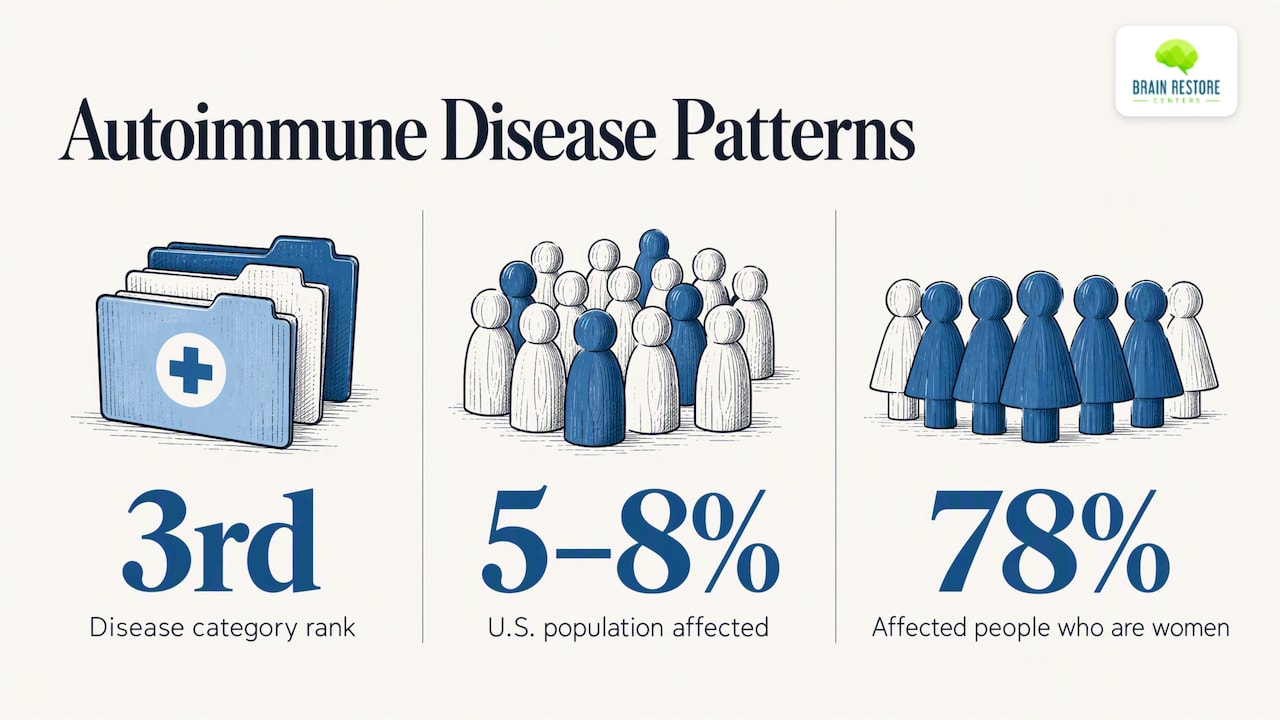
These conditions are far from rare. A CDC-published review described autoimmune diseases as the third most common disease category in the U.S., after cancer and heart disease, affecting roughly 5% to 8% of the population, with about 78% of those affected being women. That review dates from 2004, so the numbers today are likely higher, but the pattern holds: if you are a woman with unexplained symptoms, you are in very large company.
The other pattern is delay. Dr. Datis Kharrazian, a clinician who writes about neurological autoimmunity, notes in an interview in a peer-reviewed journal that people often carry autoimmune disease for years before tissue damage builds up enough to produce a diagnosis. Many people feel unwell long before a lab test confirms why. That gap is exactly where many patients go looking for a functional medicine doctor.
Functional medicine is a care model that asks why symptoms are happening, not only how to quiet them. For autoimmune patients, that usually means a long, detailed history and a look at several systems at once:
The honest framing matters. Functional medicine is a way of organizing evaluation and lifestyle support. It is not a single protocol, and the strength of evidence varies from one intervention to another. A good practitioner will tell you which parts are well supported and which are still emerging.
Gut health is a central theme in functional medicine. Research on the so-called gut-brain axis is active: a review of the gut microbiota in neuroinflammatory and autoimmune conditions describes links between changes in the intestinal environment and neurological autoimmune outcomes. It is promising, but it is still emerging science. Supporting your gut is a reasonable, low-risk part of a plan. It is not a guaranteed route to remission, and claims that all autoimmune disease starts in the gut go further than the evidence does.
Gluten is the clearest example. In celiac disease, a strict gluten-free diet is the established treatment. Beyond celiac disease, the picture is more complicated. Some practitioners see a gluten-brain connection through a process called molecular mimicry, where immune cells that react to gluten also cross-react with cerebellar tissue. This idea is discussed in the Kharrazian interview, which links it to balance problems, vertigo and nausea in some patients. It is a hypothesis used in functional neurology, not a rule that applies to everyone. A supervised elimination and reintroduction, with testing where appropriate, is more useful than guessing.
Flares often have ordinary triggers. The NIAMS lupus resources describe how sun exposure, stress and intense physical work can bring on flares, and they stress regular doctor visits to monitor for medication side effects alongside modest lifestyle changes like gentle exercise and enough rest. That is a sensible template for any autoimmune plan: lifestyle support sits next to, not instead of, medical monitoring.
If you feel mentally slowed, forgetful or unable to find words, you are not imagining it. Cognitive dysfunction is a major quality-of-life issue in autoimmune disease. A review of cognitive impairment in lupus reports that cognitive problems can appear in up to 80% of patients when neuropsychiatric lupus is defined broadly, and notes that it remains underdiagnosed and poorly understood. Memory, attention and executive function are the usual areas affected.
Thyroid disease shows the same thing. In Hashimoto’s thyroiditis, mood and thinking problems can occur even when thyroid hormone levels are normal, which suggests the antibodies themselves may affect brain circuits. If this sounds familiar, our guides on why thyroid problems cause brain fog and functional medicine for thyroid go deeper.
If brain fog is your main complaint, it also helps to look at the basics that feed it: sleep quality, lab work and when to test. This practical guide to brain fog, sleep and labs is written with men in mind, but its sleep and testing checklist applies to anyone starting that conversation with their doctor.
One of the most important ideas in functional neurology is that you cannot simply nourish a struggling brain back to health. Calming inflammation is half the job. The other half is activity. Neurons need to be used to form and strengthen connections, which is why Dr. Kharrazian argues that rehabilitation exercises should be combined with the functional medicine work, things like balance training or eye movement exercises that engage the specific brain areas under stress.
Think of it as two tracks:
Patients who do only the first track often plateau. For more on the second, see what neurological rehabilitation involves.
Search results for this topic are full of supplement lists: vitamin D, fish oil, probiotics, curcumin, glutathione, and herbs like ashwagandha. Some of these may be appropriate for you. Some may not, and the autoimmune context raises the stakes.
The FDA has issued advisory and warning letters to sellers who market natural products as treatments for autoimmune conditions. In one example, the agency’s advisory letter to an online supplement seller covers products pitched for conditions like lupus, MS and Hashimoto’s, which are not recognized as safe and effective for those uses. Ashwagandha is a common one, and the same advisory notes concerns about its withanolide compounds, though that is based on computer modeling rather than human trials.
This is why the answer to “can I take ashwagandha with an autoimmune disease?” is: ask your prescribing physician first. Herbs that stimulate or modulate the immune system, or that affect the liver or thyroid, can interact with immunosuppressants, biologics and thyroid medication. Before adding any supplement, bring the exact product to your rheumatologist, endocrinologist or pharmacist. Never stop or reduce a prescribed autoimmune medication on your own, because that can trigger a serious flare.
We see many people who have been told their labs are “fine” while they still feel foggy, exhausted and discouraged. Our view is simple: your symptoms are real, and there is almost always something to work with.
We do not treat autoimmune disease as something to fight with a single supplement or diet. We start with a thorough evaluation, work with the specialists you already see, and build a plan that combines functional medicine with brain-based therapies. Depending on your needs, that can include neurofeedback, low level laser therapy, hyperbaric oxygen therapy and progressive focused rehab. The reason for combining them is the one above: reducing inflammatory load helps, but the brain also needs to be trained to recover.
We also believe in setting honest expectations. We cannot promise a cure for an autoimmune condition, and we will not ask you to give up your medication. What we can offer is a careful search for the factors holding you back, a plan you can follow, and steady support while you reclaim energy, clarity and confidence.
— Chad
Every clinic does this a little differently, but a thorough autoimmune-focused visit usually follows these steps.
| Condition | Common complaint | Where functional support often focuses |
|---|---|---|
| Hashimoto’s thyroiditis | Fatigue, weight changes, brain fog | Thyroid antibodies, nutrients, gut, stress, cognitive support |
| Lupus | Joint pain, fatigue, cognitive problems | Flare triggers, sleep, pacing, brain fog evaluation, with your rheumatologist leading medical care |
| Multiple sclerosis | Fatigue, balance, numbness | Lifestyle support and neurological rehabilitation alongside your neurologist |
| Celiac disease | Digestive symptoms, nutrient gaps | Strict gluten avoidance, nutrient repletion, gut healing |
| Rheumatoid arthritis | Joint pain, stiffness | Diet quality, stress and movement alongside prescribed treatment |
This table is a map of where support tends to go, not a treatment promise for any of these conditions. Your diagnosing physician stays in charge of disease-modifying treatment.
You do not need a new clinic to begin. These steps are low risk for most people, and worth discussing with your doctor first if you take medication.
If mood is also affected, our guides on inflammation and mood disorders and functional medicine approaches to mental health may help. If mold exposure is a worry, read what mouse studies can and cannot tell us about mold and brain fog before spending money on testing.
If you live in the Treasure Valley and want a team that looks at both the body and the brain, we would be glad to meet you. Our Health Restore Program is built for people with chronic issues who want a thorough functional medicine workup. If brain fog, memory trouble or slowed thinking is the main concern, start with a Brain Health Consultation through our Brain Restore Program. Our clinicians bring over 50 years of combined clinical experience, and our patients have left more than 400 five-star reviews.
We do not publish prices on our site, so the best way to learn what care would involve for you is to book an appointment. You can also learn more about our approach to brain health restoration combining neurofeedback, photobiomodulation and functional medicine.
No. Autoimmune diseases are generally long-term conditions, and no functional medicine program should promise a cure. What it can do is identify contributors such as nutrient gaps, gut problems, stress and sleep issues, and support your symptoms and quality of life alongside your specialist’s treatment.
No. Never stop or lower autoimmune medication without direction from the physician who prescribes it. A responsible functional medicine plan works with your medications, and any change to them is made together with your prescribing doctor.
Triggers vary by person and condition. Stress, infections, poor sleep, sun exposure in conditions like lupus, and overexertion are commonly reported, as the NIAMS lupus guidance describes. Food reactions and gut issues matter for some people. A symptom log is the best way to find your own pattern.
Inflammation, poor sleep, nutrient gaps, medication effects and the autoimmune process itself can all play a part. In conditions like lupus and Hashimoto’s, cognitive symptoms are well documented. A brain-focused evaluation can help sort out which factors apply to you.
There is no guarantee it is. The FDA has warned about unproven autoimmune claims on herbal products, and herbs that affect the immune system, liver or thyroid may interact with your medications. Check with your prescribing physician or pharmacist before taking it.
Questions about your next step?
Our Meridian team can help you understand the evaluation process and which care options may fit your needs.
Schedule a ConsultationPrefer to speak with our team? Call 208-639-1397