Trouble Remembering Words: Causes, Tips, and When to Act
July 20, 2026


Trouble remembering words refers to difficulty retrieving a known word during conversation or writing, a condition clinicians call word-finding difficulty or anomia. This experience is far more common than most people realize, and it affects adults across all age groups. Occasional word-finding difficulty is a normal part of aging, but persistent or worsening episodes require professional evaluation. Understanding the difference between a harmless mental block and a meaningful neurological signal is the first step toward reclaiming confident, fluent speech.
Word-finding difficulty is not a single condition. It is a symptom with a wide range of causes, from everyday fatigue to serious neurological disease.
Reversible lifestyle factors are the most common culprits. Sleep deprivation, stress, anxiety, depression, vitamin B12 deficiency, and medication side effects can all disrupt the brain’s retrieval pathways. These causes are significant because they are correctable. Addressing sleep quality or adjusting a medication can restore word recall without any specialized therapy.

Normal aging also plays a role. The brain’s processing speed slows gradually over decades, and the retrieval network for words becomes less efficient. This is not memory loss in the clinical sense. The words are still stored; the brain simply takes longer to access them.
Neurological conditions represent the more serious end of the spectrum. These include:
The storage versus retrieval distinction matters clinically. Some conditions damage the memory storage network itself. Others, like anomic aphasia, leave stored memories intact but block the retrieval pathway. Therapy targets these two problems very differently. A clinician who identifies which mechanism is at work can design a far more effective treatment plan.
Pattern recognition also guides diagnosis. Clinicians look at how frequently episodes occur and whether the problem has changed over a 5–10 year window. A single embarrassing blank during a stressful week is very different from a steady, progressive decline in verbal fluency.
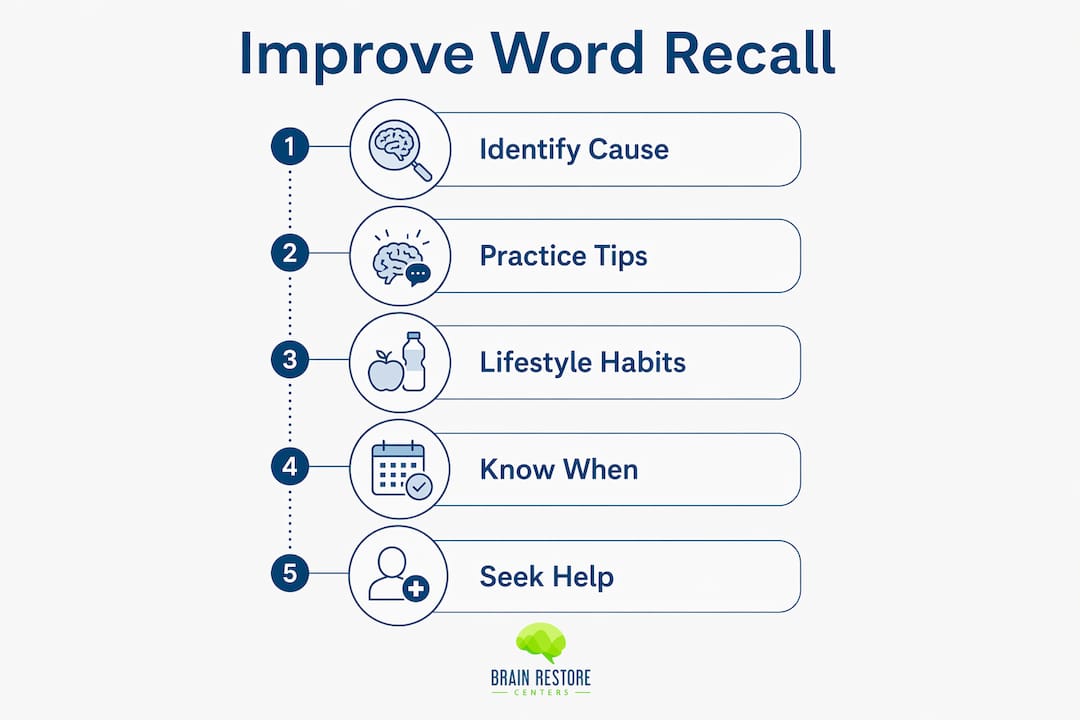
A structured clinical evaluation separates benign forgetfulness from a medical condition. Diagnosis typically involves a physical exam, cognitive assessments, and referral to speech-language pathologists when language-specific deficits appear.
The evaluation process generally follows these steps:
The goal of this process is not to alarm you. It is to give you a clear picture of what is happening so you can act on it effectively.
The good news is that word retrieval responds well to both clinical therapy and daily habits. Speech therapy targets retrieval cues rather than rote memorization, which is a meaningful distinction. You are not trying to re-learn words you already know. You are rebuilding the pathways that lead to them.
Evidence-based speech therapy techniques include:
The blocking problem deserves special attention. Excessive effort to recall a word causes retrieval-induced blocking, which actually worsens the difficulty. The harder you push, the more the word retreats. Shifting your attention away for 1–2 minutes allows spontaneous recall to occur. This is not a failure of memory. It is a well-documented feature of how retrieval works under pressure.
Pro Tip: When a word is stuck, stop trying to force it. Shift to a different topic for a minute or two. The word will often surface on its own once the pressure drops.
Lifestyle habits also protect and restore word recall. Exercise, a nutrient-rich diet, social engagement, and mental stimulation all support cognitive-linguistic functioning. Sleep is particularly critical. The brain consolidates language memories during deep sleep, and chronic sleep deprivation directly degrades retrieval speed. Supplements that support neurological health, such as B12 and omega-3 fatty acids, can address deficiencies that contribute to memory recall issues. You can read more about neurological supplement options that support brain function.
Not every word-finding lapse needs a doctor’s visit. The warning signs that do warrant evaluation are persistence, progression, and functional interference.
Seek professional evaluation if you notice:
Anomic aphasia causes significant emotional distress but does not reflect a decline in intelligence or reasoning. Many people feel shame or fear when they struggle with speech. Understanding the neurological basis of word-finding difficulty removes that stigma and makes it easier to seek help early.
Pro Tip: Keep a brief log of your word-finding episodes for two weeks before your appointment. Note the time of day, your stress level, and your sleep the night before. This pattern data helps clinicians identify reversible causes faster.
Early intervention consistently improves outcomes. Integrated brain health approaches, including neurofeedback and functional medicine, address the underlying neurological environment rather than just the surface symptom. Neurofeedback supports neurodegenerative patients by training the brain toward healthier activity patterns, which can improve language processing over time. Functional medicine identifies systemic contributors like inflammation, hormonal imbalance, or nutritional deficiency that standard care often misses.
The daily habits that protect long-term brain health are straightforward. Prioritize 7–9 hours of sleep, maintain regular aerobic exercise, eat a diet rich in omega-3 fatty acids and antioxidants, stay socially connected, and challenge your brain with new learning. These are not optional extras. They are the foundation of sustained cognitive function at every age.
Word-finding difficulty ranges from a normal aging quirk to a sign of neurological disease, and the difference lies in frequency, progression, and functional impact.
| Point | Details |
|---|---|
| Know the difference | Occasional lapses are normal; daily or worsening difficulty needs clinical evaluation. |
| Identify reversible causes | Sleep, stress, B12 deficiency, and medications are common and correctable triggers. |
| Use retrieval techniques | SFA, VNeST, and semantic priming rebuild word access pathways more effectively than memorization. |
| Stop forcing recall | Shifting attention for 1–2 minutes resolves blocking and allows spontaneous word retrieval. |
| Act early | Early intervention through speech therapy, neurofeedback, or functional medicine improves outcomes. |
Word-finding difficulty carries a quiet shame that most people never talk about. I have seen patients describe the experience as feeling “locked out” of their own minds, and that description is more accurate than most clinical definitions. The word is there. The door is just stuck.
What strikes me most is how often the cause turns out to be something correctable. Poor sleep, chronic stress, and nutritional gaps account for a large share of the cases I see. These are not glamorous diagnoses, but fixing them produces real, fast results. A patient who starts sleeping seven hours instead of five often reports noticeable improvement in verbal fluency within two weeks.
The second thing I have learned is that patience is not passive. Actively practicing circumlocution, building scripted phrases for high-pressure situations, and logging your episodes are all forms of working with your brain rather than against it. The people who recover their verbal confidence fastest are the ones who treat the process as a skill to build, not a deficit to mourn.
The emotional weight of this condition is real, and it deserves acknowledgment. Struggling with speech in a meeting or forgetting a friend’s name mid-sentence is genuinely distressing. But the neurological basis of word-finding difficulty means it is not a character flaw or a sign of diminished intelligence. It is a pathway problem, and pathways can be restored.
— Chad
Persistent word-finding difficulty often signals that the brain needs more than lifestyle adjustments alone. Brainrestoremeridian, located in Meridian, Idaho, offers an integrated approach that addresses the neurological environment behind language and memory recall issues.
The clinic combines neurofeedback, photobiomodulation, and functional medicine to support the brain’s retrieval networks at a structural level. Neurofeedback trains the brain toward healthier activity patterns, while functional medicine identifies systemic contributors like inflammation or nutritional deficiency that standard care misses. Brainrestoremeridian’s comprehensive brain health restoration program is designed for people who want personalized, evidence-informed care rather than a one-size-fits-all approach. Reach out to schedule a consultation and get a clear picture of what your brain needs.
Word-finding difficulty, also called anomia, is the inability to retrieve a known word during speech or writing. It ranges from a normal aging experience to a symptom of neurological conditions like aphasia or dementia.
Yes. Stress and anxiety activate the body’s threat response, which disrupts the prefrontal cortex and degrades retrieval speed. Reducing chronic stress often restores normal verbal fluency without any other intervention.
The tip-of-the-tongue state is a specific type of retrieval block where you know a word exists but cannot access it. Shifting focus away for 1–2 minutes allows the word to surface spontaneously in most cases.
Daily episodes, a clear worsening trend over months, or difficulty that interferes with work and relationships all warrant a clinical evaluation. A speech-language pathologist and neurologist can determine whether the cause is neurological or lifestyle-based.
No. Anomic aphasia disrupts retrieval pathways without affecting cognitive ability or intelligence. The frustration patients feel comes from accessibility problems, not from any decline in reasoning or understanding.
Questions about your next step?
Our Meridian team can help you understand the evaluation process and which care options may fit your needs.
Schedule a ConsultationPrefer to speak with our team? Call 208-639-1397