Does Insurance Cover Spinal Decompression Therapy?
August 26, 2026

Most commercial insurers and Medicare do not cover non-surgical spinal decompression therapy, and the reason comes down to one word: investigational. Payers classify the treatment as lacking sufficient clinical evidence, not because it never helps anyone, but because it hasn’t cleared the bar most policies set for coverage.
If you’re dealing with a herniated disc or chronic sciatica and hoping your plan will pick up the tab, here’s what to do right now:
The rest of this guide walks through exactly why coverage gets denied, what the Medicare rule actually says, and how to pay for care if your claim doesn’t go through.
Spinal decompression insurance coverage remains the exception rather than the rule because major payers classify the therapy as investigational due to insufficient sham-controlled trial evidence.
| Point | Details |
|---|---|
| Coverage is the exception | Most commercial insurers and Medicare classify decompression as investigational, not medically necessary. |
| Evidence gap drives denials | Payers require sham-controlled randomized trials, and the therapy hasn’t consistently met that standard. |
| Coding errors cause denials | HCPCS S9090 is commonly excluded; billing under CPT 97012 instead risks a fraud-related denial. |
| Costs add up fast | A full course often runs $1,500 to $5,000 out of pocket, depending on provider and region. |
| Documentation strengthens appeals | Brainrestoremeridian builds a multidisciplinary treatment record that supports prior authorization and appeal requests. |
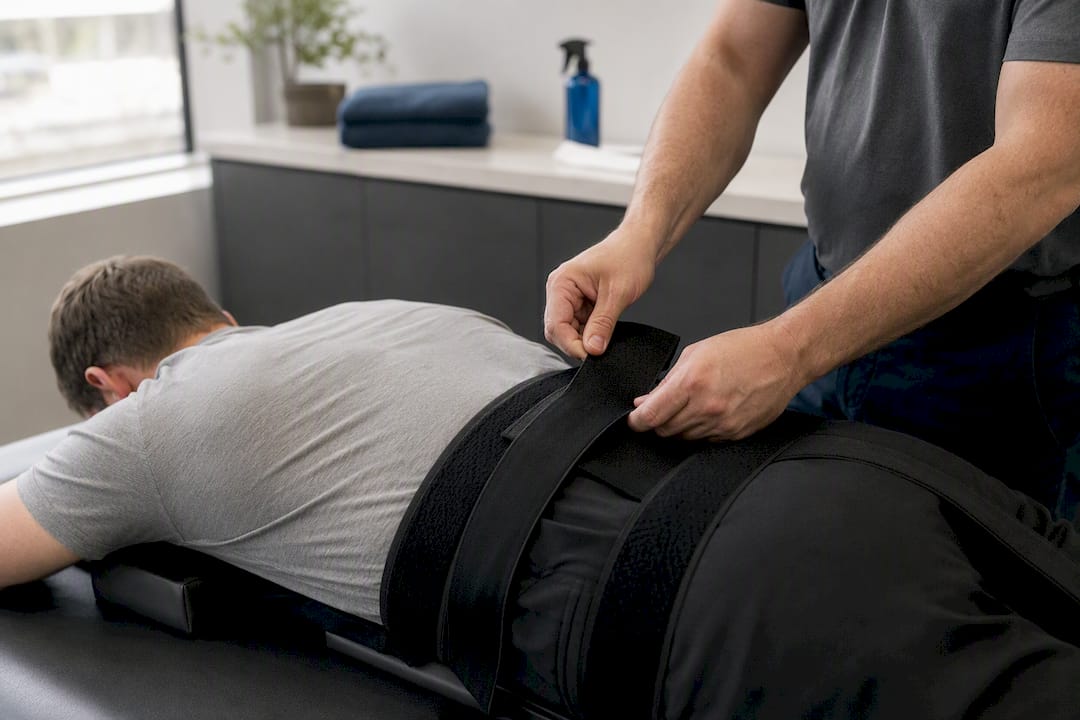
Non-surgical spinal decompression uses a motorized traction table to gently stretch the spine, creating negative pressure that can relieve pressure on a herniated or bulging disc. Clinics typically use it for degenerative disc disease, sciatica, and disc herniation when conservative care hasn’t resolved symptoms.
A typical plan runs multiple sessions spread over several weeks, often paired with chiropractic adjustments or physical therapy. That’s a meaningful commitment of time and money, which is exactly why coverage questions matter so much before you start.
Here’s the distinction that trips people up:
That difference in classification, not the clinical outcome, often decides whether a claim gets paid.
Insurance companies don’t deny decompression claims because they’re being difficult. They deny them because their own medical policy teams have reviewed the published research and concluded it doesn’t meet the evidence threshold they require for a treatment to move from “investigational” to “covered.”
Anthem’s medical policy states plainly that vertebral axial decompression is considered investigational because published evidence does not demonstrate improved net health outcomes compared with standard care. Blue Cross Blue Shield of Rhode Island’s 2024 policy goes further, explicitly listing HCPCS code S9090 as not covered and pointing to the absence of sham-controlled randomized trials as the core issue.
That last phrase, “sham-controlled randomized trial,” is the crux of the whole problem. Payers want proof that decompression works better than a placebo device that mimics the sensation of traction without delivering it. Without that kind of trial design, insurers can’t rule out that patients feel better simply because they expected to feel better, not because the treatment itself did anything unique.
One of the few sham-controlled randomized trials on this therapy found no measurable benefit over the control group, a result published in the peer-reviewed literature indexed on PubMed and cited repeatedly in payer medical policies as the reason for noncoverage.
The pattern is consistent across major carriers. When a policy calls a treatment “investigational” or “not medically necessary,” that language isn’t a formality. It’s the legal basis the payer uses to deny the claim, and it means the burden falls on you or your provider to either prove medical necessity through an appeal or accept the treatment as a self-pay service.
Medicare’s position is the clearest of all, and it shapes almost everything downstream. CMS established a national coverage determination, NCD #160.16, stating that vertebral axial decompression is not covered because the evidence doesn’t support it. This ruling has stood for decades and functions as the reference point many commercial insurers cite when writing their own policies.
A few things follow from that national ruling:
If you’re enrolled in Medicare or Medicaid, check your plan’s Evidence of Coverage document rather than assuming the national policy automatically applies word for word to your situation.
Coding errors cause more denials than most patients realize. HCPCS code S9090 is the standard code for vertebral axial decompression per session, and most insurer policies list it explicitly as not covered.
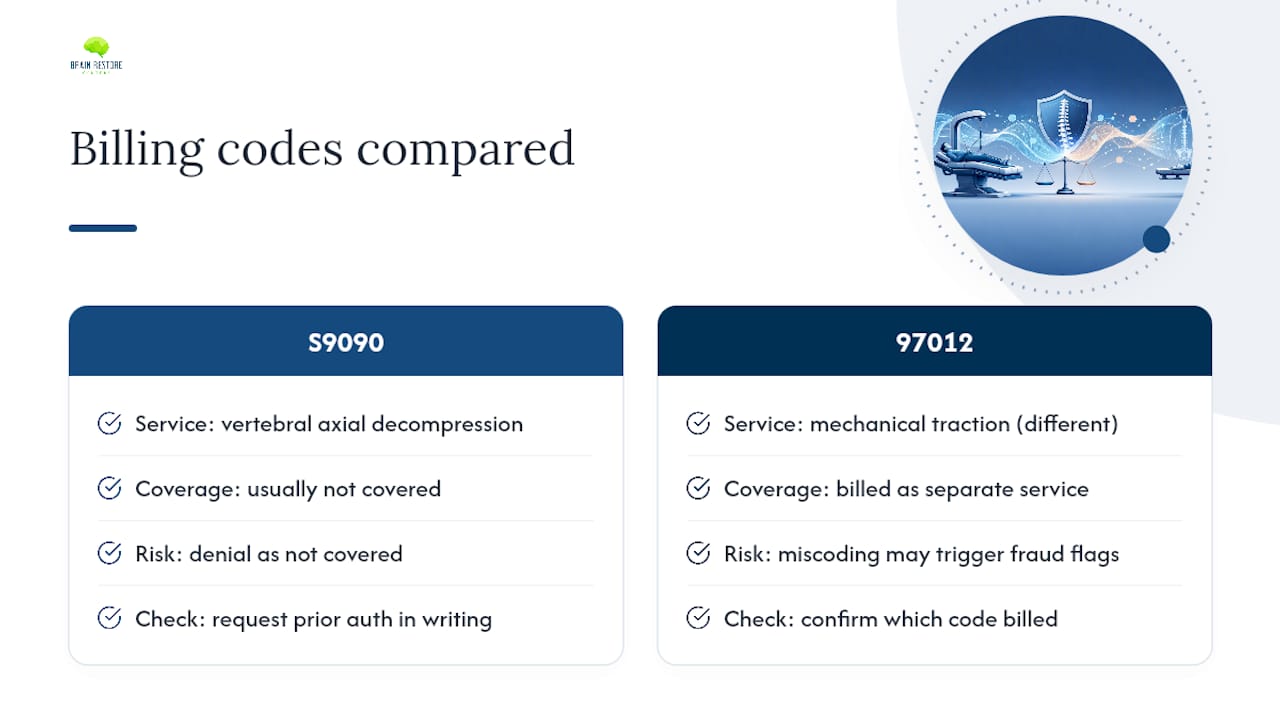
CPT code 97012, by contrast, refers to mechanical traction, a different service entirely. Some clinics use 97012 to bill decompression sessions, whether by mistake or by design, and that miscoding creates real risk: it can trigger a denial for billing fraud rather than a straightforward “not medically necessary” rejection.
Before your first appointment, ask your provider which code they plan to bill and request prior authorization confirmation in writing.
Without coverage, you’re looking at real money. A single session typically runs from tens to a few hundred dollars, and a full course of multiple sessions can cost several thousand dollars, depending on the provider, the device used, and your region.
That range is wide enough to justify shopping around before you commit to a treatment plan. Location matters, too. A clinic in a major metro market tends to charge more per session than one in a smaller city, and providers using newer computerized decompression tables often price higher than those with older traction equipment.
A few ways to soften the financial hit:
Negotiating a written estimate up front isn’t awkward. Reputable clinics expect the question and should hand you a clear number without hesitation.
Getting this right before your first session saves you from a denied claim months later. Follow this order:
Pro Tip: Save every email and reference number from insurer calls. If you appeal later, a documented paper trail carries far more weight than “I was told this was covered” over the phone.
A well-run clinic doesn’t just run you through sessions and hope insurance figures it out. Brainrestoremeridian combines chiropractic evaluation, spinal decompression, and rehabilitative therapy into one coordinated plan, which builds the kind of documentation trail that actually strengthens an appeal or a single-case agreement request.
That documentation typically includes:
The conventional advice on this topic treats coverage denial as the end of the conversation. It isn’t. The real question isn’t whether your insurer will pay. It’s whether the treatment plan in front of you is well documented enough to survive an appeal, a single-case agreement request, or a straightforward cash-pay decision made with full information.
Most people lose money not because decompression is expensive, but because they never asked for a written estimate or a coding breakdown before starting. The evidence gap driving these denials is real, and it isn’t going away soon since the research simply hasn’t produced the sham-controlled trials payers want. What patients control is preparation: get the codes, get the documentation, and treat the insurer conversation as a negotiation rather than a formality. A clinic that tracks conservative care history and objective findings, the kind of record described in how spinal decompression fits into broader recovery plans, gives you a real shot at an exception even when the default answer is no.
— Chad
Brainrestoremeridian gives you something a generic decompression clinic often can’t: a documented, multidisciplinary care plan that pairs chiropractic evaluation with spinal decompression, so your file is ready if you need to appeal a denial or request a single-case agreement. Instead of guessing at codes or hoping your insurer approves a claim after the fact, you get an itemized estimate, a clear treatment rationale, and guidance on using HSA or FSA funds before you ever sit down on the table.
If you’re in the Meridian, Idaho area and dealing with disc pain, sciatica, or chronic back issues, the non-surgical spinal decompression program walks you through exactly what a session involves and what it costs before you commit. For related concerns like Medicare’s mental health and therapy coverage rules, understanding how federal coverage decisions work elsewhere can help you anticipate how your own plan will likely respond. Call the clinic or request an appointment online to get a written cost estimate and a treatment plan built to hold up if you decide to appeal.
This article is general information, not a substitute for advice from a qualified doctor. Consult a qualified healthcare professional about your own circumstances before acting on anything here.