
Why Thyroid Problems Cause Brain Fog (And What Helps)
August 23, 2026


Yes, hypothyroidism commonly causes brain fog, but it is rarely the only factor at play. If you’re struggling to concentrate, forgetting words mid-sentence, or feeling like you’re thinking through wet cotton, thyroid dysfunction deserves a serious look, alongside a broader check for other contributors. The starting point is straightforward: request a TSH and free T4 panel and ask your clinician whether free T3 makes sense for your case.
Before your appointment, a few steps make the visit far more useful. Note when you last took your thyroid medication relative to the blood draw, since timing can shift results. Gather any past labs you have, even from years back, so a clinician can track trends rather than judging one snapshot in isolation. And resist the urge to ask for a dose increase before you’ve been properly evaluated. Bumping levothyroxine when your labs are already normal doesn’t reliably fix brain fog and can create new problems.
Here’s a number worth sitting with: in a large patient survey of 5,170 people with hypothyroidism, 79.2% reported brain fog frequently or all the time, even though many were already on treatment. This isn’t a rare complaint. It’s close to the norm for people managing this condition, which is exactly why it deserves a real diagnostic conversation instead of a shrug.
Hypothyroidism frequently causes brain fog, but lasting relief usually requires thyroid optimization plus a check for overlapping comorbidities and, often, cognitive rehabilitation support.
| Point | Details |
|---|---|
| Brain fog is common, not rare | 79.2% of surveyed hypothyroid patients reported frequent brain fog, even with treatment underway. |
| Medication alone often falls short | Fewer than one in three found medication adjustment alone sufficient for relief. |
| Test beyond TSH when symptoms persist | Request free T4, consider free T3, and screen for B12 deficiency, sleep apnea, and depression. |
| Recovery timelines vary | Symptoms may improve within weeks of LT4 optimization, but full cognitive relief can take up to 12 weeks or longer. |
| Multidisciplinary care fills the gap | Brainrestoremeridian pairs functional medicine evaluation with neurofeedback and cognitive rehab for symptoms that outlast lab normalization. |
Brain fog isn’t a single symptom. It’s a cluster, and naming the pieces accurately helps your clinician take it seriously instead of filing it under “stress” or “aging.”
Most people describe a combination of persistent fatigue that sleep doesn’t fix, forgetfulness that feels new and out of character, and a general slowness in processing information that wasn’t there before. Word-finding trouble is common too. You know the word you want, but it hovers just out of reach mid-sentence. Concentration becomes effortful in a way it never used to be, whether that’s following a meeting, reading a paragraph twice, or losing your train of thought while driving a familiar route.
Hashimoto’s brain fog, tied to autoimmune thyroid disease, often layers in additional volatility. Because thyroid antibody levels and hormone output can fluctuate before a diagnosis stabilizes things, some patients notice their mental clarity swings from reasonably sharp to noticeably foggy within the same week.
What makes hypothyroid-related cognitive symptoms tricky is the gap between what patients report and what shows up on standard testing. This is the subjective versus objective divide, and it matters more than most explanations let on.
Both deserve weight. Someone can score within a normal range on a basic cognitive screen while still experiencing real, disruptive fog in daily life, because standard screens weren’t built to catch subtle thyroid-related slowing. That mismatch is precisely why patient-reported symptoms carry diagnostic value, not just lab numbers.
In practice, this shows up in small but corrosive ways. Missing a work deadline because a task took twice as long as it should have. Forgetting a conversation you had yesterday. Rereading the same paragraph in a book three times before it registers. None of these events are dramatic on their own, but stacked day after day, they erode confidence and make people wonder if something is fundamentally wrong with their brain rather than their thyroid.
The evidence on hypothyroid-related cognitive symptoms is more substantial than most people expect, though it comes with real gaps clinicians openly acknowledge.
The 5,170-participant patient survey mentioned earlier offers the clearest picture of how common and disruptive this symptom actually is. That detail complicates the usual assumption that cognitive symptoms simply appear alongside a diagnosis and then resolve with treatment. For many patients, the fog was there first, quietly building, before thyroid dysfunction had a name.
The survey found that a minority of respondents felt a thyroid-medication adjustment actually improved their symptoms, indicating that for many patients, medication changes alone are not resolving brain fog.
A narrative review synthesizing the clinical literature on this topic reaches a conclusion that should reshape how patients and clinicians approach treatment: hypothyroid-associated brain fog has no standardized definition, and no single validated test can diagnose it. The review’s authors argue for individualized, multimodal care instead of assuming hormone replacement alone will resolve every cognitive complaint.
Brain fog in hypothyroidism resists simple measurement because it spans fatigue, memory, attention, and processing speed simultaneously, and current tools were not designed to capture that combination. The review calls for treatment plans that address thyroid status, general medical health, and psychosocial factors together, rather than treating the thyroid in isolation.
That’s an honest, if uncomfortable, admission from the research community. There’s no blood test that says “yes, this is brain fog, confirmed.” There’s also limited randomized controlled trial evidence for cognitive-specific interventions in hypothyroid patients, which means much of what clinicians recommend draws on adjacent research into fatigue and cognitive symptoms from other conditions. That doesn’t make the guidance wrong. It means the field is still catching up to what patients have been reporting for years.
Understanding the mechanism behind hypothyroid brain fog helps explain why fixing your labs doesn’t always fix your head immediately, and why patience during recovery isn’t just a platitude.
Thyroid hormone regulates metabolic activity throughout the body, and the brain is no exception. When hormone levels drop, cerebral glucose metabolism slows down, meaning brain cells simply have less energy available to fire efficiently. Neurophysiological research also points to disruptions in synaptic function and slower neural processing speed, which lines up precisely with what patients describe: thoughts that used to move quickly now take a beat longer to form.

Here’s the part that catches people off guard. Neurophysiological research indicates that normalizing TSH with levothyroxine doesn’t always restore cognitive function on the same timeline. Structural and functional brain changes associated with prolonged low thyroid hormone can take time to resolve, sometimes lagging well behind the biochemical numbers looking perfectly normal on paper. That’s not a failure of treatment. It’s a mismatch between how quickly blood chemistry responds versus how quickly neural tissue recalibrates.
Pro Tip: If your labs have been “normal” for months but your thinking still feels slow, don’t assume the thyroid is fully cleared as a cause. Ask your clinician whether the timeline for cognitive recovery has realistically been long enough, since brain-level improvement often trails lab-level improvement.
Thyroid dysfunction rarely operates alone, though. Several common conditions mimic or worsen brain fog, and ruling them out (or treating them alongside your thyroid) often makes the real difference in how you feel.
Screening for these alongside your thyroid workup, rather than after ruling out everything else, tends to shorten the path to actual relief. Our guide on functional medicine approaches to mental health covers how these overlapping conditions get untangled in a more integrated evaluation.
Getting the right tests, in the right order, saves you months of frustration. Here’s what a thorough evaluation typically includes.
NIDDK’s patient guidance recommends TSH and free T4 as the foundational first step, and that guidance holds up well against clinical practice. But if your results come back “normal” and your symptoms haven’t budged, the workup shouldn’t stop there.
A handful of additional tests round out a genuinely thorough evaluation, particularly when thyroid symptoms but normal labs is the frustrating reality you’re facing:
One scenario deserves special attention: low thyroid symptoms with normal labs. This can happen with central hypothyroidism, where the pituitary gland fails to signal the thyroid properly, making TSH an unreliable marker. It can also happen with biologically inactive TSH or other non-thyroid causes entirely. In these cases, reflexively increasing levothyroxine dose is the wrong move; a broader metabolic and hormonal workup makes more sense than chasing a single number upward. Our functional medicine thyroid evaluation guide walks through how this kind of layered testing gets structured in practice.
Levothyroxine (LT4) remains the standard treatment for hypothyroidism, and for good reason: it reliably restores biochemical thyroid levels in the vast majority of patients. But “reliably restores labs” and “reliably restores mental clarity” are not the same promise, and that distinction shapes realistic expectations.
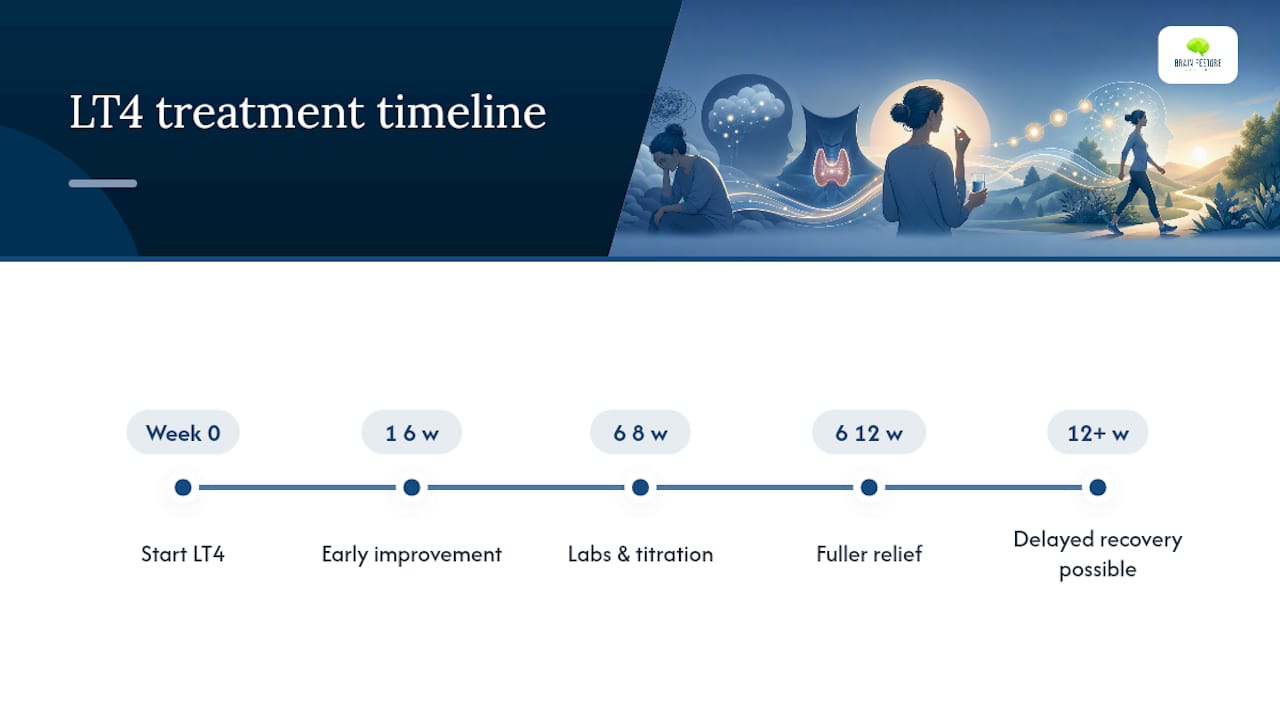
Most clinicians start with a weight-based LT4 dose, then recheck TSH roughly six to eight weeks later to fine-tune the amount. This process, called titration, can take several rounds before your levels land in the target range consistently. Clinic-style patient resources note that brain fog often begins improving within weeks of starting or optimizing levothyroxine, though fuller cognitive relief may take six to twelve weeks, and sometimes longer if there’s been prolonged untreated hypothyroidism beforehand.
What about combination therapy, adding liothyronine (LT3) to LT4, or using desiccated thyroid extract instead? This is genuinely contested territory, and it’s worth understanding both sides honestly.
The case for caution: current evidence and guideline positions urge restraint around combination therapy. Randomized trial evidence for LT3/LT4 combinations remains limited, and most reviews recommend reserving these options for carefully selected patients who haven’t responded to optimized LT4 alone, not as a first-line approach. Overtreatment carries real risks: atrial fibrillation and accelerated bone loss are documented consequences of chronically suppressed TSH from excess thyroid hormone.
The practical middle ground: a trial of combination therapy under close monitoring can be reasonable for patients who remain symptomatic despite genuinely optimized LT4 dosing, but it’s not a default upgrade everyone should request.
A few practical details matter more than people realize. Take levothyroxine on an empty stomach, ideally 30 to 60 minutes before eating, since food interferes with absorption. Separate your dose from calcium and iron supplements by at least four hours, as both significantly reduce how much hormone your body actually absorbs. And schedule follow-up labs consistently around the same time relative to your last dose, since inconsistent timing muddies the comparison between visits.
Medication optimizes your thyroid levels, but a handful of supportive strategies often make the visible difference in day-to-day mental clarity, especially while your brain catches up to your bloodwork.
Pro Tip: Think of thyroid medication as fixing the fuel supply and cognitive rehab as retraining the engine. Even with the right fuel, an engine that’s been running rough for months benefits from some dedicated tuning.
On supplements, be selective. If you’re genuinely B12 deficient, supplementation makes a real, measurable difference. But be skeptical of “thyroid support” blends marketed broadly online. Most lack rigorous evidence, and some contain unlisted iodine or hormone-like compounds that can actually destabilize a properly managed thyroid. Our breakdown of supplements with real evidence for neurological support separates what’s worth trying from what’s mostly marketing. For a deeper look at rebuilding mental stamina specifically, our mental fatigue treatment guide covers additional recovery strategies.
Most hypothyroid-related brain fog is a symptom to manage systematically, not an emergency. But a few situations call for prompt evaluation rather than a “wait and see” approach.
For persistent but non-urgent cases, it’s worth requesting an endocrine referral if your primary care workup hasn’t resolved things, along with formal neurocognitive testing if fog is significantly affecting work or daily function. A sleep evaluation and mental health screening round out a genuinely thorough assessment.
Walking into that appointment prepared changes the quality of the conversation. Bring:
When thyroid labs look reasonable but the fog hasn’t lifted, a broader clinical lens often finds what a single specialty misses. This is where Brainrestoremeridian’s approach differs from a purely endocrine focus.
Our evaluation typically starts with a functional medicine review that looks beyond TSH and free T4 alone, checking for the comorbidities covered earlier, from nutrient deficiencies to sleep disruption. From there, patients often move into a structured pathway: assessment, targeted lab review, a personalized rehab plan, and scheduled follow-up to track actual cognitive progress, not just biochemical numbers.
Persistent cognitive symptoms after “normal” thyroid labs usually mean the picture is incomplete, not that the symptoms are imagined.
Several complementary services support this pathway. Neurofeedback trains brain function directly, addressing the neural slowing that thyroid mechanisms alone can leave behind. Photobiomodulation, or laser therapy, supports cellular energy production in ways that complement, rather than replace, endocrine treatment. Cognitive rehabilitation adds structured strategies for the day-to-day tasks fog disrupts most.
If you’ve optimized your thyroid treatment and mental clarity still hasn’t caught up, scheduling a comprehensive evaluation is a reasonable next step.
The conventional advice on thyroid-related brain fog treats it almost like a math problem: fix the TSH, and the fog lifts. The patient-survey data tells a different story. Nearly half of respondents had cognitive symptoms before diagnosis, and fewer than a third found medication adjustment alone sufficient. That gap between the clean clinical narrative and lived patient experience is the single most important thing this evidence reveals.
What gets underrated is the comorbidity check. Sleep apnea, B12 deficiency, and depression aren’t footnotes. They’re often doing as much damage to your mental clarity as the thyroid itself, and they get missed when everyone, patient included, assumes the thyroid is the whole story.
If I had to prioritize one thing for readers, it would be this: get properly tested, optimize medication with a real clinician relationship, and if fog persists after that, look toward rehabilitation, not a higher pill dose. That’s where a multidisciplinary path like the one Brainrestoremeridian offers actually earns its place.
If your thyroid labs look fine but your brain still feels three steps behind, you’re not imagining it, and you’re not out of options. Brainrestoremeridian’s approach goes beyond a single hormone panel: we combine functional medicine evaluation with neurofeedback and rehabilitative therapies designed specifically for patients whose cognitive symptoms have outlasted their lab corrections.

This matters because the comorbidities covered earlier, sleep apnea, nutrient deficiencies, and lingering neural slowing, often need direct attention that a thyroid prescription alone can’t provide. Our neurofeedback program trains the brain circuits involved in focus and processing speed, giving patients a concrete way to work on clarity while their thyroid treatment stabilizes. If persistent brain fog has become part of your daily reality despite “normal” bloodwork, schedule a comprehensive evaluation with our team to map out what’s actually driving your symptoms and build a plan around it.
Can hypothyroidism cause brain fog even with normal TSH?
Yes. Central hypothyroidism, biologically inactive TSH, and non-thyroid causes can all produce low thyroid symptoms with normal labs. If your TSH looks fine but symptoms persist, ask about checking free T4 and screening for other contributors rather than assuming the thyroid is fully ruled out.
How long does hypothyroid brain fog take to improve with treatment?
Many patients notice improvement within weeks of starting or optimizing levothyroxine, though full cognitive relief can take six to twelve weeks or longer, particularly after prolonged untreated hypothyroidism.
Does Hashimoto’s cause worse brain fog than other types of hypothyroidism?
Hashimoto’s brain fog can feel more variable because autoimmune-driven hormone fluctuations sometimes create inconsistent symptom patterns, with some days noticeably sharper or foggier than others, even before hormone levels are fully stabilized.
Is combination LT3/LT4 therapy worth requesting for brain fog specifically?
It’s reasonable to discuss if optimized LT4 alone hasn’t resolved symptoms, but current evidence doesn’t support it as a first-line brain fog treatment. Guideline positions favor selective use under close monitoring due to overtreatment risks like atrial fibrillation and bone loss.
What other conditions should be ruled out before blaming thyroid dysfunction entirely?
Depression, sleep apnea, vitamin B12 deficiency, perimenopause, certain medication side effects, and long COVID all produce cognitive symptoms that overlap heavily with hypothyroid brain fog and deserve screening alongside your thyroid workup.
This article is general information, not a substitute for advice from a qualified doctor. Consult a qualified healthcare professional about your own circumstances before acting on anything here.
The claims in this article draw on a mix of patient-reported data and clinical literature worth reading directly if you want the full context.
The patient-perspective survey of 5,170 respondents offers the most detailed look at how common and disruptive brain fog is among people with hypothyroidism. The accompanying narrative review on defining and measuring hypothyroid brain fog covers the evidence gaps and treatment recommendations in depth. For foundational patient guidance, NIDDK’s hypothyroidism overview and the Cleveland Clinic’s hypothyroidism resource both provide reliable, plain-language explanations of symptoms and standard care.
Questions about your next step?
Our Meridian team can help you understand the evaluation process and which care options may fit your needs.
Schedule a Brain Health ConsultationPrefer to speak with our team? Call 208-639-1397