Before Blaming Mold for Brain Fog: Mouse Labs, Human Limits, and Fixes
September 30, 2026


Cognitive complaints like fogginess, forgetfulness, and trouble concentrating are commonly reported alongside mold exposure, but current science supports an association that deserves attention, not a proven cause-and-effect relationship for ordinary indoor exposures. If your symptoms line up with visible dampness or mold, or ease up when you’re away from a particular building, that pattern is worth taking seriously. If brain fog is interfering with your work, relationships, or daily routine, the next step is a medical evaluation, not a guess.
TL;DR:
- Most research on mold and brain fog is based on animal studies showing inflammatory responses, but there is no definitive proof that typical indoor mold exposure causes cognitive issues in humans.
- A 2026 study found a statistical link between indoor mold exposure and difficulty concentrating, but confounding factors like allergies and sleep problems complicate establishing causation.
- Common symptoms accompanying brain fog include nasal congestion, skin irritation, fatigue, and allergy-like symptoms that often improve when away from damp environments.
- Addressing moisture sources and mold in your home can improve respiratory health, but persistent cognitive symptoms should be evaluated for other medical causes like sleep disorders or nutritional deficiencies.
- Proper clinical assessment should rule out reversible factors before attributing brain fog to mold exposure, and professional remediation is recommended for larger mold infestations.
Researchers have proposed several biological pathways that might explain why some people feel mentally foggy after time in a damp or moldy space. None of these pathways are confirmed as the definitive mechanism in humans, but together they offer plausible explanations worth understanding.

The most studied route involves the immune system. When you breathe in mold spores or fungal fragments, your airway tissue can mount an inflammatory response. In animal studies, that local inflammation appears to trigger signals that reach beyond the lungs. A NIOSH and CDC-supported study exposed mice to inhaled Aspergillus versicolor and found measurable neuroinflammatory and glial transcriptional changes in the frontal lobe and midbrain, along with shifts in genes tied to neurotransmission. That is a meaningful finding for understanding mechanism, but it describes a controlled mouse inhalation model, not a confirmed pathway in people living in damp homes.
A second hypothesis centers on mycotoxins, the chemical compounds some molds produce. Laboratory toxicology has documented effects of concentrated mycotoxin exposure on cells and animal tissue, but scientists have far less causal data on whether typical household mycotoxin levels produce cognitive symptoms in humans. The gap between a petri dish finding and a lived symptom in your kitchen or basement is real, and it’s one reason clinicians are careful not to overstate what mycotoxin research proves.
A third contributor is more indirect, but arguably more common: living with a damp, musty, or visibly moldy space is stressful. Poor sleep from congestion or allergy symptoms, anxiety about your home’s condition, and even medications taken for mold-related respiratory issues can each produce brain fog on their own, independent of any direct toxic effect.
What the animal and mechanistic research offers is plausibility, not proof:
One animal study found that inhaled Aspergillus versicolor produced neuroinflammatory and glial transcriptional changes in multiple mouse brain regions. That result supports the idea that inhaled mold could plausibly affect the brain, though it does not establish that household exposure does the same in people.
When people describe brain fog tied to a moldy building, the pattern tends to repeat: mental slowness, trouble finding the right word mid-sentence, forgetfulness about recent conversations or tasks, and difficulty concentrating on work that used to feel routine. It’s not a formal diagnosis, but it is a recognizable and disruptive cluster of symptoms.
Human research on this connection is limited but not absent. A 2026 case-control study looking at indoor environmental conditions and cognitive outcomes in older adults found that difficulty concentrating was associated with mild cognitive impairment in one adjusted model, with an odds ratio of 1.49 (95% CI 1.06 to 2.09). That’s a statistically meaningful association, but it comes from an observational design, which means it can point to a relationship without proving that mold exposure caused the cognitive change. The study’s authors themselves noted that several of the environmental mold findings were imprecise, and observational associations like this one support further investigation rather than settled conclusions.
Cognitive complaints rarely show up alone. People reporting mold-related brain fog frequently also describe:
The CDC’s guidance on mold and health is direct about where the strongest evidence lies: damp and moldy environments are clearly linked to respiratory and allergic problems, and cognitive complaints can appear in reports of building-related illness, but a causal, mold-specific brain fog syndrome has not been established for ordinary indoor exposures. Public health guidance also points out that reported cognitive symptoms often co-occur with poor sleep, allergies, or mood changes, which is exactly why self-diagnosis is risky. Before assuming mold is the sole cause, it’s worth ruling out far more common culprits: thyroid dysfunction, iron or vitamin B12 deficiency, undiagnosed sleep apnea, depression, anxiety, chronic stress, and side effects from medications you’re already taking. If word-finding trouble is a prominent symptom for you, it’s worth reading more about what causes it and when to act, since that symptom has its own set of common explanations beyond mold.
Understanding the strength of evidence means separating two very different kinds of research: what happens in a controlled animal model, and what researchers observe in actual human populations living or working in damp buildings.
Animal studies, like the CDC-supported mouse inhalation work described earlier, offer precision. Researchers control the exposure dose, the timing, and the environment, then measure specific biological changes. That precision is valuable for understanding mechanism, but mice are not small humans, and a controlled inhalation chamber is not a basement with a slow leak. Human epidemiologic studies, by contrast, capture real-world exposure, but at a cost: researchers usually cannot control how much mold someone was actually exposed to, for how long, or of which species. Most studies rely on self-reported dampness or visible mold rather than measured spore counts or mycotoxin levels, which introduces real uncertainty into any association they find.
Confounding is the other persistent problem. People living in damp, mold-affected housing often face other stressors at the same time, including older building infrastructure, lower income, higher stress, and reduced access to healthcare. Any of those factors could independently contribute to cognitive complaints, making it hard to isolate mold as the specific driver even when a study finds a statistical association.
A broader evidence review published in Environmental Health Perspectives reflects this pattern across the research field: consistent associations exist between indoor dampness or mold and respiratory and allergic outcomes, but associations with non-respiratory outcomes, including some cognitive complaints, are described as suggestive rather than definitive, and often confounded by other variables.
Multiple epidemiologic and meta-analytic studies show links between dampness or mold and asthma and other respiratory outcomes, while cognitive and general symptom associations remain less definitive.
Stronger evidence, when it eventually arrives, will likely look different from what exists today. It would involve prospective studies that measure exposure directly rather than relying on recall, larger and more diverse cohorts, and objective cognitive testing rather than self-reported symptom checklists. Until then, the practical takeaway holds steady on both sides of the uncertainty:
If brain fog has lasted more than a few weeks, or it’s affecting your work, relationships, or safety, it’s time to get evaluated rather than keep guessing. Certain symptoms warrant more urgency: sudden neurologic changes like confusion, slurred speech, or weakness, high fever with respiratory symptoms, or a known weakened immune system paired with worsening breathing problems. The CDC notes that invasive mold infections are rare and mostly affect people who are immunocompromised, but when they occur, prompt care matters. Most people who inhale mold spores day to day do not develop this kind of infection.
Before your appointment, it helps to prepare a clear picture of your situation rather than a vague sense that something is wrong:
A thorough evaluation typically looks well beyond mold as a single suspect. Clinicians commonly order thyroid and metabolic labs, screen for sleep disorders and mood conditions like depression or anxiety, and may recommend neurocognitive testing to measure memory, processing speed, and attention objectively rather than relying on how foggy something feels. If respiratory symptoms are prominent, a pulmonary evaluation may be added to the workup. You can read more about what brain function testing can reveal if objective testing is part of your plan.
Pro Tip: Bring a simple written timeline to your first appointment rather than trying to recall details on the spot. A clinician can act on “symptoms started in October, worse at home, better on a two-week trip” far more easily than a general sense that something feels off.
One more thing worth knowing before your visit: avoid disturbing large areas of visible mold contamination yourself. Not only can that release more spores into the air, it can also complicate a professional assessment of the original problem.
Whatever the cognitive question ultimately proves to be, addressing dampness and mold in your living or working space is worthwhile on its own, since the respiratory and allergic effects of mold exposure are well established. The EPA’s guidance on mold remediation is built around one core principle: mold needs moisture to grow, so controlling water is the real fix, not just cleaning what you can see.
Start with the basics as soon as you notice a problem:
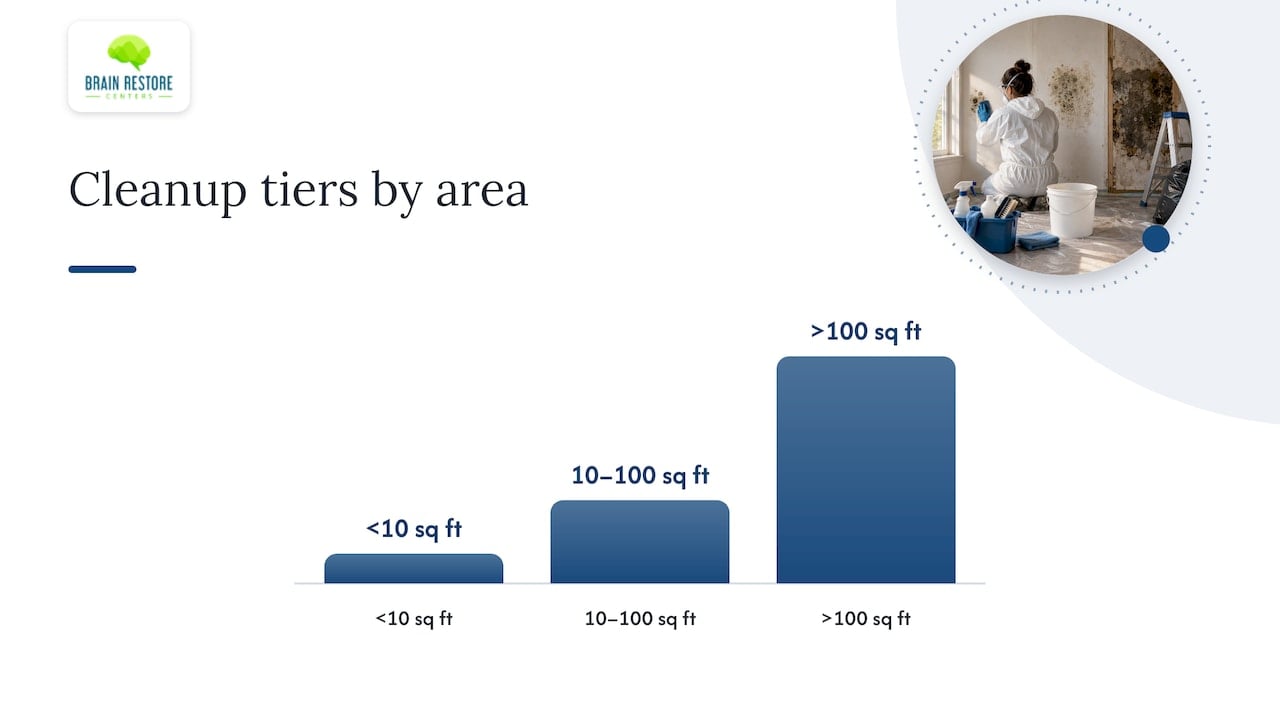
The size of the contaminated area determines how you should respond. The EPA categorizes cleanup scope into three tiers: areas smaller than 10 square feet, which a person can often handle with basic cleaning and proper protection; areas between 10 and 100 square feet, which call for more caution and possibly professional guidance; and areas larger than 100 square feet, which the EPA recommends handling with professional remediation. When remediation crews handle larger contamination, proper containment, negative air pressure, and post-remediation inspection reduce the risk of spreading spores further through the building.
A few more practical points worth knowing before you start any cleanup:
EPA guidance also cautions against reaching for bleach or other biocides as a standard first step. Removing and replacing heavily contaminated porous materials is often the more reliable approach than trying to disinfect your way out of the problem.
Persistent brain fog, whether it stems from mold exposure, another environmental factor, or something else entirely, is best managed by addressing the specific, reversible contributors behind it rather than chasing a single miracle fix. This is where a careful clinical workup pays off: many of the most common causes of fog are treatable once identified.
Sleep quality is often the first place to look, since poor or fragmented sleep from congestion, allergies, or an undiagnosed sleep disorder can produce cognitive symptoms that mimic what people describe as mold-related fog. Thyroid dysfunction, nutritional deficiencies like low B12 or iron, and depression or anxiety are similarly common and similarly correctable once identified through routine labs and screening. A full medication review matters too, since some common prescriptions, including certain antihistamines and sleep aids, carry cognitive side effects on their own.
If allergic or asthma symptoms are part of your picture, treating those directly, whether through allergy management, inhaled medications, or an allergist referral, often improves overall well-being and indirectly supports clearer thinking. Care for persistent or complex cases benefits from a team approach:
Pro Tip: Be cautious of aggressive “mold detox” protocols marketed online, including unsupervised supplement stacks or extreme dietary restrictions. A supervised, evidence-based plan built around your actual lab results and symptoms will get you further than a one-size-fits-all cleanse. If you’re curious what supplement research actually supports for cognitive health, this review of the evidence is a more grounded starting point than most online claims.
For readers exploring newer adjunctive approaches, some early research has looked at peptide compounds and cognitive symptoms; a research-oriented overview of peptides for brain fog walks through what’s being studied, though this remains an emerging area rather than an established treatment. Many patients also find that brain fog from other causes, including post-viral illness, follows a similar management path; our guide to brain fog after COVID covers a comparable clinical approach.
Patients rarely arrive describing a single, clean cause for their fog. More often, someone notices they’ve been slower at work, forgetting names or appointments, and struggling to focus by mid-afternoon, and only later connects it to a basement leak or a musty smell they’d stopped noticing. That pattern, mold suspected after the fact rather than before, is common, and it’s exactly why a careful history matters more than a quick assumption.
Our approach starts with ruling out the reversible contributors: sleep, thyroid, mood, medications, and nutritional gaps, before treating mold as the default explanation. When dampness or mold is part of the picture, we treat remediation and clinical care as complementary steps, not competing ones. Fixing the building matters. Understanding what’s happening in your brain and body matters just as much. Bringing a written timeline of your symptoms and exposure to your first visit makes that process faster and more precise for everyone involved.
— Chad
Getting real answers starts with a proper evaluation, not another guess. At Brain Restore Meridian, our Brain Health Consultation is built to look at the reversible pieces behind persistent fog, sleep, thyroid function, mood, and cognitive performance, before assuming any single cause. Remediation of a damp or moldy space is worth doing on its own, but it works best alongside a clear picture of what’s actually happening in your brain and body.
There are various approaches combining assessment and targeted therapies for people dealing with persistent cognitive symptoms; these may include brain regulation training and adjunctive recovery support therapies.
| Service | What it addresses | Where to start |
|---|---|---|
| Brain Health Consultation | Initial evaluation of cognitive complaints and reversible contributors | Brain Restore Program |
| Neurofeedback | Brain regulation training as part of a broader plan | Learn more |
| Hyperbaric Oxygen Therapy | Adjunctive recovery support | Learn more |
If persistent brain fog has been disrupting your work or your days, schedule a Brain Health Consultation and start with a clear, personalized evaluation instead of another unanswered question.
For readers who want to go straight to the primary material, the CDC’s overview of mold and health and the EPA’s mold remediation guidance are the most authoritative starting points. The 2026 case-control study and the CDC-supported animal inhalation study offer more detail on the human and mechanistic research discussed above. Your local health department can also advise on remediation resources specific to your area.
This article is general information, not a substitute for advice from a qualified doctor. Consult a qualified healthcare professional about your own circumstances before acting on anything here.
Most documented long-term effects of mold exposure, including black mold, involve respiratory and allergic conditions rather than a specific confirmed cognitive syndrome, according to the CDC. Cognitive complaints are sometimes reported alongside prolonged exposure, but current evidence describes an association that needs more research, not a proven long-term brain effect.
There is no established, well-supported causal link between mold exposure and obsessive-compulsive disorder in current medical literature. Anxiety and mood changes are sometimes reported alongside mold-related building illness, but these are distinct from a diagnosed connection to OCD specifically, and any such concern is best evaluated by a clinician directly.
There is no universally agreed-upon list of “10 warning signs” of mold toxicity recognized by major health authorities, though the CDC links damp and moldy environments to respiratory symptoms, allergic reactions, eye and skin irritation, and, in some reports, fatigue or trouble concentrating. If you’re noticing a cluster of these symptoms tied to a specific building, a medical evaluation is the most reliable way to sort out the cause.
The most effective approach combines two tracks: addressing the moisture and mold source in the building using EPA remediation guidance, and getting a medical evaluation for reversible contributors like sleep, thyroid function, mood, and nutritional deficiencies. A Brain Health Consultation can help identify which of these factors are contributing to your specific symptoms.
See a doctor if brain fog has lasted more than a few weeks, is affecting your work or daily function, or comes with red flags like sudden confusion, high fever, or significant breathing problems. Bringing a written timeline of your symptoms and any visible mold or water damage helps your clinician evaluate your situation more efficiently.