Laser Therapy for Arthritis: What the Research Shows
November 9, 2026


Low-level laser therapy (also called cold laser therapy or photobiomodulation) uses gentle, non-heating light over a painful joint. The aim is to ease pain and inflammation and support tissue repair. The best evidence is for knee osteoarthritis, where a large meta-analysis found pain relief beyond placebo. Results in rheumatoid arthritis are less consistent. It is a painless, drug-free option many people use alongside exercise, chiropractic care and medical treatment. Below, we explain how it works, what a course looks like, what to expect and who should talk with a doctor first.
Low-level laser therapy is a continuous laser or light-emitting diode (LED) of 600 to 1000 nm applied to relieve pain, stimulate tissue repair and decrease inflammation, as a 2019 review in the musculoskeletal literature defines it. The “cold” part matters. The light does not raise tissue temperature enough to change the tissue’s structure, so you are not being burned or cut. You are being given a measured dose of light energy.
You may also see the terms photobiomodulation (PBM) or photobiomodulation therapy (PBMT). They describe the same family of treatments: low-intensity light that triggers biological responses in cells.
In the United States, the FDA has cleared these devices for the temporary relief of muscle and joint pain, according to the same review. That is the right frame for laser therapy: a way to ease joint pain and stiffness while you build strength and mobility, not a cure for the underlying disease.
The leading explanation starts inside your cells. LLLT is thought to act on the mitochondria, the parts of the cell that make energy. It may stimulate ATP production and other biological factors that promote healing and reduce inflammation and pain, according to Arthritis Australia. The same source describes several proposed effects:
Pain nerves may be part of the story too. A 2021 review describes how photobiomodulation applied over peripheral nerves can limit inflammatory mediators such as prostaglandin E2, interleukin-6 and tumor necrosis factor alpha. The result is less stimulation of the nerve endings that signal pain. Research on peripheral nerves has also shown a partial, temporary dampening of nerve signaling within 10 to 20 minutes of application that reverses within 24 hours, per the 2019 review.
In plain terms, think of it as giving irritated joint tissue and the nerves around it a signal to settle down, while the body’s own repair processes get more support. These are proposed mechanisms, and researchers are still refining them.
Osteoarthritis of the knee is where laser therapy has the most research behind it. A 2019 meta-analysis of 22 trials with 1,063 participants found that LLLT reduced knee osteoarthritis pain versus placebo by 14.23 mm on a 100 mm visual analog scale at the end of therapy. At follow-ups one to twelve weeks later, the gap was 15.92 mm.
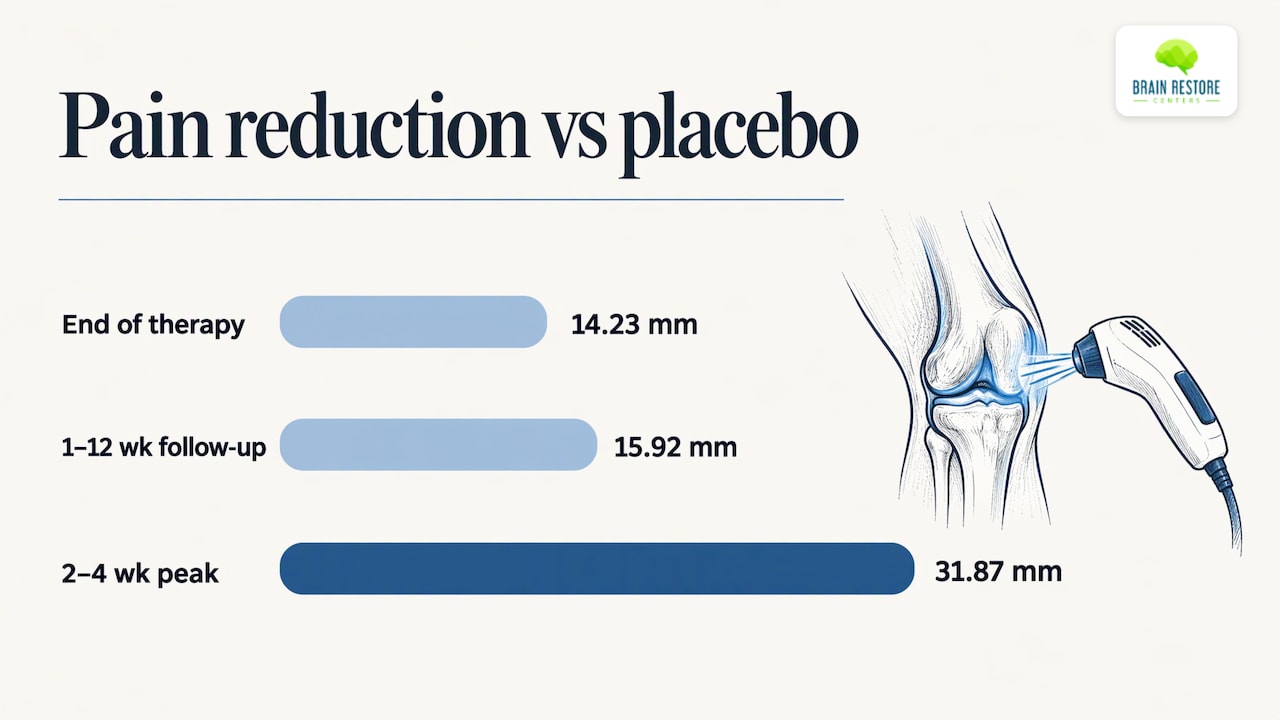
The details of dosing mattered. The same analysis found that pain and disability improved at 4 to 8 joules with 785 to 860 nm wavelengths, and at 1 to 3 joules with 904 nm wavelengths, per treatment spot. With those recommended doses, pain reduction peaked two to four weeks after therapy ended, at 31.87 mm beyond placebo.
Two more recent trials show how researchers are testing different approaches:
If your knee is the main problem, our own overview of what the evidence says about laser therapy for knee pain goes deeper into those findings.
Rheumatoid arthritis (RA) is an autoimmune condition, and the research picture is less settled. A 2023 systematic review of 18 randomized trials with 793 participants found low-quality evidence suggesting infrared laser may not differ from sham for pain, morning stiffness, grip strength or disease activity. The authors pointed to big differences between studies in sample size, treatment time, treatment site and laser settings, which makes results hard to compare.
That last point is useful for you as a patient. Results depend on the parameters: wavelength, dose, power and where the light is placed. The 2019 review also notes a lack of agreement on the ideal laser type, dose and wavelength, and many studies follow people only briefly. So if you have RA, the sensible approach is to keep your rheumatology care at the center and ask whether laser therapy could be a comfort-focused addition for sore joints.
The 2019 American College of Rheumatology and Arthritis Foundation osteoarthritis guideline strongly recommends exercise, weight loss, self-management programs, tai chi, bracing, canes and certain medications and injections. It does not list laser therapy among its recommended interventions. That makes the most sense as a reason to build laser into a broader plan rather than use it alone. Arthritis Australia takes the same view, saying LLLT is not a cure but can be complementary alongside medication, physical therapy and lifestyle changes.
On the other side, the authors of the 2021 photobiomodulation review argue that good evidence plus virtually no side effects make PBMT well suited to become an alternative pain treatment, with a potential to reduce reliance on NSAIDs and opioids in musculoskeletal conditions. Between those two views sits a practical answer: it is a low-risk option that can fit around the proven basics.
Two laser sessions are not equal. The results in the studies above changed with wavelength (red around 660 nm, near-infrared from 785 to 904 nm), with energy per spot, and with how many points around the joint were treated. Red wavelengths tend to be discussed for surface tissue, and near-infrared for deeper joints such as the knee and hip. If you are curious about how light-based approaches are discussed for joint and bone concerns more broadly, this piece on red light therapy for arthritis is a helpful companion read.
For you, this means the practitioner matters as much as the device. Look for a clinic that:
A session is simple. In the 2023 knee trial, patients lay on their backs with the knee supported at about 15 to 30 degrees of bend. They felt either nothing or a low-level warmth that went away right after treatment. That fits most people’s description: no needles, no downtime, no sedation.
LLLT may be delivered by a physician, physical therapist, occupational therapist or doctor of chiropractic in an office or outpatient setting, and it needs no sedation or anesthesia. Everyone in the room wears protective eyewear.
Research courses range from six sessions over three weeks to three sessions a week for eight weeks. Pain relief in the knee meta-analysis peaked a few weeks after treatment ended, so patience helps. Many people want to judge the benefit after a short run of visits, and it is reasonable to agree on a checkpoint with your provider: how you are sleeping, how stairs feel, how long morning stiffness lasts.
For more on timing, our guide to cold laser therapy benefits, dosing and when it works lays out what we look at over a course of care.
Laser works best when it is not the only thing you are doing. The guideline’s strongest recommendations center on movement, weight management and self-management, and light therapy can make that easier by taking the edge off sore joints so you can exercise.
A practical combination for many joint pain patients looks like this:
| Part of your plan | What it does | How laser fits |
|---|---|---|
| Strengthening and movement | Supports the joint and improves function | Less pain may make exercise more comfortable |
| Weight and nutrition | Lowers load on knees and hips | Complements, does not replace |
| Medication from your doctor | Manages pain or disease activity | Discuss timing and goals with your doctor |
| Chiropractic and joint support | Improves mechanics and mobility | Often delivered in the same visit schedule |
| Other drug-free modalities | Support circulation and comfort | Can be layered into the plan |
At our clinic, chiropractic care and laser therapy sit under one roof, and we also use PEMF for circulation and joint comfort. Wrist and hand joints are common arthritis trouble spots as well, and you can read how we approach chronic wrist pain with low-level laser.
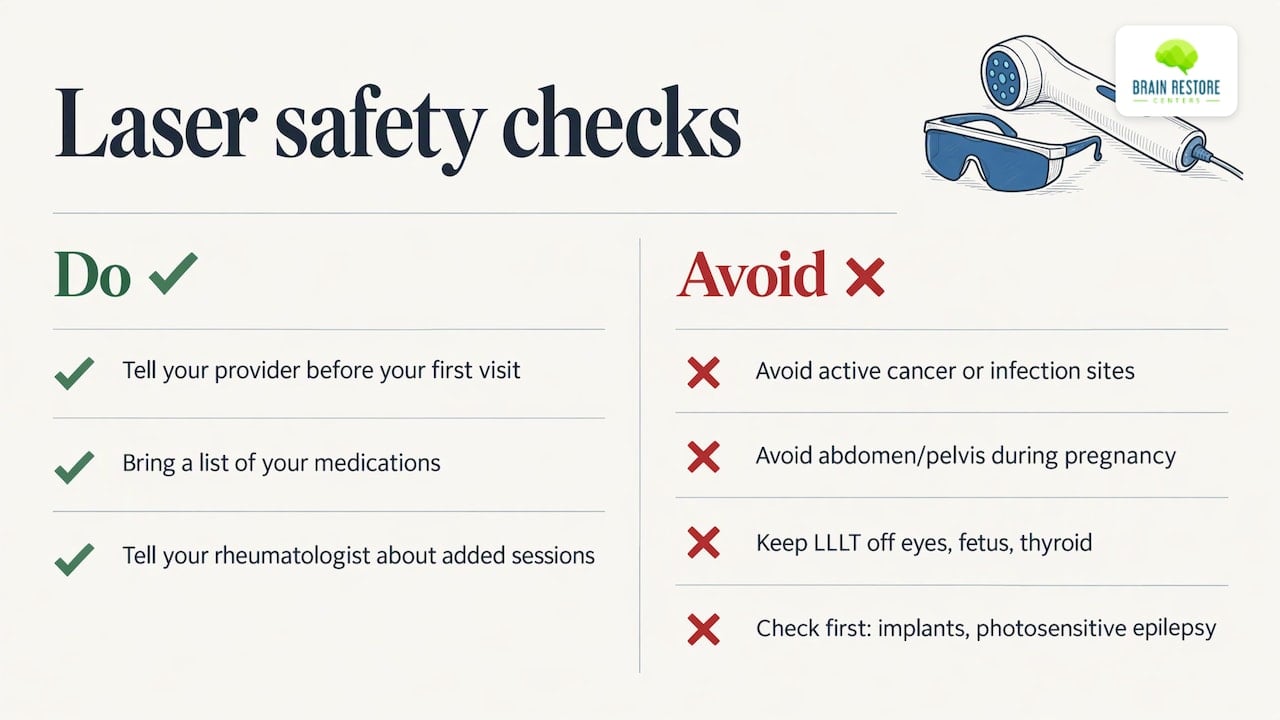
Laser therapy has a good safety record in the research. The 2021 review states that no adverse effects have been demonstrated with photobiomodulation to date. It lists areas of active carcinoma, areas of infection, and the abdomen and pelvis in pregnancy as contraindications. The RA meta-analysis noted that most trials reported no side effects, though in one study two people receiving infrared laser had increased disease activity that needed steroids.
The Merck Manual adds safe-use rules to keep in mind. LLLT should not be used over the eyes, a known cancer site, a developing fetus, a pacemaker or other implanted device, or the thyroid gland. The light can trigger seizures in people with photosensitive epilepsy.
Tell your provider before your first visit if any of those apply to you, and bring a list of your medications. If you have RA or another inflammatory type, let your rheumatologist know you are adding laser sessions so your plan stays coordinated.
Laser therapy is for comfort and function, not for diagnosing what is going on. Cleveland Clinic lists joint pain, stiffness or reduced range of motion, swelling, skin discoloration, tenderness and warmth as common signs of arthritis, and it advises seeing a healthcare provider for severe pain, worsening stiffness, sudden loss of joint movement, or worsening or more frequent flare-ups. A hot, red, swollen joint with fever should be looked at promptly. Getting a clear diagnosis first means any therapy, including laser, is matched to the right problem.
We see laser therapy as one of the most patient-friendly tools we have for joint pain. It is quiet, comfortable and does not ask your body to tolerate anything harsh. The research on knee osteoarthritis encourages us, and the way dose and wavelength change results is exactly why we build every plan around the person in front of us.
What we care about most is function: climbing stairs, walking the dog, sleeping through the night. So we pair laser with chiropractic care, movement and rehab, and we check in on how you feel at set points along the way. Our team brings more than 50 years of combined clinical experience to that conversation, and our patients have left over 400 five-star reviews.
If arthritis has been shrinking your world, you deserve a plan that is personal, hopeful and realistic. That is what we aim to give you.
Chad
If you live in Meridian or nearby Ada and Canyon County communities and want to see whether low-level laser therapy could fit your joint pain, we would be glad to help. Our low-level laser therapy care is offered in person at our clinic, and our team will talk through your history, your goals and what a reasonable plan looks like.
You can also read about how laser therapy helps relieve pain before you come in. When you are ready, contact our clinic through our website to schedule.
For knee osteoarthritis, a 2019 meta-analysis of 22 trials found pain relief beyond placebo, especially at the recommended doses. Evidence in rheumatoid arthritis is less consistent, and results vary with laser settings. Many people use it as a comfort-focused part of a broader plan.
Researchers think light may lower inflammatory molecules such as cytokines and prostaglandin E2 and encourage anti-inflammatory signals, as described in a 2021 review. Clinical results depend on the condition, dose and wavelength, so your provider should explain what they are targeting and how they will track your progress.
Most people feel nothing or mild warmth, and sessions need no anesthesia. Safe use means avoiding the eyes, known cancer sites, pregnancy over the treated area, implanted devices such as pacemakers, and the thyroid, and checking with a clinician if you have photosensitive epilepsy.
Studies range from six sessions over three weeks to three sessions a week for eight weeks. Your provider can suggest a schedule after examining you and set a checkpoint to review how your pain and movement are changing.
Questions about your next step?
Our Meridian team can help you understand the evaluation process and which care options may fit your needs.
Schedule a ConsultationPrefer to speak with our team? Call 208-639-1397