Functional Medicine for Thyroid: Tests, Causes, and a Plan
August 10, 2026


Functional medicine for thyroid care is a root-cause, systems-based evaluation that pairs expanded testing with targeted nutrition, lifestyle, and immune-modulating treatments. If you’re reading this because your TSH came back “normal” but you still feel exhausted, foggy, cold, or stuck at a weight that won’t budge, this approach was built for exactly that situation. Your most practical immediate next step: request a comprehensive thyroid panel (TSH, free T4, free T3, reverse T3, TPO antibodies, and thyroglobulin antibodies) alongside a basic nutrient screen covering ferritin, vitamin D, and B12. The Institute for Functional Medicine (IFM) frames this kind of full-axis assessment as the clinical standard for identifying drivers that TSH alone routinely misses. The National Institute of Diabetes and Digestive and Kidney Diseases (NIDDK) confirms that hypothyroidism affects millions of Americans, and conventional care centers on levothyroxine as the primary treatment. Brainrestoremeridian adds the next layer: finding out why your thyroid is struggling and addressing those drivers directly.
Pro Tip: Bring any prior lab results to your first appointment. Even a “normal” TSH from six months ago tells a functional clinician something useful about your trend.
A functional medicine approach to thyroid health is most effective when it combines expanded testing, root-cause identification, and a phased protocol that addresses nutrients, gut health, stress, and medication optimization together.
| Point | Details |
|---|---|
| Start with a full panel | Order TSH, free T4, free T3, reverse T3, TPO antibodies, TgAb, ferritin, and vitamin D before any intervention. |
| Root causes vary by patient | Autoimmunity, conversion impairment, nutrient deficits, gut dysfunction, and cortisol dysregulation each require different interventions. |
| Medication and functional care work together | Levothyroxine remains appropriate for overt hypothyroidism; functional care optimizes conversion and addresses upstream drivers alongside it. |
| Timeline is months, not weeks | Antibody reductions typically take 3–12 months; energy and sleep improvements often appear within 6–12 weeks of nutrient repletion. |
| Brainrestoremeridian | Offers in-person functional thyroid evaluation in Meridian, Idaho, with comprehensive labs, individualized plans, and multidisciplinary support. |
Conventional thyroid care is built around a single number: TSH. If it falls within the reference range, most standard workups stop there. That approach works well for clear-cut hypothyroidism, but it leaves a significant gap for people whose TSH is technically normal while free T3 is low, antibodies are climbing, or conversion from T4 to active T3 is impaired.
A functional approach to thyroid health starts from a different premise. Rather than asking “Is the number in range?” it asks “What is driving this person’s symptoms, and where in the thyroid axis is the breakdown occurring?” This means evaluating the full production-to-conversion-to-tissue pathway: how much T4 the thyroid makes, how efficiently the body converts T4 to active T3, whether reverse T3 is competing with active T3 at the receptor level, and whether the immune system is attacking thyroid tissue. Research supports this expanded testing rationale, noting that TSH-only screening can miss conversion impairment and early autoimmune disease.
The IFM describes this as a systems-biology model: rather than treating the thyroid as an isolated gland, it treats the thyroid as one node in a network that includes the gut, adrenal glands, immune system, and nutrient status. Rupa Health is a commonly used lab-ordering platform that functional clinicians use to consolidate these panels into a single requisition, which simplifies the process for patients.
For you, this means a first visit that looks less like a five-minute TSH check and more like a thorough intake covering your symptoms, history, diet, stress load, gut health, and prior labs. The goal is a personalized plan, not a protocol applied uniformly to everyone with a low TSH. That distinction is what separates functional thyroid care from a prescription refill.
Most thyroid dysfunction doesn’t start in the thyroid. It starts upstream, in the immune system, the gut, the adrenal glands, or a nutrient gap that quietly erodes thyroid enzyme function over months or years. Identifying which driver is dominant in your case is what makes a functional workup worth doing.
Pro Tip: If you’ve been told your thyroid is “borderline” or “subclinical,” ask specifically about your free T3 and TPO antibody levels. Those two numbers often tell a more complete story than TSH alone, especially if fatigue is your primary complaint.
Addressing these upstream drivers of thyroid symptoms is where functional medicine creates the most value for patients who’ve cycled through conventional care without resolution.
The testing phase is where a functional approach to thyroid care becomes concrete. A well-designed panel doesn’t just confirm hypothyroidism; it tells you where in the axis the problem lives and which interventions are most likely to help.
| Lab | What it measures | Why it matters functionally |
|---|---|---|
| TSH | Pituitary signal to the thyroid | Screening marker; normal range doesn’t rule out conversion issues |
| Free T4 | Unbound storage hormone | Shows thyroid output; low suggests production problem |
| Free T3 | Unbound active hormone | The hormone your cells use; low despite normal TSH = conversion issue |
| Reverse T3 (rT3) | Inactive T3 isomer | Elevated rT3 competes with free T3 at receptors; rises with stress, inflammation |
| TPO antibodies | Immune attack on thyroid peroxidase | Elevated = Hashimoto’s; present before TSH changes |
| Thyroglobulin antibodies (TgAb) | Immune attack on thyroglobulin | Second antibody marker; some patients are TgAb-positive but TPO-negative |
Authoritative endocrinology references confirm that peripheral conversion of T4 to T3 is the primary source of circulating active hormone, which is why free T3 and rT3 are clinically meaningful beyond what TSH captures.
Ferritin, a complete iron panel, and CBC help identify iron deficiency that impairs thyroid peroxidase function. Low ferritin is linked to impaired thyroid enzyme activity and worse symptoms, making it one of the most commonly correctable findings in a functional thyroid workup. Vitamin D, B12, folate, zinc, and a comprehensive metabolic panel round out the nutrient picture. A lipid panel is worth including because hypothyroidism raises LDL cholesterol, and improvement after treatment is a useful objective marker.

Morning cortisol (serum or salivary) is ordered when fatigue, sleep disruption, or conversion impairment is prominent. Sex hormones (estradiol, progesterone, testosterone) matter because estrogen dominance can raise thyroid-binding globulin, reducing free hormone availability. Fasting insulin and hemoglobin A1c are added when metabolic symptoms or weight gain are present.
When Hashimoto’s is confirmed or suspected, a comprehensive stool PCR for dysbiosis and a celiac panel are standard additions. SIBO breath testing is considered when bloating, constipation, or malabsorption is part of the picture. Toxin screening (heavy metals, environmental chemicals) is reserved for patients with clear exposure history.
How these results inform treatment is straightforward in practice: low free T3 with normal T4 points toward conversion support (selenium, stress reduction, iron repletion); elevated antibodies with gut symptoms points toward immune and gut-directed work; overt low T4 and high TSH points toward medication as a primary intervention.
A functional thyroid program isn’t a single supplement or a single dietary change. It’s a phased sequence where each step builds on the last, and the timeline is measured in months, not days.
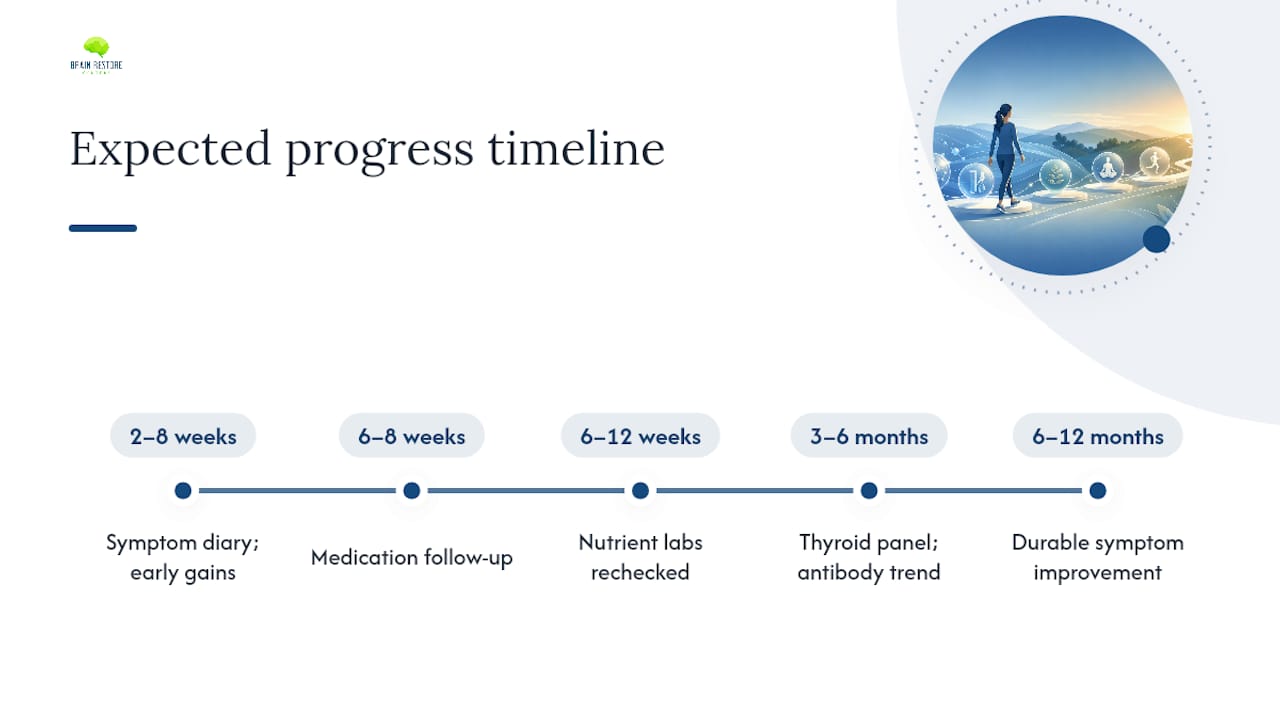
Typical checkpoints: nutrient labs recheck at 6–12 weeks, thyroid panel and antibodies at 3–6 months, medication titration follow-up at 6–8 weeks after any dose change. Many patients notice energy and sleep improvements within 6–12 weeks of addressing nutrient deficits and cortisol dysregulation. Antibody reductions often take 3–12 months of sustained intervention.
Nutrients are not optional extras in thyroid care. Several have direct, mechanistic roles in hormone synthesis, conversion, and immune regulation, and deficiency in any one of them can blunt the effect of everything else you’re doing.
Dietary approach: An anti-inflammatory whole-food pattern, adequate protein (to support conversion enzymes and muscle), and selenium-rich foods (Brazil nuts, sardines, eggs) form the dietary backbone. Restrictive elimination diets are used selectively, not universally. Gluten elimination is most supported for confirmed celiac disease or strong Hashimoto’s with gut symptoms; blanket elimination without a clinical indication adds burden without guaranteed benefit.
Timing and interactions: Calcium and iron supplements taken within four hours of levothyroxine reduce its absorption significantly. Space them by at least four hours, and take levothyroxine on an empty stomach with water. The same applies to antacids and soy-based foods.
For a broader look at evidence-based neurological and systemic supplement support, the clinic’s resources cover the overlap between thyroid-supportive nutrients and brain health.
Medication and functional medicine are not competing options. They address different parts of the same problem, and the most effective thyroid care usually involves both.
Mayo Clinic guidance is clear that overt hypothyroidism, post-thyroidectomy patients, and anyone with significantly elevated TSH and symptomatic low hormone levels require replacement therapy. Delaying medication in these situations while pursuing lifestyle interventions alone is not appropriate and can cause real harm, including cardiovascular effects, cognitive decline, and worsening fatigue. NIDDK confirms levothyroxine as the most common and effective conventional treatment for an underactive thyroid.
Where functional medicine adds value is in the monitoring and optimization layer:
Pro Tip: Use the same laboratory and the same time of day for repeat thyroid panels. TSH has a diurnal rhythm, and switching labs mid-treatment introduces variability that can look like a clinical change when it isn’t.
Setting realistic expectations is one of the most useful things a functional clinician can do. Thyroid physiology changes slowly, and the timeline for meaningful improvement reflects that.
Short-term (2–8 weeks): The most useful early tracking tools are a symptom diary covering energy, sleep quality, bowel habits, brain clarity, and cold tolerance. Nutrient labs (ferritin, vitamin D, B12) are rechecked at 6–12 weeks after repletion begins to confirm absorption and dose adequacy. Many patients notice energy and sleep improvements within this window once iron and vitamin D deficits are corrected.
Medium-term (3–6 months): The full thyroid panel and antibody levels are rechecked at 3–6 months. Antibody trends matter more than single values; a downward trajectory over two or three measurements is a meaningful signal even if absolute levels remain elevated. Medication titration follow-up is scheduled at 6–8 weeks after any dose change, consistent with standard clinical practice.
Longer-term (6–12 months): Durable symptom improvement, including resolution of fatigue, weight normalization, and cognitive clarity, typically requires 6–12 months of consistent intervention. This timeline reflects the biology: thyroid tissue regenerates slowly, antibody levels shift over months, and nutrient stores take time to rebuild.
Lab targets used in functional practice differ from standard reference ranges in one key way: free T3 is targeted in the upper-normal quartile for symptomatic patients, not merely “within range.” A free T3 at the bottom of the reference range may still be insufficient for a given individual’s tissue needs. Caution applies here: overaggressive normalization, particularly pushing free T3 above range, carries cardiovascular and bone risks and requires careful monitoring.
The quality of your care depends heavily on the clinician you choose. Functional medicine is a broad term, and the training behind it varies considerably.
Credentials to look for:
Questions worth asking at a first visit:
Red flags to watch for:
Practical tips: Request a sample treatment plan before committing to a program. Ask specifically about follow-up cadence (monthly? quarterly?) and what labs will be ordered at each visit. A clinician who can’t answer these questions clearly is not yet operating at the standard a functional thyroid patient deserves.
For patients who want to understand what functional medicine can do for chronic symptoms more broadly, the clinic’s resources outline the typical program structure and what to expect over time.
Brainrestoremeridian operates as a multidisciplinary, in-person clinic in Meridian, Idaho, integrating functional medicine with supportive therapies including neurofeedback, laser therapy, spinal decompression, chiropractic care, and hyperbaric oxygen therapy. For thyroid patients, this means the evaluation doesn’t stop at a lab panel. It extends to the neurological, metabolic, and stress-related systems that directly influence thyroid function and symptom burden.
The clinic’s functional medicine program is built around comprehensive lab ordering and interpretation, individualized nutrition planning, targeted supplementation based on confirmed deficiencies, and coordinated medication co-management when prescription therapy is needed. Practitioners hold functional medicine training and clinical experience with the full range of thyroid presentations, from subclinical Hashimoto’s with normal TSH to overt hypothyroidism requiring medication optimization.
Outcomes are tracked through lab targets (free T3 in the upper-normal range, antibody trend reduction, ferritin above 70 ng/mL), symptom diaries, and periodic reassessment at structured intervals. The clinic’s model emphasizes clinician oversight at every phase, not self-directed supplementation, because the difference between a therapeutic dose and a harmful one is often narrower than patients expect, particularly with iodine and iron.
The most consistent pattern in functional thyroid care is this: a patient arrives with years of fatigue, brain fog, and weight gain, a stack of labs showing TSH in the normal range, and a growing sense that something is being missed. In most of those cases, the free T3 is in the lower quartile of normal, TPO antibodies are elevated, and ferritin is below 50 ng/mL. None of those findings trigger a diagnosis in conventional care. All of them are treatable.
What I find most underappreciated in the broader conversation about thyroid health is how much cortisol drives the picture. Patients who are chronically sleep-deprived or under sustained psychological stress are running elevated cortisol that directly suppresses deiodinase activity, the enzyme responsible for converting T4 to active T3. Addressing sleep and stress isn’t a soft recommendation. It’s a mechanistic intervention with direct effects on the hormone your cells actually use. The hidden culprits behind thyroid problems are often lifestyle-driven, and that’s genuinely good news: they’re modifiable.
The other thing patients deserve to hear is that medication and functional care are not in conflict. The goal is not to avoid levothyroxine. The goal is to use it at the right dose, confirm it’s actually converting to free T3, and address the upstream factors that medication alone cannot fix. That combination, not one or the other, is where most patients find lasting improvement.
If you’re in the Meridian, Idaho area and ready to move beyond a TSH-only workup, Brainrestoremeridian offers a structured, in-person thyroid evaluation that covers the full clinical picture.
Your first appointment includes a thorough intake covering your symptom history, prior labs, current medications, and lifestyle factors. From there, the team orders a comprehensive thyroid panel alongside nutrient and hormonal adjuncts based on your specific presentation. You leave with an initial plan, not a generic protocol. Follow-up visits are scheduled at 6–8 weeks for nutrient rechecks and at 3–6 months for a full thyroid panel review. For patients who need HPA support alongside thyroid care, neurofeedback for stress and anxiety relief is available as part of the clinic’s multidisciplinary model.
Bring your prior labs and your current medication list to your first visit. Schedule your evaluation at Brainrestoremeridian and start with a plan that actually accounts for why your thyroid is struggling.
The claims in this article are grounded in primary clinical and research sources. The following are worth consulting directly if you want to go deeper.
This article provides general health information and is not a substitute for professional medical advice. Consult a qualified clinician before changing thyroid medications, starting new supplements, or making significant dietary changes.
Questions about your next step?
Our Meridian team can help you understand the evaluation process and which care options may fit your needs.
Schedule a ConsultationPrefer to speak with our team? Call 208-639-1397