How to Evaluate Neurofeedback Clinic Quality: A Patient Checklist
August 6, 2026


A high-quality neurofeedback clinic uses qEEG brain mapping before any training begins, is led or supervised by clinicians holding BCIA/BCN or QEEG-D credentials alongside a licensed clinical degree, operates clinical-grade multi-channel EEG hardware, and documents measurable outcomes at regular checkpoints. That sentence is the whole standard. Every section below explains the evidence behind it and gives you the exact words to use when you call a clinic.
Use this checklist on your first phone call or website scan:
Brainrestoremeridian publishes this guide as a clinic that follows each of these criteria, and the sections below explain exactly why each one matters.
Pro Tip: Ask the clinic which normative database they use for qEEG analysis. A confident, specific answer (“We use an age-matched normative database with 19-channel mapping”) signals genuine clinical depth. Vague answers or blank stares are a warning sign.

Neurofeedback is EEG-based brain training. Sensors placed on your scalp read your brainwave activity in real time, and a computer provides feedback, typically audio or visual, that rewards the brain for producing healthier patterns. Over repeated sessions, the brain learns to self-regulate more effectively. Think of it as exercise for your mind: consistent practice builds capacity, but no single session “fixes” anything overnight.
Common clinical applications include:
What neurofeedback cannot do is cure major neurological disease or produce guaranteed results on a fixed timeline. Legitimate clinics are clear about this distinction. Progress depends on neuroplasticity, session consistency, and the accuracy of the underlying protocol.
That accuracy comes from qEEG, or quantitative EEG, also called brain mapping. A qEEG records your brainwave activity across multiple scalp sites, compares it to an age-matched normative database, and identifies which regions are dysregulated and in which frequency bands. That data becomes the blueprint for your personalized training protocol. Without it, a clinician is essentially guessing.
The strongest credential combination you can find is a BCN (Board Certified in Neurofeedback) or QEEG-D designation from the BCIA (Biofeedback Certification International Alliance), paired with a licensed clinical degree. Either credential alone is meaningful; together, they indicate both specialized neurofeedback training and the scope-of-practice accountability that comes with a state license.
Here is what each credential means in practice:
Practical verification steps are straightforward. Ask the clinic to name the certifying board for each credential they list. Then check the BCIA directory at bcia.org and the QEEG Certification Board’s registry independently. Also ask whether the supervising clinician has completed continuing education in neurofeedback within the past two years. Published case studies or de-identified pre/post qEEG metrics are an additional trust signal worth requesting.
Pro Tip: When you call, ask: “Is your neurofeedback clinician BCN-certified, and can I verify that through the BCIA directory?” A clinic confident in its credentials will give you the clinician’s name without hesitation.
A clinical-grade qEEG brain map performed before training begins is non-negotiable for protocol-based neurofeedback. Any clinic that skips this step and moves straight to sessions is working without a map.
A robust intake covers:
The qEEG assessment itself should produce a written report, not just a colorful topographic image handed to you without explanation. A complete report includes the channel count used (19 channels is the clinical standard for full mapping), the normative database the data was compared against, artifact handling notes (how eye blinks and muscle noise were removed), topographic maps for each frequency band, and a written protocol rationale explaining which sites and frequencies will be trained and why.
| Assessment Element | Clinical-Grade Intake | Minimal / Wellness-Only Intake |
|---|---|---|
| qEEG brain map | Yes, before training begins | No, or optional add-on |
| Channel count | 19+ channels | 2–4 channels (consumer device) |
| Licensed clinician oversight | Yes | Not always |
| Individualized protocol rationale | Written, tied to qEEG findings | Generic or template-based |
| Documented informed consent | Yes, signed before sessions | Informal or absent |
| Baseline symptom measures | Standardized questionnaires | Self-report only or none |
Mid-course reassessment matters just as much as the baseline. A quality clinic sets measurable goals at intake and schedules a checkpoint, typically around sessions 10–15, to review symptom scale changes and decide whether to continue, adjust, or pause the protocol.
Clinical neurofeedback treatment relies on clinical-grade, multi-channel EEG and validated software. Consumer wearables, the kind sold for meditation or sleep tracking, are not sufficient for diagnostic-quality brain mapping or protocol design.

The channel count difference is the clearest dividing line. A 19-channel qEEG system captures activity across the full scalp, allowing a clinician to identify regional dysregulation with enough spatial resolution to design targeted training. A 2–4 channel consumer device captures a fraction of that picture. Using one as the primary clinical tool is like trying to read a map with most of the roads removed.
Beyond channel count, ask about these specifics:
Red flags in protocol design are equally telling. A clinic that runs the same protocol for every patient, regardless of their qEEG findings, is not practicing individualized neurofeedback. Reputable practitioners explain how your specific qEEG data led to the chosen electrode sites and frequency targets, and they adapt when expected progress does not appear.
Pro Tip: Ask the clinic: “Can you show me an anonymized sample qEEG report and explain how you translated it into a training protocol?” A skilled clinician will walk you through it confidently. Hesitation or a refusal to share a sample report is worth noting.
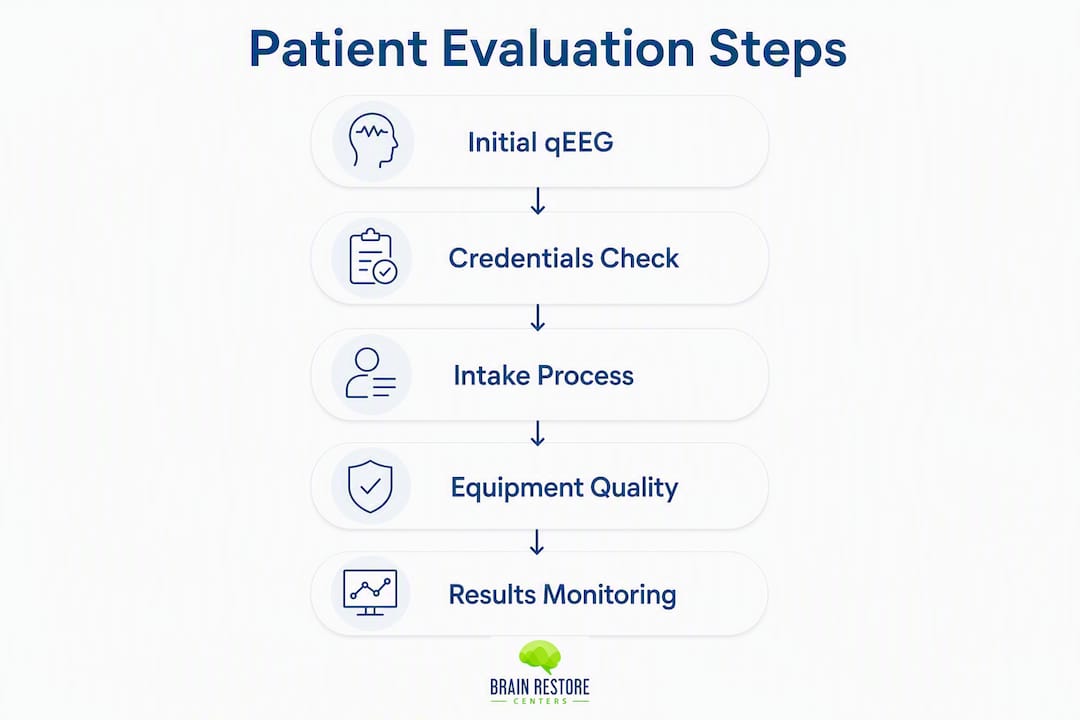
Good clinics set measurable goals at intake, use symptom questionnaires and repeat qEEG assessments, and document outcomes. Measurement is not a bonus feature; it is how a clinician knows whether training is working.
A standard measurement schedule at a quality clinic looks like this:
Many patients begin noticing subjective changes, such as improved sleep, steadier attention, or reduced anxiety, within the first 10–20 sessions. Full treatment courses typically range from 20–40 sessions, with many clinicians describing 30 sessions as a common target depending on the presenting condition and severity.
Outcome reporting at a reputable clinic includes de-identified pre/post metrics or aggregate case summaries that you can review before committing. Ask directly: “Do you have outcome data or case studies you can share?” A clinic that tracks results will have something to show you. One that does not track results cannot tell you whether its training works.
When you consult with a clinic, request:
Safety and cost transparency are core quality signals. A clinic that documents consent, discloses risks, and states realistic timelines before you pay anything is operating ethically. One that pressures you to commit financially before completing an assessment is not.
ISNR practice guidelines require that providers accurately represent what neurofeedback training can achieve, obtain informed consent, document session notes, and use safe, accurate equipment. In the U.S., because state-level regulation of neurofeedback varies, the presence of a licensed clinician in a supervisory or direct-care role is one of the strongest accountability safeguards available to you as a patient.
| Item | Typical Range | What It Covers |
|---|---|---|
| Initial qEEG assessment | — | Brain mapping, report, protocol rationale |
| Per-session neurofeedback | — | Training session |
| Full treatment course | 20–40 sessions | Varies by condition and severity |
| Session frequency | 2x per week (recommended) | Faster learning curve than once weekly |
On insurance: Medicare does not cover neurofeedback. Some private insurers reimburse under biofeedback CPT codes when the service is prescribed for a specific diagnosis and properly documented. Ask the clinic whether they provide superbills and whether a physician prescription is required for your insurer. Never assume coverage without confirming directly with your plan.
Key safety points to confirm before starting:
Use these questions as a script on your initial phone or video consult. A quality clinic will answer every one of them directly.
Clear red flags that should stop you from proceeding:
Verification is straightforward once you know where to look. Use the BCIA and ISNR directories, request sample qEEG reports, and ask for de-identified outcome data before you book anything beyond an initial evaluation.
Step-by-step verification:
Starting with an independent baseline qEEG before committing to a full session package is the single most protective step you can take. The qEEG is valuable on its own, and it gives you objective data to bring to any follow-up consultation, whether at the same clinic or elsewhere.
For brain function testing in the Meridian area, Brainrestoremeridian offers an initial evaluation that includes intake, qEEG mapping, and a written protocol review before any training commitment is required.
Brainrestoremeridian follows the checklist above across every stage of care: qEEG-based assessments, licensed clinician oversight, clinical-grade equipment, measurable outcome tracking, and an integrated multidisciplinary model.
Here is how the clinic maps to each trust signal:
To request a sample qEEG report or review the clinic’s outcome documentation, contact Brainrestoremeridian directly before scheduling your evaluation.
A quality neurofeedback clinic is defined by five verifiable criteria: a clinical qEEG before training, BCN or QEEG-D credentials, a licensed clinician in a supervisory role, clinical-grade 19-channel EEG hardware, and documented outcome tracking at regular checkpoints.
| Point | Details |
|---|---|
| qEEG is non-negotiable | Any clinic that skips brain mapping before training is designing protocols without a clinical foundation. |
| Credentials are verifiable | BCN status is searchable at bcia.org; QEEG-D status is searchable through the QEEG Certification Board. |
| Channel count matters | A 19-channel clinical EEG system provides the spatial resolution needed for full qEEG mapping; 2–4 channel consumer devices do not. |
| Costs and timelines | Sessions typically run — each; a full course ranges 20–40 sessions; Medicare does not cover neurofeedback. |
| Brainrestoremeridian | Offers qEEG-based assessments, licensed oversight, and integrated care in Meridian, Idaho, with no commitment required before your evaluation. |
Most people searching for a neurofeedback clinic focus on proximity and price. Those are reasonable starting points, but they are the wrong filters to lead with. The real question is whether the clinic can tell you, in specific terms, what is happening in your brain before they start training it.
The field has a credibility problem that honest clinics acknowledge openly. Because neurofeedback regulation varies so much by state, a provider can legally offer sessions with minimal training, a consumer-grade device, and no qEEG. Some do. The gap between that and a BCN-certified clinician using a 19-channel system with age-matched normative data is not a minor technical distinction. It is the difference between a personalized clinical intervention and a wellness product dressed up in clinical language.
What concerns me most is the pressure-to-commit pattern. Asking a patient to purchase a large session package before completing a baseline qEEG removes the one objective check that protects both the patient and the clinician. Without a baseline, there is no way to measure whether training is working, and no ethical basis for recommending a specific number of sessions. The qEEG is not just a marketing tool. It is the clinical foundation of the whole process.
Patients who come in asking the right questions, about channel counts, normative databases, and outcome data, tend to get better care. Not because the questions are magic, but because they signal to the clinic that you expect accountability. And accountability, in any healthcare setting, tends to produce better outcomes.
If you are ready to move from research to action, Brainrestoremeridian’s initial evaluation is the right first step. The evaluation includes a clinical intake, a full qEEG brain mapping session, a written report with protocol rationale, and a review of recommended next steps. You leave with objective data about your brain, regardless of whether you continue with training at the clinic.
The evaluation does not obligate you to purchase a full training package. Brainrestoremeridian’s approach is to give you the information you need to make a confident, informed decision. For patients dealing with anxiety, cognitive concerns, TBI recovery, or chronic pain, the qEEG assessment is where clarity begins. Contact Brainrestoremeridian in Meridian, Idaho, to schedule your evaluation and ask for a sample qEEG report before your appointment.
These resources let you independently confirm what any neurofeedback clinic claims.
| Resource | What It Verifies | Why It Matters |
|---|---|---|
| BCIA Directory (bcia.org) | BCN certification status and expiration | Confirms a provider’s neurofeedback credential is current and legitimate |
| ISNR Guidelines for Practice | Ethical and clinical practice standards | The professional standard for responsible neurofeedback administration in the U.S. |
| QEEG Certification Board | QEEG-D diplomate status | Verifies a clinician’s competency in reading and applying quantitative EEG data |
| PubMed / NCBI | Peer-reviewed neurofeedback research | Lets you evaluate the evidence base behind specific clinical claims |
| Brainrestoremeridian qEEG page | Clinic-side qEEG service details | Shows what a professional qEEG report and evaluation process should include |
| Brainrestoremeridian integrated care overview | Multidisciplinary service model | Reference for evaluating clinics that combine neurofeedback with other therapies |
This article provides general educational information about evaluating neurofeedback clinics and is not a substitute for professional medical or clinical advice. Confirm current credentials, costs, and treatment suitability with a qualified clinician before beginning any program.
Questions about your next step?
Our Meridian team can help you understand the evaluation process and which care options may fit your needs.
Schedule a Brain Health ConsultationPrefer to speak with our team? Call 208-639-1397