Brain Fog After Anesthesia: How Long It Lasts and What Helps
November 17, 2026


Feeling foggy, forgetful, or slow to think after anesthesia is common, and for most people it clears within hours to days. For some, memory and focus problems last weeks or months, and that is the point where a closer look at your brain health makes sense. If your thinking has not returned to normal, our Brain Health Consultation in Meridian is a place to start. Below you will find the realistic timeline, what is actually behind the fog, which signs need a call to your surgeon right away, and how to support your recovery.
Brain fog is not a medical diagnosis. It is the word many people use for trouble concentrating, slower thinking, word-finding problems, and forgetfulness. The American Society of Anesthesiologists notes that some patients describe reversible cognitive complaints as brain fog, and it recommends sorting cognitive changes after surgery by timing, duration, and severity:
This matters because the label tells you how urgent things are and what to expect. If you came here searching for memory problems after anesthesia, the first question is simply when it started and how it behaves through the day.
The two are easy to confuse, and they should not be. Delirium is an acute disturbance of attention, awareness, and consciousness that usually fluctuates over the day, with disorientation, hallucinations, or disorganized behavior. A person with the milder, longer-lasting kind of cognitive change may stay fully oriented but have trouble with memory, attention, planning, or processing speed.
A 2024 review cautions that postoperative cognitive dysfunction and delirium are sometimes mistakenly conflated, even though delirium typically arises within roughly one to three days of surgery. The Anesthesia Patient Safety Foundation describes the other pattern as more gradual trouble with memory, focus, or clear thinking that often improves over weeks or months.
A simple way to tell them apart:
| Brain fog | Delirium | |
|---|---|---|
| Typical onset | Noticed as you wake up or in the days after | Sudden, often within 1 to 3 days |
| Pattern | Steady, mild to moderate | Comes and goes, worse at times of day |
| Awareness | You know where you are | May be disoriented, may see or hear things |
| Who notices | Usually you | Often family or nurses first |
| Action | Track it, rest, support recovery | Report to the care team immediately |
The honest answer is that it depends on the person, the surgery, and the type of change.
The same statement emphasizes that most patients have no apparent cognitive problem after surgery. Changes can last from days to years in a smaller group, which is why persistence deserves attention rather than worry. If you are at week three and still feeling foggy, that sits inside the range clinicians describe. If you are at month three and not improving, it is time to have it looked at.
It is tempting to blame the anesthetic alone. The research is more nuanced and, in a way, more encouraging, because many contributors can be supported.
A 2022 review found that surgery, inflammation, pain, opioids and other medicines, sleep disruption, dehydration, infection, and blood pressure or oxygen changes commonly occur together, which makes it hard to separate their individual effects. The same review reports that healthy adults who received about two hours of general anesthesia without surgery showed no link between age and time to cognitive recovery within 30 days. That points to surgical stress and inflammation as major contributors.
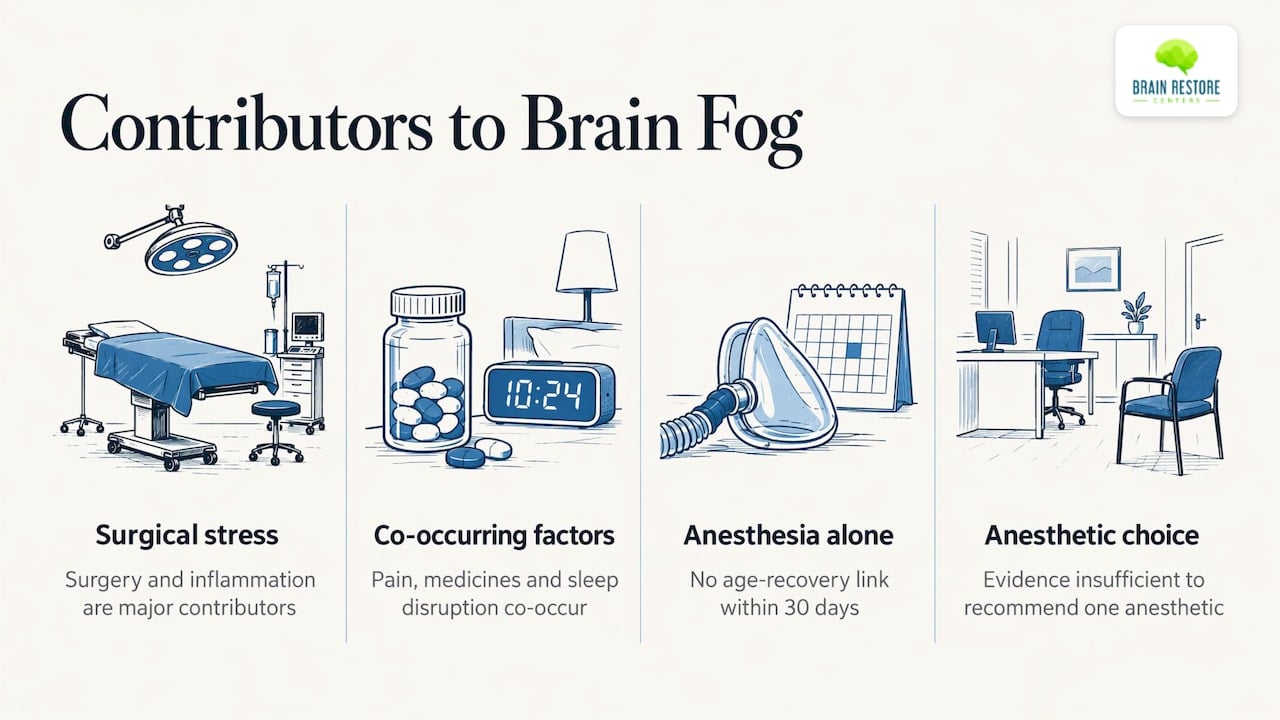
The Anesthesia Patient Safety Foundation lists several possible contributors to postoperative confusion: leftover anesthetic and other drugs, brain inflammation, electrolyte or hormonal imbalance, dehydration, low oxygen, infection, sleep deprivation, unfamiliar surroundings, and pain. Expert recommendations also note that the current literature is insufficient to recommend one particular anesthetic for lowering risk in older adults. In practice, that means the conversation to have before surgery is about your whole situation, not just the drug.
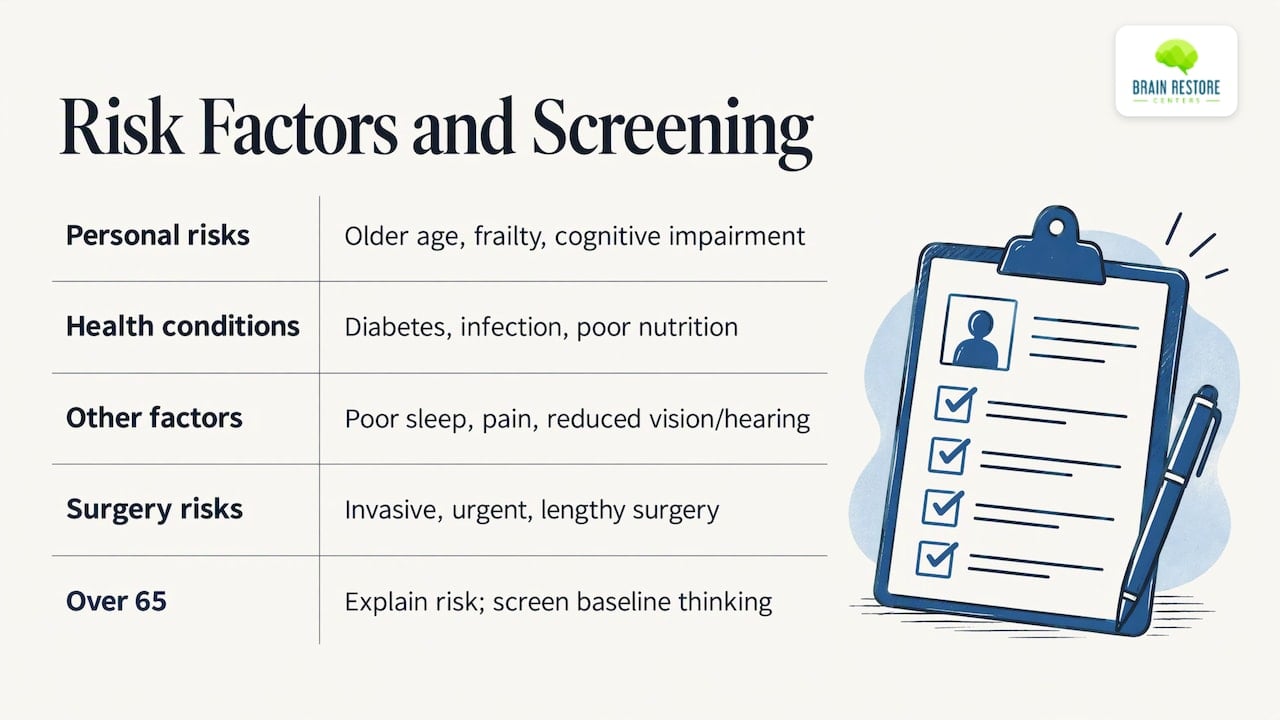
Anyone can feel foggy for a day or two. Lasting changes are more likely with certain factors. A 2022 patient-focused review lists older age, existing cognitive impairment, frailty, other health conditions, poor sleep, pain, reduced vision or hearing, diabetes, infection, neuropsychiatric conditions, and poor nutrition. Aging can reduce the brain’s reserve and its resilience to stress.
Procedure-related factors matter too. Researchers point to invasive, urgent, or lengthy surgery and intensive-care admission afterward, and reviews also associate low oxygen, low blood pressure, blood loss, and prolonged surgery with a higher risk.
American Society of Anesthesiologists-sponsored recommendations say everyone over 65 should be told about the risk of postoperative confusion, inattention, and memory problems, and that baseline thinking should be screened before surgery in anyone over 65 or with risk factors. If you have a procedure coming up, that is a fair request to make of your surgical team. Having a baseline also makes it far easier to tell later whether something has changed.
This is the one place where you should not wait and see. Delirium is a medical issue that needs prompt attention from the team that did your surgery.
A delirium patient guide says to report immediately any new confusion, inattention, disorganized or slurred speech, hallucinations, agitation, unusual withdrawal or sleepiness, personality change, or rapid changes in energy or behavior. If you or a loved one is at home after surgery and develops new or worsening confusion, hallucinations, inability to stay awake, severe agitation, or disorientation, do not wait for the next scheduled appointment. Call the surgeon or your primary care clinician promptly, and use emergency services if the person cannot be woken or seems unsafe.
The Anesthesia Patient Safety Foundation also advises contacting a healthcare provider about severe or persistent confusion that does not improve.
Family members are often the first to notice. If someone you love seems “not themselves” after surgery, say so plainly to the nurse or surgeon.
The research does not support one magic fix. A 2022 review recommends a bundle of steps built around modifiable risk factors rather than any single intervention. That is good news, because most of the bundle is within your reach.
Some people also look into hydration-focused options while they recover, such as IV therapy for brain fog. Talk with your surgeon first about anything new you add after an operation.
The research is reassuring for most people and honest about the exceptions. A 2022 review cites evidence that cognitive decline persisted for more than seven years in some patients after coronary artery bypass surgery, while also reporting that anesthesia without surgery did not produce measurable impairment in a healthy adult group. The takeaway is not to fear anesthesia. It is to take persistent changes seriously and to look at the whole picture, including sleep, mood, nutrition, and other health conditions.
If several weeks have passed and you still lose words, forget conversations, struggle to focus, or tire quickly when thinking, you deserve a clear picture rather than a shrug. A useful evaluation looks at how your brain is working now, compares that with what is normal for you, and looks at the factors that slow recovery: sleep, inflammation, nutrition, mood, and stress.
Here is what we recommend you bring to any brain health visit:
Progress is easier to trust when it is measured. Our page on measuring progress explains how we track change over time, and our guide to brain fog after COVID shows the same kind of thinking applied to another common trigger for lingering fog.
Our Brain Restore Program is built for people whose memory, focus, or mental clarity has not bounced back. It begins with a Brain Health Consultation, where we listen to your story, including your surgery and recovery, and work out a personalized plan. Depending on what your evaluation shows, our care can include neurofeedback, low level laser therapy, hyperbaric oxygen therapy, and progressive focused rehab, delivered in person at our clinic by a multidisciplinary team with more than 50 years of combined clinical experience.
If you want to understand the tools, see how hyperbaric oxygen works and how many neurofeedback sessions people typically need. When you are ready, book a Brain Health Consultation and bring your symptom log.
If your symptoms are sudden, severe, or getting worse, contact your surgeon or urgent care first. Our work begins once acute problems are ruled out and you are ready to restore clarity.
Most people who come to us after surgery are not looking for a diagnosis. They are looking for themselves again. They want to follow a conversation, finish a thought, and trust their memory.
We start from the same place the research does: fog after surgery is rarely about one cause. Sleep, inflammation, pain, medicine, stress, and nutrition all play a part. That is why we do not treat a single symptom in isolation. Our approach is multidisciplinary, combining brain-based therapies such as neurofeedback and photobiomodulation with functional medicine and rehab, so the whole picture is addressed.
We also believe in measuring what matters. When you can see your progress, you stop guessing and start building confidence. Our team brings more than 50 years of combined clinical experience and over 400 five-star reviews to every plan we create, and we design each one around your goals.
If you have been told to just wait it out and your brain still does not feel right, you are not imagining it, and you do not have to carry it alone. Calm, steady, personalized care can help you reclaim your clarity.
Chad
Yes, mild fogginess is common and usually fades within hours to a couple of days. The Anesthesia Patient Safety Foundation notes that temporary confusion or memory trouble usually lasts hours to days. Let your surgeon know if it is severe or is not improving.
Some people do have memory and focus problems that last weeks or months, and a smaller group has changes lasting longer. The evidence suggests that surgery, inflammation, pain, medicines, and sleep loss contribute along with anesthesia. If your memory has not recovered after a month or two, ask for an evaluation.
Delirium comes on suddenly, often within a few days of surgery, and fluctuates through the day with disorientation, hallucinations, or agitation. Brain fog is steadier, and you generally stay oriented. Treat any sudden or worsening confusion as urgent and call the surgeon or seek urgent care.
Sleep on a regular schedule, drink fluids, eat regular meals, wear your glasses and hearing aids, walk when your surgeon allows, and spend time with familiar people. Do one task at a time and keep a symptom log. These steps address the modifiable factors that research links to recovery.
If fog has lasted more than several weeks, interferes with work or daily life, or is getting worse, schedule an evaluation. We offer a Brain Health Consultation in Meridian where we review your history and build a personalized plan.
Questions about your next step?
Our Meridian team can help you understand the evaluation process and which care options may fit your needs.
Schedule a Brain Health ConsultationPrefer to speak with our team? Call 208-639-1397