
9 Types of Anxiety Disorders Explained, Symptom by Symptom
August 20, 2026


The main types of anxiety disorders are generalized anxiety disorder (GAD), panic disorder, social anxiety disorder, specific phobias, agoraphobia, separation anxiety disorder, selective mutism, substance/medication-induced anxiety disorder, and other specified/unspecified anxiety disorder. Each one shows up differently, but they share a common thread: worry or fear that outlasts the situation causing it and starts crowding out daily life.
You can get a rough self-read using a short screening tool like the GAD-7, but a screening score is not a diagnosis. Reach out to a clinician if worry, panic, or avoidance has lasted weeks and is disrupting sleep, work, or relationships. If you’re having thoughts of suicide, chest pain, or a sudden severe decline in functioning, treat that as an emergency and call 911 or go to your nearest emergency room right now.
Effective anxiety disorder care depends on matching the correct diagnosis to evidence-based treatment, since each of the nine recognized types responds best to a specific combination of therapy and medication.
| Point | Details |
|---|---|
| Nine recognized categories | GAD, panic disorder, social anxiety, specific phobias, agoraphobia, separation anxiety, selective mutism, substance-induced, and unspecified anxiety disorder each have distinct criteria. |
| Duration cues matter | DSM-style time thresholds, like six months for GAD, help distinguish a disorder from normal stress. |
| CBT plus medication leads treatment | Cognitive behavioral therapy, often with exposure, paired with SSRIs or SNRIs, is first-line for most types. |
| Only 1 in 4 get treated | WHO data shows most people with an anxiety disorder never receive care, despite effective options existing. |
| Next step is simple | Try a brief self-screen like the GAD-7, then schedule an evaluation if symptoms have lasted weeks and disrupt daily life. |
An anxiety disorder is a persistent, excessive pattern of fear or worry that interferes with daily life, not a personality trait or a phase you’ll grow out of on your own. It’s a medical condition with real biological and genetic contributors, and Cleveland Clinic notes the key marker isn’t the worry itself but whether you can control it and whether it’s disrupting your ability to function.
Anxiety disorders affect roughly 359 million people worldwide, making them among the most common mental health conditions on the planet. Yet only about one in four people with an anxiety disorder ever receive treatment, often because they assume the symptoms are temporary.
Clinically, fear and anxiety aren’t the same thing. The American Psychiatric Association draws a clean line: fear is your brain’s response to a threat happening right now, while anxiety is the anticipation of a threat that hasn’t arrived yet. That distinction explains why anxiety disorders so often involve avoidance. You’re not just reacting to danger. You’re organizing your life around danger that might show up.
The National Institute of Mental Health recognizes a specific set of anxiety disorders, and understanding each one helps you recognize your own patterns instead of lumping everything under one vague label.
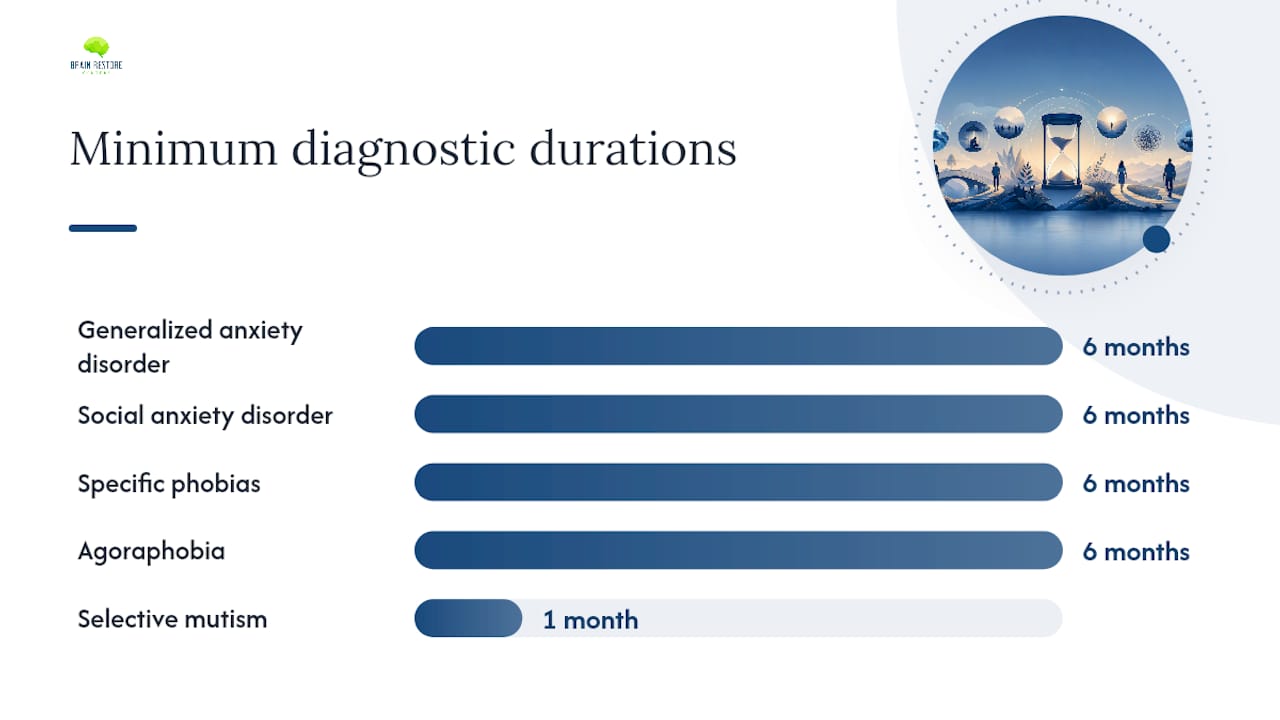
Generalized anxiety disorder (GAD) involves excessive, hard-to-control worry about work, health, finances, or relationships that persists for at least six months. It tends to develop gradually, often in the mid-20s to early 30s, though it can start in childhood. First-line treatment usually combines cognitive behavioral therapy (CBT) with an SSRI or SNRI.

Panic disorder brings sudden, intense episodes of fear that peak within minutes, often with a racing heart, chest tightness, or shortness of breath severe enough to feel like a heart attack. A diagnosis typically requires recurring attacks plus at least a month of worrying about future attacks. CBT with interoceptive exposure (deliberately triggering mild physical sensations to reduce fear of them) is the go-to therapy, sometimes paired with an SSRI.

Social anxiety disorder centers on intense fear of being judged, embarrassed, or scrutinized in social or performance situations, lasting six months or more. Onset commonly occurs in early-to-mid adolescence. Exposure-based CBT works well, and beta-blockers are sometimes used short-term for specific performance triggers like public speaking.
Specific phobias involve marked fear of a particular object or situation, such as heights, needles, or flying, disproportionate to the actual danger and lasting six months or longer. These often start in childhood. Exposure therapy alone, without medication, is typically the most effective approach.
Agoraphobia is fear of two or more situations where escape might be difficult, like crowds, public transit, or being outside alone, persisting for six months. It frequently co-occurs with panic disorder. Gradual exposure therapy combined with an SSRI is standard care.
Separation anxiety disorder isn’t just a childhood issue. It involves developmentally inappropriate, excessive fear about separation from attachment figures, lasting at least four weeks in children and six months in adults. Family-based CBT is the primary treatment.
Selective mutism shows up as a consistent failure to speak in specific social settings, like school, despite speaking normally elsewhere, lasting at least one month. It’s diagnosed almost exclusively in children. Behavioral therapy with gradual exposure to speaking situations is the standard approach.
Substance/medication-induced anxiety disorder develops during or shortly after substance use, intoxication, or withdrawal, or as a medication side effect. Treatment focuses on addressing the underlying substance or medication issue first.
Anxiety due to another medical condition occurs when a physical illness, like thyroid dysfunction or a cardiac condition, directly causes anxiety symptoms. Treating the medical condition often resolves the anxiety.
Other specified/unspecified anxiety disorder covers significant, impairing anxiety symptoms that don’t meet the full criteria for any single category above.
Treatment at a glance, across most categories:
Anxiety disorders vary in their triggers, but the symptoms cluster into three recognizable domains.
Several risk factors raise your odds of developing one of these conditions. Genetics and family history play a real role, as does temperament, particularly a trait researchers call behavioral inhibition, where a child is unusually cautious or withdrawn in new situations. Stressful or traumatic life events, chronic illness, and certain medications or substances can also trigger or worsen symptoms.
Depression and substance use disorders commonly ride alongside anxiety disorders, and that overlap matters for treatment planning. Missing a co-occurring depression, for instance, can leave a patient partially treated even after their anxiety symptoms improve, which is part of why a thorough evaluation covers more than just the presenting complaint.
There’s no blood test for an anxiety disorder, so diagnosis relies on structured screening plus a clinical interview. Validated tools like the GAD-7 for generalized anxiety, PHQ screens for co-occurring depression, and disorder-specific panic or social anxiety screens give clinicians a quick, standardized read on symptom severity.
The clinical interview does the heavier lifting. A clinician will ask about the duration of your symptoms, since DSM-5 criteria hinge on time thresholds, six months for GAD, for example, and will explore how much the anxiety interferes with daily functioning. Because physical symptoms like a racing heart or shortness of breath can mimic medical emergencies, a physical exam and basic labs are often used to rule out conditions like thyroid dysfunction or cardiac issues before confirming a primary anxiety diagnosis.
Differential diagnosis matters here. Clinicians distinguish anxiety disorders from depression, bipolar disorder, and PTSD, since DSM-5-TR actually classifies trauma-related conditions like PTSD separately from anxiety disorders, which changes the treatment pathway. If you experience suicidal thoughts, chest pain, or a sudden, severe decline in your ability to function, that calls for emergency care, not a scheduled appointment.
Evidence-based treatment for anxiety disorders almost always combines therapy, medication, or both, tailored to which disorder you’re dealing with.
Psychotherapy options include:
Medication classes commonly prescribed:
In the first six to twelve weeks, expect symptom tracking, dose adjustments if you’re on medication, and steady progress through exposure or cognitive work in therapy. Meaningful improvement in avoidance behaviors often takes several months, with follow-up visits every few weeks initially, then spacing out as symptoms stabilize.
Before your first appointment, write down when symptoms started, how they affect your daily routine, and any physical symptoms you’ve noticed. Ask your provider about your specific diagnosis, the reasoning behind a recommended therapy or medication, expected side effects, and how long before you should see improvement. Preparing clear questions ahead of time makes that first conversation far more productive.
Pro Tip: Keep a simple daily log of your anxiety triggers and physical symptoms for two weeks before your appointment. It gives your clinician real data instead of a vague memory of “it’s been bad lately,” and it often speeds up an accurate diagnosis.
Beyond therapy and medication, some patients explore adjunct approaches like neurofeedback, transcranial stimulation, and supplements. The evidence here is still developing. Clinical trials continue to investigate these interventions, and results range from promising to mixed depending on the modality and the person.
Neurofeedback trains self-regulation of brain wave patterns and shows encouraging signals for anxiety symptoms in some patients, though it works best as part of a broader care plan rather than a standalone fix. Supplements like magnesium or L-theanine come up often in patient conversations, but the evidence backing them for clinical anxiety disorders remains limited.
Any adjunct approach should happen under clinical oversight, both to watch for side effects and to make sure it’s layered onto, not replacing, evidence-based psychotherapy or medication when those are indicated.
Most people who receive treatment see meaningful improvement, and starting early tends to produce better long-term outcomes than waiting years to seek help. Predictors of a smoother recovery include early intervention and sticking with therapy or medication as prescribed; delayed treatment and co-occurring substance use tend to predict a rockier course.
Anxiety disorders can recur, even after successful treatment, which is why relapse-prevention planning, not just symptom relief, belongs in a complete care plan.
A basic coping routine goes a long way toward keeping symptoms manageable between clinical visits.
If anxiety affects your work or schooling, you can typically request reasonable accommodations, like flexible deadlines or a quieter workspace, by communicating specific, documented needs to HR or a school counselor rather than a general “I’m struggling” message.
Anxiety disorders are treatable, and no one should feel resigned to living with them indefinitely. At Brainrestoremeridian, our approach blends evidence-based psychotherapy referrals with integrative, multidisciplinary care built around your specific diagnosis, not a one-size-fits-all protocol.
What are the main types of anxiety disorders?
The main categories are generalized anxiety disorder, panic disorder, social anxiety disorder, specific phobias, agoraphobia, separation anxiety disorder, selective mutism, and substance/medication-induced anxiety disorder, along with a catch-all “other specified” category.
How long do symptoms need to last for a diagnosis?
Most anxiety disorders require symptoms to persist for six months, though separation anxiety disorder in children requires only four weeks. A brief period of stress after a hard week doesn’t meet that bar.
Can anxiety disorders be cured completely?
Many people achieve full symptom remission with treatment, though anxiety disorders can recur, which is why ongoing relapse-prevention strategies matter even after you feel better.
What’s the difference between anxiety and a panic attack?
Anxiety builds gradually around anticipated threats, while a panic attack is a sudden, intense episode that peaks within minutes and often includes physical symptoms like chest pain.
When should I seek emergency care instead of scheduling an appointment?
Seek emergency care immediately for suicidal thoughts, chest pain, or a sudden severe decline in your ability to function. These are red flags that shouldn’t wait for a routine visit.
This article is general information, not a substitute for advice from a qualified doctor. Consult a qualified healthcare professional about your own circumstances before acting on anything here.
Questions about your next step?
Our Meridian team can help you understand the evaluation process and which care options may fit your needs.
Schedule a ConsultationPrefer to speak with our team? Call 208-639-1397