
Feeling Mentally Exhausted? Causes, Signs, and Recovery
July 19, 2026


Feeling mentally exhausted is defined as a psychobiological state in which the brain’s cognitive resources are depleted, causing slowed thinking, reduced focus, and diminished motivation. This condition differs from ordinary tiredness. It is measurable through objective markers like reaction time and attention performance, and it worsens with prolonged mental effort. Research confirms that cognitive depletion significantly impairs both mental and physical performance. If you have been struggling to concentrate, feeling irritable without clear reason, or finding that sleep no longer restores you, this guide explains why that happens and what you can do about it.
Mental exhaustion produces both subjective and objective signs. Recognizing them early gives you a real advantage in recovery.
Subjective symptoms are the ones you feel directly:
Objective markers are measurable changes in cognitive performance. The Psychomotor Vigilance Task (PVT) is a clinically validated test that tracks attention lapses. A reaction time above 500 ms on PVT testing signals significant cognitive depletion. That threshold matters because it separates normal fatigue from a state where your brain is genuinely struggling to process information reliably.
Mental fatigue is also distinct from general sleepiness. Specific cognitive impairments such as reduced attention span, impaired decision-making, and higher error rates define mental exhaustion. Sleepiness, by contrast, is primarily a drive to sleep, not a collapse in cognitive accuracy. Research also shows that EEG brain wave changes appear before you even feel tired, meaning the brain signals depletion before your conscious awareness catches up.
Pro Tip: Track your focus quality at three points during the day: morning, early afternoon, and late afternoon. Note where your errors spike or your decisions feel harder. That pattern reveals your personal cognitive depletion curve, which you can then work around.
Mental exhaustion builds when the brain processes more information than it can efficiently recover from. The causes are often less obvious than people expect.

| Cause | Effect on cognitive health |
|---|---|
| Prolonged single-task concentration | Depletes prefrontal cortex resources, slowing decision speed |
| Multitasking and constant task-switching | Increases cognitive load, raising error rates and mental fatigue |
| Unresolved worries and rumination | Keeps the brain in a low-level alert state, blocking recovery |
| Emotional labor (managing others’ emotions) | Drains cognitive and emotional reserves simultaneously |
| Chronic stress and allostatic load | Disrupts hormonal balance, impairing memory and attention |
| Poor sleep quality | Prevents overnight cognitive restoration, compounding depletion |
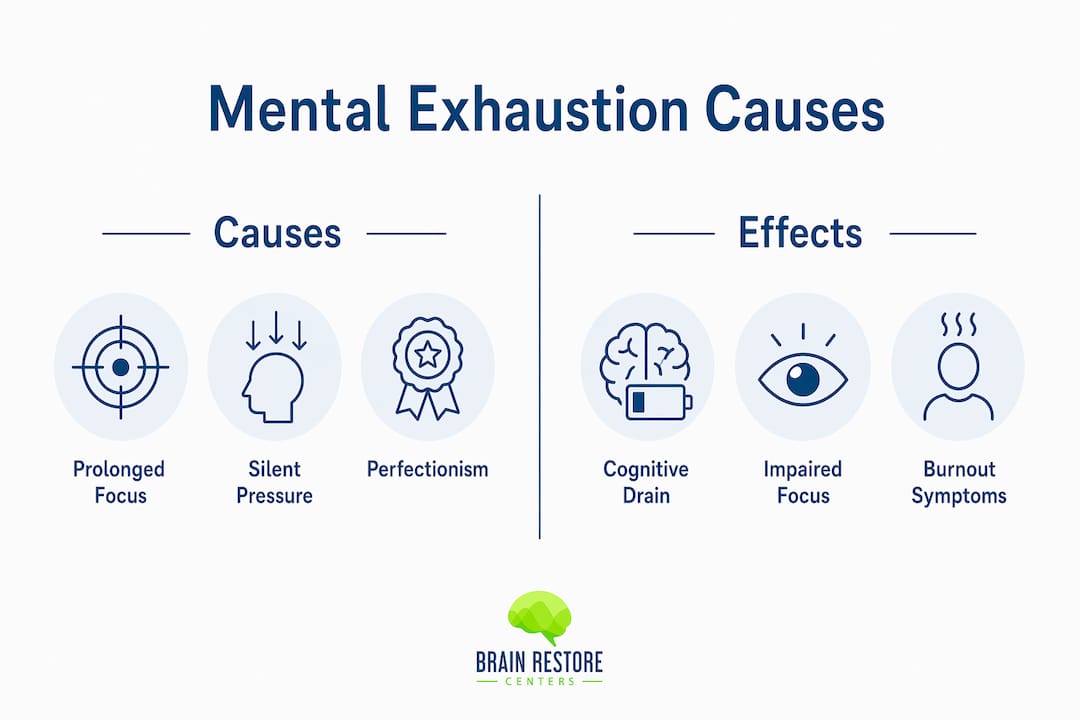
Cognitive load refers to the total mental effort your working memory carries at any moment. When that load stays high for extended periods, the brain cannot clear its processing queue. Allostatic load is the cumulative wear on the body and brain from chronic stress. Both concepts explain why mental exhaustion often feels like it arrived out of nowhere: it accumulates silently over weeks or months.
The most underappreciated cause is what researchers call silent pressure. Burnout develops from chronic cognitive overload driven by unresolved worries and constant vigilance, not from laziness or weakness. That distinction is clinically significant. It means that traditional rest alone, such as weekends off or eight hours of sleep, often fails to restore cognitive resources when the mind remains engaged with stressors.
Perfectionism and identity pressure add another hidden layer. Maintaining a fixed identity, such as always being the productive one or the person who never says no, silently drains cognitive resources around the clock. Recovery requires addressing these psychological patterns, not just adjusting sleep schedules.
Recovering from cognitive fatigue requires more than passive downtime. The brain needs structured, deliberate recovery to restore its resources.
Clinical guidance recommends 25–40 minute focused work intervals followed by 20–30 minute screen-free breaks. That structure gives the prefrontal cortex time to clear its processing load before the next demand cycle begins. Breaks must be genuinely screen-free. Scrolling social media or watching video content keeps the brain processing new information, which is the opposite of recovery.
True cognitive recovery requires the brain to disengage from constant input and processing. Activities that qualify include slow walking in nature, quiet sitting, light stretching, or listening to familiar, low-stimulation music. Activities that do not qualify include news consumption, social media, email, or any screen-based entertainment that demands attention tracking.
Moderate aerobic exercise, such as a 20-minute brisk walk, improves blood flow to the prefrontal cortex and reduces the subjective experience of mental fatigue. Quality sleep, not just duration, determines overnight cognitive restoration. Poor sleep architecture, even with eight hours in bed, leaves cognitive depletion unresolved. Addressing sleep quality is a non-negotiable part of overcoming cognitive fatigue. You can learn more about why cognitive rest matters for brain recovery in general.
Journaling, talking with a trusted person, or working with a therapist reduces the cognitive cost of suppressed emotion. Unprocessed emotional content occupies working memory continuously. Releasing it frees up cognitive capacity that was silently being consumed.
| Recovery technique | Recommended duration | Primary benefit |
|---|---|---|
| Single-task focus intervals | 25–40 minutes | Reduces cognitive overload |
| Screen-free breaks | 20–30 minutes | Allows prefrontal cortex recovery |
| Moderate aerobic exercise | 20–30 minutes daily | Improves cerebral blood flow |
| Quality sleep | 7–9 hours with good sleep hygiene | Restores overnight cognitive function |
| Emotional journaling or therapy | 15–20 minutes daily | Clears suppressed cognitive load |
Pro Tip: Practice cognitive budgeting by treating your mental energy as a finite daily resource. Schedule your most demanding cognitive tasks in the morning when reserves are highest, and protect at least one 30-minute block each afternoon for genuine, screen-free recovery.
Recovery strategies work well for most people experiencing ordinary cognitive fatigue. Certain symptoms, however, signal that something more serious may be happening and require prompt professional evaluation.
Seek urgent care if you experience any of the following alongside mental exhaustion:
These red-flag symptoms indicate that the problem may extend beyond cognitive fatigue into a medical or neurological condition requiring diagnosis. Mental exhaustion alone does not cause focal neurological symptoms. When those appear, they point to conditions that need clinical investigation.
Even without red-flag symptoms, professional support is appropriate when self-directed recovery strategies have not produced improvement after several weeks. A clinician can assess whether underlying conditions such as thyroid dysfunction, anemia, depression, or anxiety are driving the fatigue. Functional medicine approaches offer a thorough framework for identifying these root causes. Persistent mental exhaustion that does not respond to lifestyle changes often has a physiological component that standard advice cannot address alone.
If you are unsure how to describe what you are experiencing to a provider, guidance on communicating mental health needs can help you prepare for that conversation effectively.
Mental exhaustion is a measurable psychobiological state that requires structured cognitive recovery, genuine rest, and, when persistent, professional evaluation to resolve.
| Point | Details |
|---|---|
| Mental exhaustion is measurable | Reaction times above 500 ms on PVT testing confirm cognitive depletion beyond ordinary tiredness. |
| Silent pressures drive burnout | Unresolved worries and emotional labor deplete cognitive resources even when physical rest seems adequate. |
| Genuine rest requires disengagement | Screen-free breaks and low-stimulation activities restore the brain; passive screen time does not. |
| Cognitive budgeting prevents depletion | Scheduling demanding tasks when mental energy is highest protects cognitive reserves throughout the day. |
| Red-flag symptoms need urgent care | Sudden confusion, focal weakness, or severe atypical headache alongside fatigue requires prompt medical evaluation. |
The pattern I see most often is this: someone arrives having done everything “right.” They sleep eight hours. They exercise. They take weekends off. And they are still depleted. What they have not addressed is the cognitive cost of who they are being all day long.
Perfectionism is one of the quietest energy drains I know. When your identity depends on being productive, helpful, or unshakeable, your brain never fully powers down. It keeps running background processes, monitoring for threats to that identity, rehearsing responses, and managing impressions. That is exhausting work, and it happens below conscious awareness.
The other misconception I encounter constantly is that rest means doing less. Real cognitive recovery means doing something genuinely different, something that asks nothing of your attention or your identity. For many people, that is harder than working. Sitting quietly without a phone feels uncomfortable. That discomfort is actually useful information. It tells you how dependent your nervous system has become on constant stimulation.
The patients who recover fastest are not the ones who sleep more or take more vacations. They are the ones who get honest about what is actually consuming their mental energy and make deliberate changes to those patterns. That often means saying no more, letting go of perfectionism, and accepting that rest is not a reward for productivity. It is a biological requirement.
— Chad

When self-directed strategies are not enough, Brainrestoremeridian offers clinically grounded options for restoring cognitive clarity. The clinic’s neurofeedback for anxiety relief program uses real-time brainwave monitoring to help retrain the brain’s activity patterns, reducing the mental noise that keeps cognitive depletion locked in place. Neurofeedback is not a passive treatment. It gives your brain direct feedback about its own function, which accelerates the kind of self-regulation that mental exhaustion disrupts. Brainrestoremeridian’s team in Meridian, Idaho, builds personalized programs based on each patient’s specific cognitive profile, so the approach fits your actual needs rather than a generic protocol.
Mental exhaustion is a psychobiological state caused by prolonged cognitive effort, characterized by slowed reaction times, reduced attention, and impaired decision-making. It differs from sleepiness and is measurable through objective cognitive performance tests like the Psychomotor Vigilance Task.
Recovery time varies depending on how long depletion has accumulated and whether underlying stressors are addressed. Mild cases may improve within days of structured rest; chronic cases tied to burnout or psychological stressors can take weeks to months of consistent recovery practice.
Sleep restores cognitive function only when the mind genuinely disengages from stressors during rest. When unresolved worries, emotional labor, or chronic stress remain active, sleep quality suffers and overnight restoration is incomplete, leaving depletion unresolved.
Seek urgent evaluation if mental exhaustion is accompanied by sudden confusion, severe or unusual headache, chest pain, fainting, or localized weakness or numbness. These symptoms indicate a possible medical or neurological condition beyond ordinary cognitive fatigue.
Neurofeedback trains the brain to regulate its own activity patterns, which can reduce the mental overactivation that sustains cognitive fatigue. Clinics like Brainrestoremeridian use personalized neurofeedback protocols to support cognitive recovery in patients who have not responded to lifestyle changes alone.
Questions about your next step?
Our Meridian team can help you understand the evaluation process and which care options may fit your needs.
Schedule a ConsultationPrefer to speak with our team? Call 208-639-1397