Evidence Based Non Medication Depression Treatments Clinicians Trust
September 2, 2026


The most reliably effective non-medication treatments for depression are evidence-based psychotherapies like CBT, plus structured exercise and behavioral activation for milder cases, with TMS or ECT reserved for treatment-resistant or severe symptoms. Supplements show mixed, mostly modest results and should never replace clinician-guided care. If symptoms are moderate to severe, or if there’s any history of mania or suicidal thinking, a full clinical evaluation comes before you choose a path.
TL;DR:
- Psychotherapy, especially CBT, and behavioral activation are equally effective as medication for many adults, with fewer adverse side effects.
- Lifestyle changes like structured exercise, sleep stabilization, and social connection can significantly help mild depression, especially when support and tracking are involved.
- Procedures like TMS or ECT are reserved for treatment-resistant or severe cases after multiple medication or therapy trials, with TMS being noninvasive and ECT more intensive.
- Supplements have modest, varied evidence and are not FDA-approved; quality and interactions pose safety risks, so medical supervision is essential before use.
- Matching treatment to depression severity involves considering personal preference, history, and clinical evaluation rather than assumptions about invasiveness or naturalness.
Depression treatment without medication is not a consolation prize. A systematic review published by the American College of Physicians found that cognitive behavioral therapy and second-generation antidepressants produce similar symptom relief for many adult outpatients with major depressive disorder, and that antidepressants carried a higher risk of adverse events than several nonpharmacologic options. That finding reframes the whole conversation. This isn’t about choosing a “softer” alternative to real treatment. It’s about choosing among several legitimate, evidence-backed paths.
Cognitive behavioral therapy (CBT) targets the loop between distorted thinking and low mood, teaching patients to identify and challenge automatic negative thoughts. It works especially well for people whose depression is tangled up with anxiety, perfectionism, or rumination.
Acceptance and commitment therapy (ACT) takes a different angle. Instead of fighting negative thoughts, patients learn to accept them without acting on them while committing to value-driven behavior. It tends to suit people who find traditional thought-challenging exercises exhausting or who have tried CBT without full success.
Interpersonal therapy (IPT) zeroes in on relationship patterns, grief, role transitions, and social conflict as depression drivers. It’s a strong fit after a major life change, like divorce, job loss, or the death of a parent.
Dialectical behavior therapy (DBT) blends CBT techniques with mindfulness and emotion regulation skills, originally built for borderline personality disorder but now widely used for depression with strong emotional volatility or self-harm risk.
Here’s what practical engagement with any of these usually looks like:
The equivalence in outcomes between CBT and medication shifts the real decision toward personal fit: which side effects you’re willing to tolerate, how consistently you can attend sessions, and whether you’d rather work on thought patterns or brain chemistry first. That’s the essence of shared decision-making, and it’s worth raising directly with whoever is coordinating your care. Brainrestoremeridian’s guide on how to communicate mental health needs to your provider breaks down how to bring treatment history and preferences into that conversation clearly.
Pro Tip: Ask any prospective therapist how they measure progress. If the answer is vague, ask specifically whether they use the PHQ-9 or a comparable outcome measure. Therapists who track scores tend to catch stalled progress faster.
For mild depression, lifestyle interventions are not an afterthought. Harvard Health identifies regular aerobic exercise, reduced refined sugar, and increased social connection as clinically recognized first-line strategies, often prioritized ahead of medication for milder presentations. The catch is that “exercise more” as generic advice rarely works. What works is structure.
Behavioral activation is the clinical term for scheduling specific, rewarding activities on a calendar, regardless of motivation, and tracking whether mood follows action rather than waiting for motivation to arrive first. This is the single most underused non-drug depression treatment strategy, mostly because it sounds too simple to be a real intervention. It is a real intervention, with a real track record for symptom reduction and relapse prevention.
Here’s how to actually start:
Sleep stabilization matters just as much. A consistent wake time (even on weekends), morning light exposure, and cutting screens an hour before bed help reset a circadian rhythm that depression routinely disrupts.
On diet, the evidence favors patterns over pills. A Mediterranean-style eating pattern, rich in vegetables, fish, olive oil, and whole grains, has more consistent support than any single supplement discussed later in this guide. A basic nutritional assessment, sometimes including bloodwork for deficiencies, helps determine whether diet changes alone will move the needle or whether something else needs addressing.
Social connection closes the loop. Isolation both causes and worsens depressive episodes, and structured peer support, whether a support group, a faith community, or simply a scheduled weekly call with family, functions as a genuine clinical lever. If someone you love is struggling, Couples Fight School’s guide on supporting a partner with depression offers practical language for staying present without becoming their therapist.
Pro Tip: If motivation feels impossible to find, stop waiting for it. Schedule one small, values-aligned activity for tomorrow and treat the calendar entry as non-negotiable. Motivation tends to show up after the behavior, not before it.
Procedures enter the conversation when psychotherapy and lifestyle changes haven’t moved the needle, or when depression is severe enough that waiting weeks for gradual improvement isn’t safe. These aren’t first resorts, and they aren’t experimental fringe options either.
Transcranial magnetic stimulation (TMS) is an outpatient, noninvasive procedure that uses magnetic pulses to stimulate underactive regions of the brain linked to mood regulation. Sessions run daily on weekdays for about four to six weeks, and most patients go home immediately afterward and resume normal activities.

Electroconvulsive therapy (ECT), despite its outdated reputation, remains one of the most effective treatments available for severe or life-threatening depression, particularly with psychotic features or high suicide risk. It’s typically administered in a hospital or specialized clinic setting under anesthesia, with a course of six to twelve sessions.
Ketamine and esketamine work differently from both. These are pharmacologic, rapid-acting agents (esketamine is FDA-approved as a nasal spray) that can produce mood improvement within hours to days, compared to weeks for standard antidepressants. Because they’re drugs, not procedures, they carry their own monitoring requirements and don’t belong in the “non-medication” category, but they often get raised alongside TMS and ECT in treatment-resistant discussions, so it’s worth understanding the distinction.
Reviews on closing treatment gaps in depression care describe TMS and ECT as evidence-based options specifically for treatment-resistant depression, typically considered after two or more adequate medication or therapy trials have failed to produce sufficient relief.
Referral pathways usually start with a psychiatrist, who evaluates treatment history, side-effect tolerance, and any comorbid medical conditions before connecting patients to a neuromodulation center for TMS or ECT coordination. Common side effects include scalp discomfort and headache with TMS, and temporary memory or confusion issues with ECT that typically resolve within days to weeks.
Access and cost vary widely. Many insurance plans now cover TMS after documented failure of at least two antidepressant trials, while ECT coverage depends heavily on the plan and facility. Neither is something you self-refer into. Both require a specialist to confirm candidacy first.
Supplements occupy the murkiest territory in non-drug depression treatment, and the murkiness itself is the main safety issue. Cleveland Clinic’s review of natural antidepressants notes that options like omega-3 fatty acids, SAMe, saffron, vitamin D, and probiotics are commonly discussed, but effectiveness and safety vary considerably, and clinical supervision is recommended before starting any of them.
Here’s a realistic read on the evidence:
The bigger problem sits underneath all of it: supplements like St. John’s wort and SAMe are not FDA-approved for depression in the United States, which means quality and dosing consistency across brands is essentially unregulated. That same review flags a serious interaction risk: St. John’s wort can trigger serotonin syndrome when combined with SSRIs or other serotonergic drugs, and can precipitate a manic episode in someone with undiagnosed bipolar disorder.
Before adding any supplement, get a baseline nutrient panel (B12, vitamin D, folate) and have a real medication reconciliation conversation with whoever prescribes anything you’re currently taking. Functional medicine evaluation, the kind that looks at inflammation markers and nutrient deficiencies rather than just symptoms, often clarifies which supplement strategies, if any, are worth pursuing. Brainrestoremeridian’s guide to functional medicine approaches to mental health walks through how that kind of diagnostic workup actually gets done.
Mindfulness-based cognitive therapy (MBCT) deserves separate mention. Unlike loose supplements, MBCT has structured clinical guideline support specifically for relapse prevention after a depressive episode resolves. Acupuncture shows benefit in select trials, but the evidence certainty behind it remains lower than for MBCT or standard psychotherapy.
Matching treatment to severity isn’t guesswork. It follows a fairly consistent clinical logic that you can apply to your own situation.
NCBI’s review of nonpharmacological versus pharmacological treatment approaches points out that shared decision-making, weighing patient preference, prior treatment history, and real-world feasibility, consistently improves adherence compared to a one-size-fits-all treatment assignment. That’s the framework worth bringing into any appointment.
A short list of questions worth asking a clinician directly:
Certain symptoms override all of the above and require urgent evaluation, not a scheduled follow-up: active suicidal thinking, psychotic symptoms (hearing voices, paranoid delusions), or a rapid decline in functioning over days rather than weeks. None of the strategies in this guide are appropriate as a substitute for emergency care in those situations.
For ongoing monitoring, retaking the PHQ-9 every two to four weeks and tracking specific functional goals (returning to work, resuming a hobby, sleeping through the night) gives you and your clinician an objective read on whether the current plan is working or needs adjustment.
Pro Tip: Keep a simple log: date, PHQ-9 score, and one functional win or setback. Bring it to every appointment. Clinicians make better adjustments with data than with “I think I’m doing okay.”
Depression rarely shows up in isolation. It travels with sleep disruption, chronic pain, past concussions, or unaddressed nutrient deficiencies, and outpatient psychotherapy alone sometimes can’t reach those layers. Brainrestoremeridian’s multidisciplinary team pairs functional medicine evaluation with neurofeedback and hyperbaric therapy to address physiological contributors that talk therapy isn’t built to touch. An in-clinic evaluation makes sense when depression coexists with complex comorbidities, or when outpatient strategies alone haven’t produced meaningful change. Read more in our Meridian depression treatment guide.
The conventional wisdom treats non-medication treatments as a hierarchy: try lifestyle changes, then supplements, then maybe therapy, and only escalate to procedures as a last resort. That ordering is backwards. Evidence weight matters more than perceived invasiveness. CBT is not a gentler stepping stone before “real” treatment. It’s a treatment with outcomes that rival medication for many patients, and it deserves to be considered early, not after supplements have failed.
What’s overrated is the supplement aisle as a starting point. What’s underrated is behavioral activation, precisely because scheduling activities on a calendar sounds too unremarkable to be clinical. It works because unsupported willpower rarely does, and structure closes that gap.
If you take one thing from this guide, prioritize getting a real evaluation before choosing a lane. Severity, comorbidity, and personal history should drive the decision, not which option sounds least medical. A clinic that can assess the full picture, not just prescribe or refer, tends to catch what a single-modality approach misses.
— Chad
Psychotherapy, exercise programs, and supplement research all matter, but they work best when someone is looking at your whole picture, not just your mood scale score. Brainrestoremeridian is built for exactly that gap: a Meridian clinic where functional medicine diagnostics, neurofeedback, and hyperbaric therapy work alongside, not instead of, evidence-based psychotherapy and lifestyle planning.
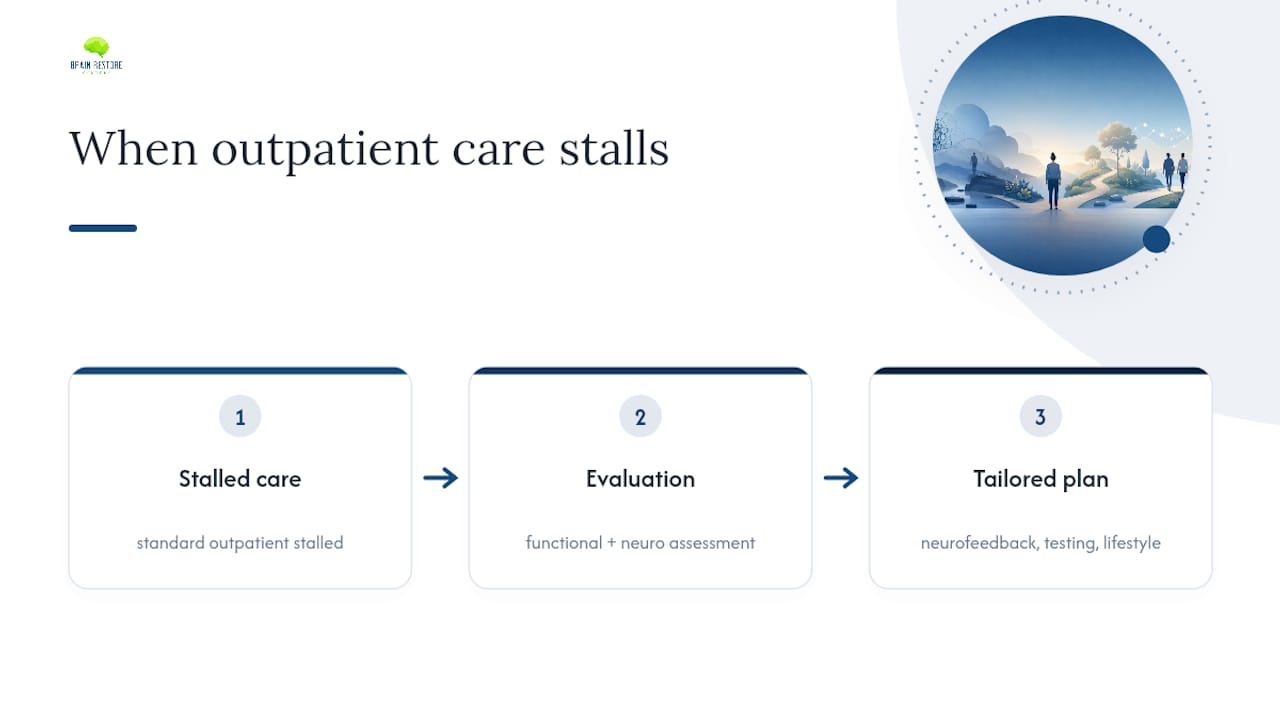
If standard outpatient care has stalled, or if you suspect something physiological (inflammation, old head trauma, chronic sleep disruption) is feeding your symptoms, neurofeedback offers a way to retrain the brain patterns underlying mood regulation directly. Our guide on how operant conditioning shapes neurofeedback training explains the mechanism in plain terms. The next step is simple: schedule an evaluation with our team, and we’ll map out whether neurofeedback, functional medicine testing, or a combined plan fits where you are right now.
This article is general information, not a substitute for advice from a qualified doctor. Consult a qualified healthcare professional about your own circumstances before acting on anything here.
For readers who want to dig into the primary evidence: the ACP systematic review compares psychotherapy and medication outcomes directly, Cleveland Clinic’s overview covers natural antidepressant options, Mayo Clinic addresses supplement safety, and the PMC review on treatment gaps details procedural options. For local evaluation, see Brainrestoremeridian’s clinic page.