Three Year Trial: What the MIND Diet Means for Brain Health
September 28, 2026


The MIND diet is one of the most researched eating patterns for cognitive health, and the honest verdict sits between hope and caution. Long-term observational studies link higher adherence to lower dementia risk, yet a major three-year randomized trial found no significant cognitive advantage over a well-balanced control diet. That gap does not make the diet useless. It means the MIND pattern is a reasonable, heart-healthy habit within a broader brain-health strategy, not a guaranteed shield against decline.
TL;DR:
- The three-year randomized trial found no significant cognitive benefits from the MIND diet despite observational studies suggesting lower dementia risk with higher adherence.
- The MIND diet emphasizes leafy greens, berries, fish, nuts, olive oil, whole grains, beans, and moderation in red meats, cheese, sweets, and fried foods.
- Simple weekly targets, such as eating greens most days and fish once a week, make adopting the diet feasible without strict daily counting.
- Combining diet with blood pressure control, physical activity, social engagement, and addressing other health factors increases its protective potential.
- Supplements offer modest cognitive support, but no single vitamin has been proven to significantly lower dementia risk; dietary and lifestyle changes remain primary.
The MIND diet stands for Mediterranean-DASH Intervention for Neurodegenerative Delay. It borrows the plant-forward habits of the Mediterranean diet and the blood-pressure focus of DASH, then narrows both toward foods researchers associate with brain aging. According to the Harvard T.H. Chan School of Public Health, the pattern emphasizes antioxidant-rich, anti-inflammatory foods while limiting items tied to saturated fat and heavy processing.
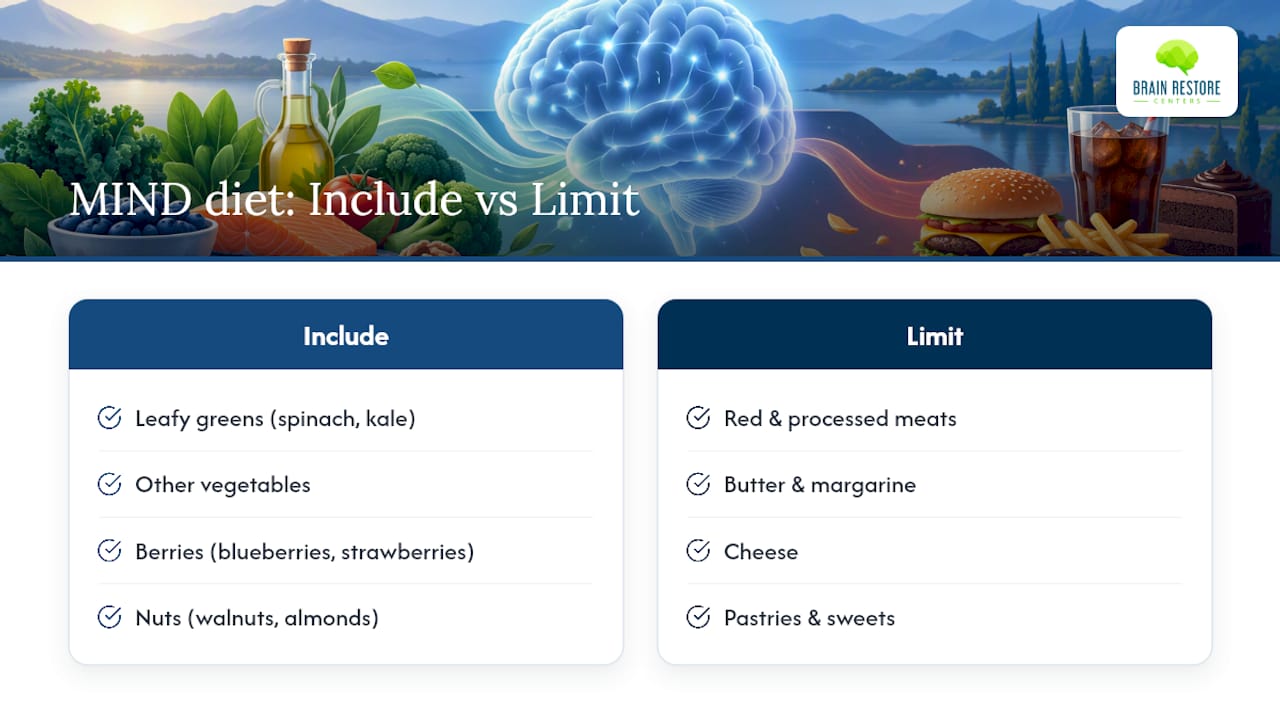
The 10 brain-healthy groups typically include leafy greens (such as spinach, kale, and collards), other vegetables, berries (like blueberries and strawberries), nuts (such as walnuts and almonds), olive oil as the primary added fat, whole grains (like oats, quinoa, and brown rice), fish (particularly fatty varieties), beans and other legumes, poultry (such as chicken or turkey), and moderate amounts of wine for those who already drink
Five categories are meant to stay limited: red and processed meats, butter and margarine, cheese, pastries and sweets, and fried foods. These are the foods the diet’s scoring system flags for reduction, not elimination.
Serving guidance is meant as a flexible target rather than a clinical prescription. A common version calls for leafy greens most days, berries at least twice a week, fish once a week, and beans several times weekly, with red meat and sweets kept occasional. Mayo Clinic frames this as a safe, adaptable pattern for most adults, one built around substitution rather than strict rules. Swapping butter for olive oil or trading a sugary dessert for berries moves you toward the pattern without requiring a full overhaul.
The strongest signal for the MIND diet comes from observational cohorts, and the strongest caution comes from a randomized trial that tested the pattern directly. Both matter, and they point in slightly different directions.
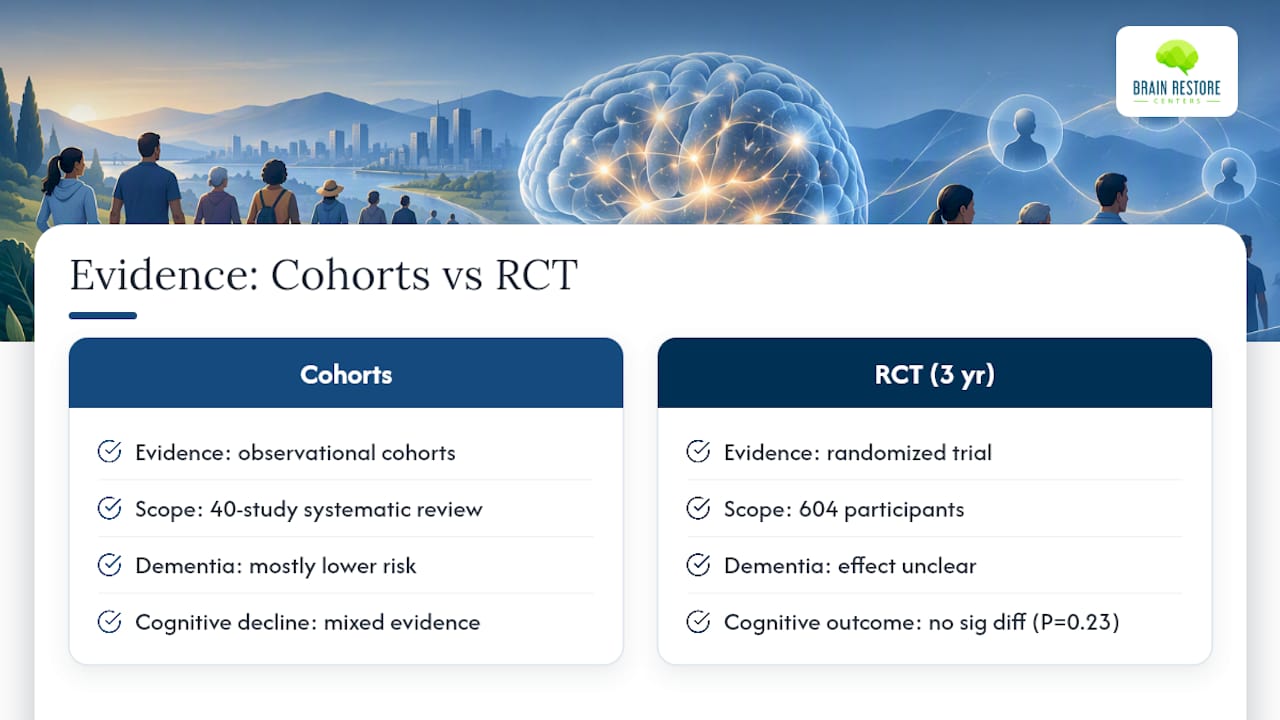
Cohort studies, including data drawn from the Memory and Aging Project, have repeatedly found that people who score higher on MIND adherence tend to have lower rates of dementia over time. A 2024 systematic review pooling 40 articles found that most cohorts showed this protective association for dementia risk, though the picture for cognitive decline specifically was mixed and effect sizes varied by population. These are association studies: they show a pattern connecting diet and outcome, not proof that diet alone causes the difference.
A 2024 systematic review of 40 studies found that most cohorts linked higher MIND adherence to lower dementia risk, while evidence for cognitive decline was inconsistent or varied by population. That distinction between “dementia risk” and “cognitive decline” is easy to miss and important to hold onto when reading headlines about the diet.
The clearest test of causation came from a three-year, NIA-funded randomized controlled trial that enrolled 604 older adults with a family history of dementia and randomly assigned them to either the MIND diet or a control diet with mild caloric restriction. Both groups received nutrition counseling and modest weight-loss support. After three years, global cognition improved similarly in both groups, with no statistically significant difference between them (P=0.23).
That result surprised many researchers who expected the MIND group to pull ahead. Several factors may explain these results, including improvements in the control group due to structured dietary support, that three years may be too short to detect brain changes that develop over decades, that observational studies often capture healthier lifestyle choices beyond diet, and that adherence in trials is typically less consistent than in long-term followers.
None of this proves the MIND diet does nothing. It shows that a single trial, even a well-designed one, cannot settle a question that observational data suggests takes years to unfold. Evidence hierarchies exist for a reason: randomized trials control confounding better, but they also test a narrower window of time than the decades-long cohorts that first raised the signal.
Turning the MIND diet from a concept into daily meals is easier than the food list suggests. A weekly rhythm works better than rigid daily counting.
A workable weekly target looks like this:
A simple day might look like oatmeal with walnuts and blueberries for breakfast, a spinach salad with grilled chicken and olive oil dressing for lunch, and salmon with roasted vegetables and quinoa for dinner. Snacks can rotate between almonds, an apple, or a small square of dark chocolate with wine optional in the evening for those who already drink.
Budget and convenience do not have to work against you. Frozen berries cost less than fresh and retain most of their nutrients. Canned beans save prep time. Olive oil in a larger bottle is cheaper per serving than small specialty bottles. If you want a fast plant-forward option to build around, a bowl built on legumes and vegetables, like the protein bowl approach from Wild Foodz, shows how quickly a MIND-aligned meal can come together.
Pro Tip: Keep a bag of frozen spinach and a can of beans in the house at all times. On busy days, they turn any meal into something that counts toward your weekly targets.
Food choices matter, but they sit alongside several other factors with strong evidence behind them. Treating diet as the whole strategy risks missing changes that carry equal or greater weight.
Combined-intervention research, including large multi-domain programs like U.S. POINTER, points toward layered lifestyle change producing more reliable benefits than any single habit alone. If you only have energy for one or two changes right now, blood pressure management and regular movement tend to have the most consistent backing, with diet as a strong complement rather than a stand-alone fix.
You may have seen a claim online that a single vitamin cuts dementia risk by 40%. That figure does not hold up against the current evidence, and no supplement, vitamin, or nutrient has been shown to reduce dementia risk by that margin.
What the research does show is more modest. The NIH reports that a daily broad-spectrum multivitamin-mineral supplement produced measurable but modest improvements in memory and global cognition in older adults compared with placebo. Modest is the operative word: this is a supporting habit, not a substitute for diet, movement, or medical care.
A daily multivitamin-mineral supplement was linked to modest gains in memory and overall cognition in older adults, though no single nutrient has been shown to cut dementia risk by anywhere near the figures often shared online.
National Institutes of Health
Supplementation makes the most sense when a specific deficiency, such as low vitamin B12 or vitamin D, has been confirmed by bloodwork, or when a clinician recommends it for an individual reason. Some supplements interact with medications or existing conditions, so it is worth discussing your own history before adding anything new. For a closer look at which supplements have real support for cognitive health, our review of supplements and neurological health breaks down the evidence in more depth.
Most people who abandon a new eating pattern do not fail because the plan was wrong. They fail because it demanded too much precision too soon. The MIND diet responds well to small, steady substitutions instead of an all-or-nothing overhaul.
Feasibility research on MIND-style interventions backs this approach. Small pilot trials that focused on gradual substitution and light self-monitoring saw better adherence and improved mood and quality of life, even when cognitive changes were not yet measurable in the short term. Goal-setting and simple tracking, done lightly, tend to outperform rigid, intensive programs for long-term follow-through.
Pro Tip: Set one small, specific goal each week, like “eat fish twice,” instead of a vague goal like “eat healthier.” Specific goals are easier to track and easier to feel good about hitting.
If you have a personal or family history of cognitive decline, or you simply want a plan tailored to your own labs and health history, a registered dietitian or your care team can help translate general MIND guidance into something built around your body.
Diet adjustments are a reasonable first step for most people, but memory concerns that feel new, sudden, or disruptive deserve more than a nutrition change. Some clinics combine functional medicine, neurofeedback, and qEEG brain mapping to look at what is actually happening in a person’s brain and body rather than guessing from symptoms alone.
If you are noticing memory lapses that worry you or a family member, that is a signal to pursue evaluation rather than wait and see. Our Brain Restore Program is built around this kind of assessment, pairing diagnostic tools with a personalized plan that can include nutrition guidance alongside other restorative therapies.
The MIND diet deserves its reputation as one of the more thoughtfully designed eating patterns for brain health, but it is not a guarantee, and treating it as one sets people up for disappointment or false reassurance. The observational signal is real and worth taking seriously. The recent randomized trial is also real, and it tempers expectations about how much a diet alone can do over a few years.
What I would tell a friend is this: eat the MIND way because it is a genuinely healthy pattern with cardiovascular benefits that stand on their own, not because it promises to prevent dementia by itself. Pair it with blood pressure management, movement, and mental engagement, and see a clinician if memory changes feel out of the ordinary rather than routine forgetfulness.
— Chad
Changing what is on your plate is a solid start, and it works even better alongside a clearer picture of what your brain actually needs. Brain Restore Meridian was built for people who want that clarity, offering evaluation and treatment that goes beyond general advice into something personalized.

Some approaches include brain health consultations that assess memory, mood, and cognitive function together, neurofeedback and qEEG brain mapping to understand patterns specific to the brain, functional medicine evaluations that look at metabolic and nutritional factors alongside diet, and integrated rehab support for people recovering from cognitive or neurological setbacks.
Diet is one lever. A full evaluation shows you which other levers matter most for your situation. If memory changes have you concerned, schedule a Brain Health Consultation and get a plan built around your own brain, not a generic checklist.
The MIND diet asks you to limit, rather than fully avoid, red and processed meats, butter and margarine, cheese, pastries and sweets, and fried foods. These five categories are linked to dietary patterns associated with poorer brain aging, so cutting back matters more than eliminating them completely.
Guidance built on the MIND diet consistently points to leafy greens, berries, and fish as the foods most often highlighted for brain health. Higher intake of these three groups shows up repeatedly in the observational research connecting diet to lower dementia risk.
Mayo Clinic describes the MIND diet as a safe, flexible, heart-healthy eating pattern appropriate for most adults. Their guidance emphasizes practical substitutions and gradual change over strict adherence to any single food list.
No, that figure is not supported by current research, and no single vitamin has been shown to reduce dementia risk by that amount. The NIH reports that a daily multivitamin-mineral supplement produced modest, not dramatic, improvements in memory and cognition in older adults.