Patients' HBOT Contraindications: Pneumothorax Is the Only Absolute
September 26, 2026


The single absolute contraindication to hyperbaric oxygen therapy is an untreated pneumothorax. If that applies to you, stop and get immediate clinical evaluation and imaging before any session is scheduled. Everything else you’ll read about, from ear problems to certain medications, falls into the “relative” category, which means your physician weighs the risk against the benefit for your specific situation rather than ruling you out automatically.
TL;DR:
- Untreated pneumothorax is the only absolute contraindication for hyperbaric oxygen therapy, as pressure changes can cause life-threatening tension pneumothorax.
- Most other conditions, such as lung issues or ear infections, are relative contraindications that require careful assessment and management by a physician.
- Medications like bleomycin, doxorubicin, and drugs lowering seizure threshold influence HBOT safety and need full disclosure before treatment.
- Pre-treatment screening includes imaging, history review, and possibly pulmonary tests to evaluate risks based on individual health conditions.
- Optimal safety measures involve adjusting treatment pressure, scheduling air breaks, and treating any active infections, with serious adverse effects being rare but closely monitored.
A collapsed lung and a hyperbaric chamber are a dangerous combination. HBOT works by raising ambient pressure, and that pressure change is exactly what turns a stable pocket of air in the chest cavity into a life-threatening emergency. As the chamber pressurizes and then decompresses, trapped air can expand rapidly and compress the lung, heart, and major vessels, a condition called tension pneumothorax. This is why the NCBI Bookshelf’s clinical review identifies untreated pneumothorax as the one contraindication accepted across every major hyperbaric standard, with no gray area.
The fix isn’t necessarily permanent exclusion. Once a pneumothorax has been treated, typically with a chest tube or thoracostomy to drain the trapped air and re-expand the lung, a patient can often be reconsidered for HBOT after the treating physician confirms resolution on imaging.
There’s a narrow exception worth knowing about: in rare emergency contexts, such as certain gas embolism cases, physicians may proceed with HBOT despite a pneumothorax if a chest tube is placed first to manage pressure changes safely. That decision belongs entirely to the medical team, never to the patient.
Most people who ask about HBOT patient eligibility aren’t dealing with an absolute exclusion. They’re dealing with one or more relative contraindications, conditions that require a closer look rather than an automatic no. The StatPearls chapter on hyperbaric patient selection recommends lung imaging for every patient and stresses that the attending physician, not a generic checklist, makes the final call.
Here’s how the concerns break down by system:
Pro Tip: Bring a full list of past surgeries, not just current diagnoses, to your intake appointment. A brain or eye surgery from two years ago can matter just as much as an active condition happening right now.
A handful of drug classes change how safely you can undergo HBOT, and screening for them is standard practice at any accredited facility. The NCBI’s review of contraindicated chemotherapeutic agents outlines specific timing rules clinicians use to reduce risk while still allowing treatment when it’s genuinely needed.
Full medication transparency with your treating team is the single easiest way to avoid a preventable complication.
Before your first session, expect a structured evaluation designed to catch anything on the contraindication list. This isn’t paperwork for its own sake. It’s how clinicians translate general guidance into a decision specific to your body.
A relative contraindication rarely ends the conversation. More often, it opens a discussion about mitigation. UHMS guidance on managing contraindications frames this as an ongoing risk-benefit judgment rather than a fixed yes-or-no rule, and that judgment plays out in a few concrete ways.
Pro Tip: If you struggle to equalize ear pressure on airplanes, mention it before your first HBOT session. A quick equalization lesson upfront saves you a painful, session-ending problem later.
Most complications are pressure-related or oxygen-related, and knowing the difference helps you flag a problem early. Ear and sinus barotrauma is the most common event, typically managed with equalization technique and, when needed, decongestants. Oxygen toxicity affecting the brain shows up as visual changes, tinnitus, twitching, or nausea, sometimes remembered by the mnemonic VENTID, and staff halt the session immediately if these appear.
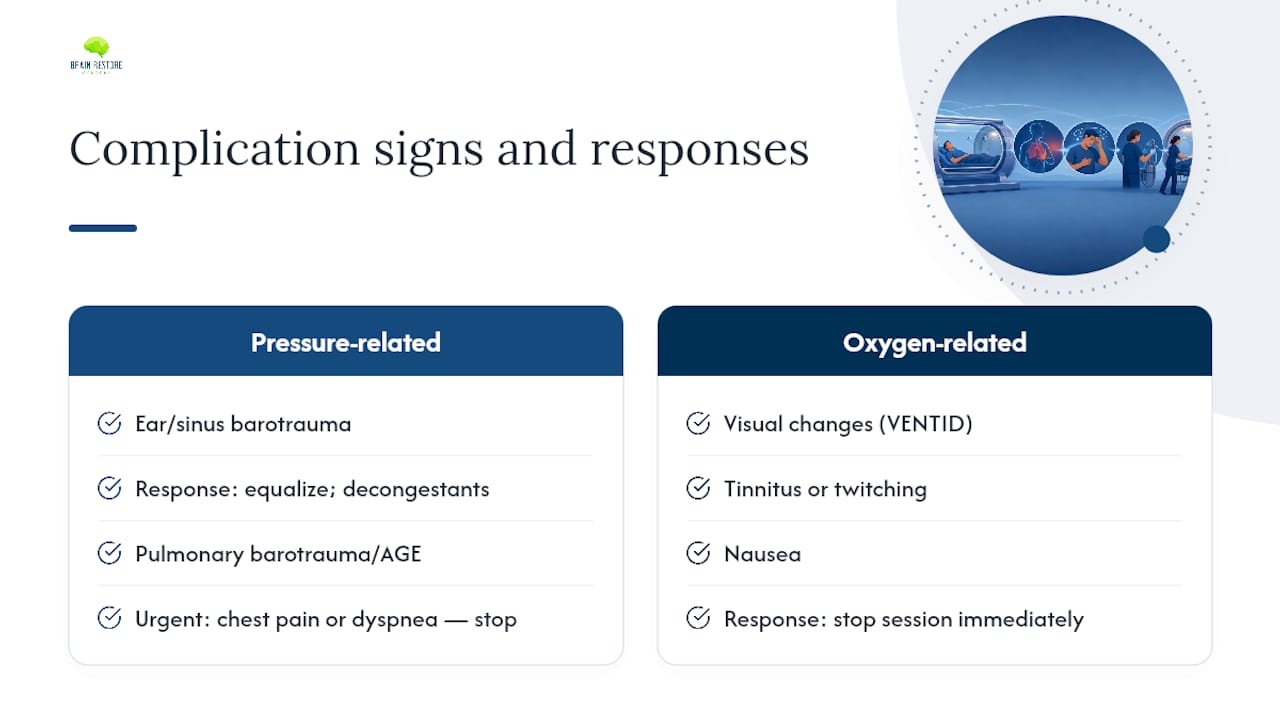
Pulmonary barotrauma and arterial gas embolism are rare but serious, and any chest pain or breathing difficulty warrants stopping treatment right away. Temporary nearsightedness is common after multiple sessions and typically resolves within weeks, though repeated long courses have been linked to earlier cataract changes in some patients.
Seizure incidence from oxygen toxicity runs at roughly 1 in 5,000 to 10,000 treatments, and risk climbs with treatment courses longer than 10 sessions and higher chamber pressures, according to a systematic review of adverse effects.
Full disclosure of every medication and past surgery isn’t optional paperwork. It’s the foundation of safe screening. Choose accredited centers with genuine physician oversight, not a wellness storefront with a chamber. When something feels uncertain, push for evaluation and imaging rather than assuming you’re fine.
— Chad
The clinic approaches hyperbaric oxygen therapy the way the research above suggests it should be approached: as a medical treatment, not a walk-in wellness add-on. Patients start with a consultation that includes a full medication review and any imaging their history calls for, integrated with a broader neurological and functional medicine evaluation rather than treated as a stand-alone service.

That means the same visit that screens you for HBOT eligibility can also connect the dots on related cognitive or physical health concerns, from concussion recovery to chronic pain, under one coordinated plan. If you’ve been wondering whether your medical history rules you in or out, the next step is a Brain Health Consultation at the Meridian clinic, where a physician reviews your case directly instead of leaving you to guess from a checklist online.
This article is general information, not a substitute for advice from a qualified doctor. Consult a qualified healthcare professional about your own circumstances before acting on anything here.
Anyone with an untreated pneumothorax should not undergo HBOT until it’s treated and cleared by imaging, per NCBI’s clinical guidance. Patients with uncontrolled seizure disorders, certain recent surgeries, or specific chemotherapy exposure need individualized physician evaluation before proceeding.
Bleomycin, doxorubicin, and cisplatin all carry special timing and safety considerations, since they can affect lung tissue, heart function, or wound healing during treatment. Disulfiram and other drugs that lower seizure threshold, including some stimulants and psychiatric medications, also require disclosure before screening.
Yes, though most are manageable with proper screening; ear barotrauma is the most common issue, while oxygen-toxicity seizures occur in roughly 1 in 5,000 to 10,000 treatments. Rare but serious risks include pulmonary barotrauma and arterial gas embolism, which is why accredited facilities monitor every session closely.
Daily HBOT is common in many treatment protocols, but adverse-effect risk rises with longer courses, particularly beyond 10 sessions and at higher pressures, according to a systematic review of HBOT safety data. Your physician should set session frequency and pressure based on your specific condition and how you tolerate early treatments.