
How Integrative Care Treats Mental Health: 2026 Guide
July 4, 2026


Integrative mental health care is defined as a coordinated, whole-person treatment model that combines psychiatry, psychotherapy, nutrition, sleep medicine, and lifestyle coaching into a single unified plan. Unlike traditional approaches that address symptoms in isolation, this model treats the whole person simultaneously across biological, psychological, and social dimensions. Understanding how integrative care treats mental health means recognizing that your mood, sleep, gut health, and stress response are all connected. When those connections are treated together, outcomes improve in ways that medication alone rarely achieves.
Integrative mental health care, also called integrative psychiatry, starts from one foundational premise: mental health conditions rarely have a single cause. The biopsychosocial framework at the center of this model recognizes that biological factors, psychological patterns, and social circumstances all shape how you feel. That means your provider assesses inflammation markers, gut health, sleep quality, and social support, not just your symptoms.
Traditional psychiatric care often adds complementary treatments only after months of medication trials. Integrative care reverses that sequence. Psychiatry, psychotherapy, and lifestyle interventions are coordinated from the start, reducing the time you spend in a trial-and-error cycle.
The model also draws on the biopsychosocial framework to improve diagnostic accuracy. When brain and mind are treated together, providers catch connections that isolated specialty care misses. A patient presenting with depression may also have disrupted sleep, poor gut health, and low social support. Treating only the depression leaves the other drivers untouched.
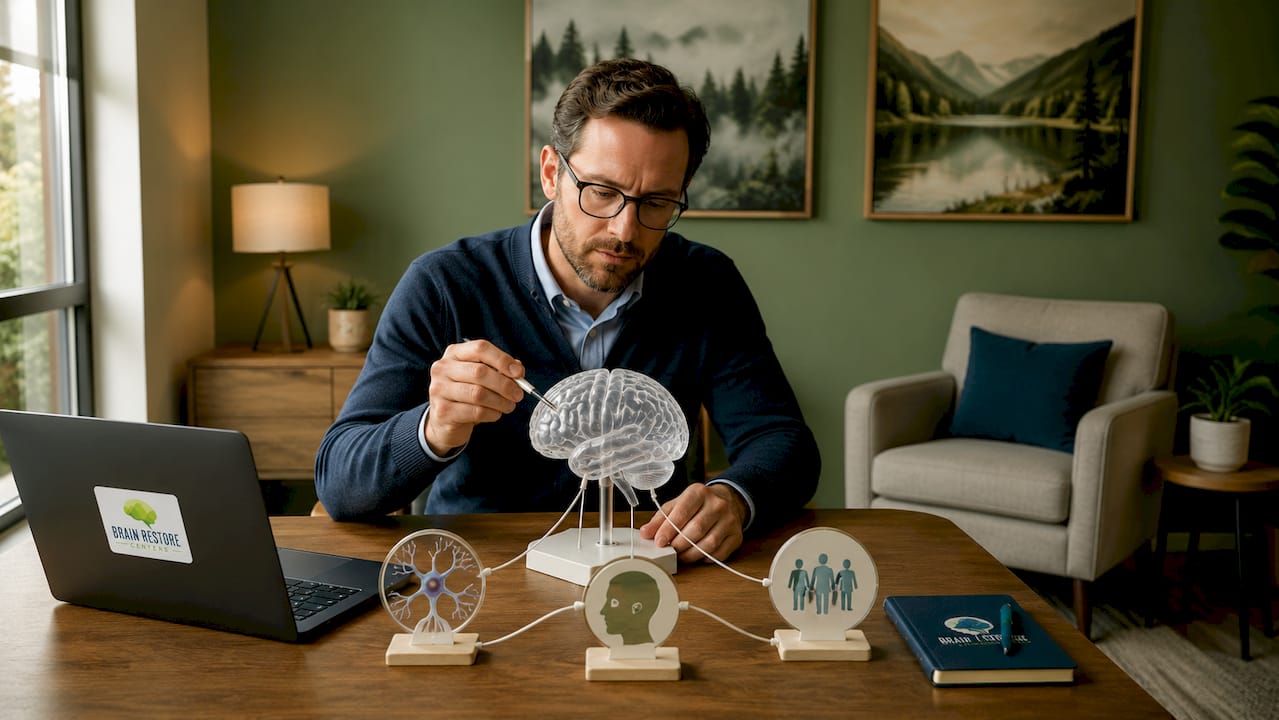
Integrative psychiatry pulls from two broad categories of treatment: conventional and complementary. Both are evidence-based. Neither is optional.
Conventional disciplines include:
Complementary modalities include:
The gut-brain connection deserves specific attention. Research on nutrition and mental wellness shows that what you eat directly influences neurotransmitter production and inflammatory load. Providers in integrative care assess dietary patterns as part of the clinical picture, not as an afterthought.
Pro Tip: Ask your provider to include a gut health assessment in your intake. Imbalances in the microbiome are a documented driver of anxiety and depression, and they respond well to targeted nutritional interventions.
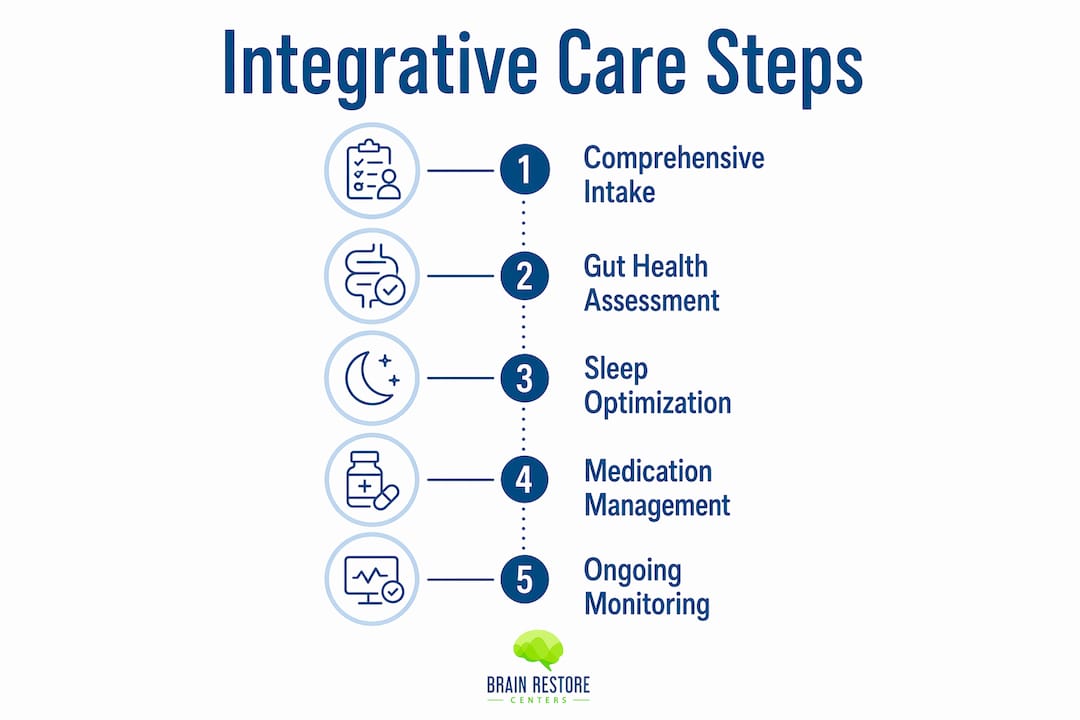
Sleep is treated with the same seriousness as medication. Poor sleep disrupts cortisol regulation, impairs emotional processing, and worsens every psychiatric condition. Integrative care treats sleep as a root cause, not a side effect.
Integrative care produces better outcomes because it addresses root causes rather than managing surface symptoms. Integrative psychiatry is particularly effective for complex, persistent, or co-occurring conditions such as anxiety, depression, PTSD, and substance use disorders. That effectiveness comes from combining conventional psychiatry with evidence-based complementary interventions rather than relying on one modality alone.
The most significant improvement is in medication management. Traditional psychiatry often adjusts prescriptions based on patient feedback alone. Integrative care uses data-informed dose adjustment, incorporating objective markers like sleep tracking, lab results, and neurofeedback data to guide decisions. That shift reduces the guesswork that frustrates so many patients.
Outcomes also improve because all interventions are coordinated. When your therapist, prescriber, and nutritionist share a unified plan, they reinforce each other’s work. A structured mental health plan prevents the fragmentation that happens when specialists operate in silos.
Conditions that respond well to integrative approaches include:
The result is a treatment plan that builds resilience rather than managing symptoms indefinitely.
Integrative care starts with a comprehensive intake session. These assessments last 60 to 90 minutes and map root causes across gut health, sleep hygiene, nutritional status, trauma history, and social support. The goal is a whole-person roadmap, not a DSM-5 classification followed by a prescription.
Your active participation is not optional. It is the mechanism that makes the model work.
Here is what that participation looks like in practice:
Pro Tip: Bring a written summary of your top three concerns to your first appointment. Providers can cover more ground when you arrive prepared, and your priorities shape the roadmap.
Progress is monitored continuously. Intervention doses adjust based on objective data, not just how you report feeling on a given day. That ongoing calibration is what separates integrative care from a one-time assessment followed by a static plan.
Integrative care gives significant attention to the brain’s physical function, not just its psychological patterns. This is where how integrative care supports neurological patients becomes especially relevant for people dealing with anxiety, ADHD, depression, or trauma.
| Modality | Target | Evidence Level |
|---|---|---|
| Neurofeedback | Brainwave dysregulation | Level 1 for ADHD; promising for anxiety, depression, PTSD |
| Exercise protocols | Mood regulation, neuroplasticity | Effect size comparable to antidepressants for mild to moderate depression |
| Nutritional medicine | Gut-brain axis, inflammation | Documented impact on neurotransmitter production |
| Photobiomodulation | Cellular energy, neurological stress | Used in multi-modal brain health restoration |
Neurofeedback is the most technically specific of these modalities. It uses real-time EEG feedback to identify and retrain dysregulated brainwave patterns. The American Academy of Pediatrics rates it as a Level 1 evidence-based intervention for ADHD. Results for anxiety, depression, and PTSD are strong and growing.
Exercise is often underestimated as a neurological treatment. Structured movement protocols increase brain-derived neurotrophic factor, support neuroplasticity, and regulate the hypothalamic-pituitary-adrenal axis. These are biological changes, not just mood lifts from fresh air.
The gut-brain axis adds another layer. The vagus nerve connects the gut directly to the brain, and gut microbiome imbalances affect mood and cognition through inflammatory and neurotransmitter pathways. Integrative care addresses this connection through targeted nutrition and, when indicated, probiotic protocols.
Photobiomodulation, also called low-level laser therapy, supports cellular energy production in neural tissue. It is used at Brainrestoremeridian as part of a multi-modal approach to brain health restoration alongside neurofeedback and functional medicine.
Integrative mental health care improves outcomes by treating biological, psychological, and social root causes simultaneously through coordinated, data-informed, multi-modal plans.
| Point | Details |
|---|---|
| Whole-person assessment | Intake sessions map gut health, sleep, nutrition, and social factors, not just symptoms. |
| Coordinated modalities | Psychiatry, psychotherapy, neurofeedback, and nutrition work together from day one. |
| Data-informed adjustments | Medication and therapy doses adjust based on objective markers, not feedback alone. |
| Patient participation | Tracking sleep, diet, and stress triggers directly improves care plan accuracy. |
| Neurological support | Neurofeedback and exercise protocols target brainwave and nervous system function directly. |
Most articles about integrative psychiatry focus on what it offers. Few are honest about what it requires. The patients I have seen get the most out of this model are the ones who treat their own participation as a clinical responsibility, not a suggestion.
The shift from symptom management to resilience building is real. But it does not happen passively. You have to show up to appointments with data. You have to be willing to change sleep habits, dietary patterns, and stress responses at the same time you are adjusting medication or doing neurofeedback. That is a lot to hold at once.
The coordination challenge is also real. Integrative care works best when all providers share information. In practice, that often falls on the patient to facilitate. Knowing how to communicate your needs clearly, and how to advocate for a unified plan, makes a measurable difference in outcomes.
What I find most encouraging is that the model treats you as someone capable of understanding your own biology. The curiosity that brings people to integrative care, the willingness to ask why you feel the way you do rather than just accepting it, is exactly the mindset that makes the treatment work. That is not a small thing. It is the foundation of every durable recovery I have witnessed.
— Chad
Brainrestoremeridian offers a multi-modal program built around the same principles this article describes: coordinated care, data-informed decisions, and treatment that addresses the whole person.
The clinic’s neurofeedback services target brainwave dysregulation patterns linked to anxiety, depression, and PTSD using real-time EEG feedback. Photobiomodulation and functional medicine are integrated alongside neurofeedback to support cellular and neurological recovery. Every plan starts with a comprehensive intake that maps your biology, lifestyle, and history before any intervention begins. If you are ready to move beyond symptom management and work toward lasting psychological resilience, Brainrestoremeridian is a strong next step.
Integrative mental health care coordinates psychiatry, psychotherapy, nutrition, sleep medicine, and lifestyle coaching into one unified treatment plan. It addresses biological, psychological, and social factors simultaneously rather than treating symptoms in isolation.
Traditional psychiatry typically focuses on medication and talk therapy as separate interventions. Integrative care combines those with evidence-based complementary modalities like neurofeedback, nutritional medicine, and exercise protocols, all coordinated from the start.
Anxiety, depression, PTSD, and substance use disorders show strong responses to integrative approaches. These conditions benefit from multi-modal treatment that targets root causes including sleep disruption, gut health, and nervous system dysregulation.
Neurofeedback uses real-time EEG feedback to identify and retrain dysregulated brainwave patterns. The American Academy of Pediatrics rates it as a Level 1 evidence-based intervention for ADHD, with strong evidence for anxiety, depression, and PTSD as well.
Patient participation is central to the model. Tracking sleep, diet, and stress triggers, and sharing that data with your provider, directly improves the accuracy and effectiveness of your personalized care plan.
Questions about your next step?
Our Meridian team can help you understand the evaluation process and which care options may fit your needs.
Schedule a ConsultationPrefer to speak with our team? Call 208-639-1397