
Your Exercise Routine for Sharper Focus Starts Here
August 9, 2026


A 20-minute daily session of moderate aerobic activity, two short resistance sets per week, and one mind-body practice is enough to meaningfully sharpen your focus, starting today. Here is the minimum you need to act on right now:
Pro Tip: Set a phone alarm 90 minutes after your morning workout. That is your window to tackle the hardest task on your list.
A multi-modal exercise routine combining aerobic work, resistance training, and mind-body practice, timed around the 2–4 hour BDNF window, is the most reliable self-directed strategy for sharper focus and reduced brain fog.
| Point | Details |
|---|---|
| Start with 20 minutes daily | Moderate aerobic activity for 20 minutes raises BDNF, dopamine, and norepinephrine for 30–120 minutes post-session. |
| Add resistance twice weekly | Plyometric and resistance work produces meaningful executive function gains alongside aerobic training. |
| Time your deep work | Schedule focused tasks 1–2 hours after exercise to align with the 2–4 hour BDNF peak window. |
| Track progress for 2–4 weeks | Use a daily focus rating (1–5) and work-block timer to detect real attention improvements early. |
| Escalate after 8–12 weeks | No measurable gain after consistent effort warrants a clinical evaluation at Brainrestoremeridian. |
Twenty minutes of moderate aerobic exercise produces measurable increases in norepinephrine, dopamine, and BDNF that sharpen attention for 30–120 minutes after the session ends. These are not subtle shifts. Norepinephrine tightens the signal-to-noise ratio in your prefrontal cortex. Dopamine raises motivation and working memory capacity. BDNF primes neurons to form new connections.
Key finding: A controlled study found that both light and vigorous bouts of acute aerobic exercise improved sustained attention and inhibitory control versus rest. Light intensity alone was sufficient to raise task discrimination scores, which means you do not need to push hard to see real attention gains.
Resistance and plyometric training add a different layer. Moderate-intensity plyometric and resistance exercises produced marginal to significant improvements in executive function in adults, making them a meaningful complement to cardio. Mind-body work rounds out the picture: Tai Chi interventions show improvements in sustained attention and executive function through increased activation in the cuneus and precuneus, brain regions tied to attention monitoring.
The practical takeaway is that no single modality does everything. Aerobic work drives blood flow and catecholamines. Resistance training amplifies BDNF. Mind-body practice trains the sustained attention networks that keep you on task during long work blocks.
Modifications for joint pain, low fitness, or brain-fog fatigue:
Pro Tip: If brain fog makes motivation inconsistent, anchor your workout to an existing habit, right after your morning coffee or just before lunch, so the decision is already made.
This protocol takes 15–20 minutes and is designed to prime your brain before a focused work block.
Heart-rate guidance:
For most people with brain fog, moderate intensity is the reliable target. Light intensity still works, as the gradCPT attention research confirms, so do not skip a session just because you cannot push hard.
A 20-minute cardio session increased high-frequency brain activity linked to memory consolidation and readiness for focused tasks. Start your deep work 30–120 minutes after finishing, with the strongest window typically at 60–90 minutes post-session.

Exercise raises the neurochemical ceiling. Single-task practice trains you to use that ceiling. Both together produce better sustained attention than either alone.
The pairing model is simple:
Neuropsychologist Kim Willment recommends single-task reading with periodic refocus checks as a direct way to train the brain’s monitoring networks, the same networks that exercise primes. Pairing the two methods gives you the neurochemical boost and the deliberate practice that makes it stick.
For hybrid or commute schedules, a 15-minute walk followed by focused podcast listening (one topic, no skipping) counts as a valid pairing session.
Pro Tip: Use a simple kitchen timer for your focus blocks. The physical act of setting it creates a commitment that a phone timer does not.
Exercise is a powerful first step, but some cognitive symptoms need professional evaluation. Watch for these red flags:
When these appear, a clinical evaluation can identify what exercise cannot address on its own. A comprehensive evaluation for cognitive dysfunction typically includes neurocognitive screening, QEEG brain mapping, and a functional medicine review to check metabolic and hormonal contributors.
Clinic services that complement an exercise-based plan include:
Before your first appointment, track your focus symptoms for two weeks using a simple daily rating (1–5 scale) and note sleep quality and medication use. That data helps clinicians build a personalized plan with measurable goals from day one.
Before starting any new fitness routine for mental clarity, run through this checklist:
| Goal | Safer exercise choice | Notes |
|---|---|---|
| Raise BDNF | Bodyweight resistance, slow tempo | 2–3 sets, 10–15 reps, seated options available |
| Improve cerebral blood flow | Brisk walking, cycling, pool walking | 20–30 min, moderate pace |
| Build sustained attention | Tai Chi, yoga, focused walking | Lower impact; evidence-backed for older adults |
When in doubt, consult your primary care provider before progressing intensity. This article provides general health information, not medical advice.
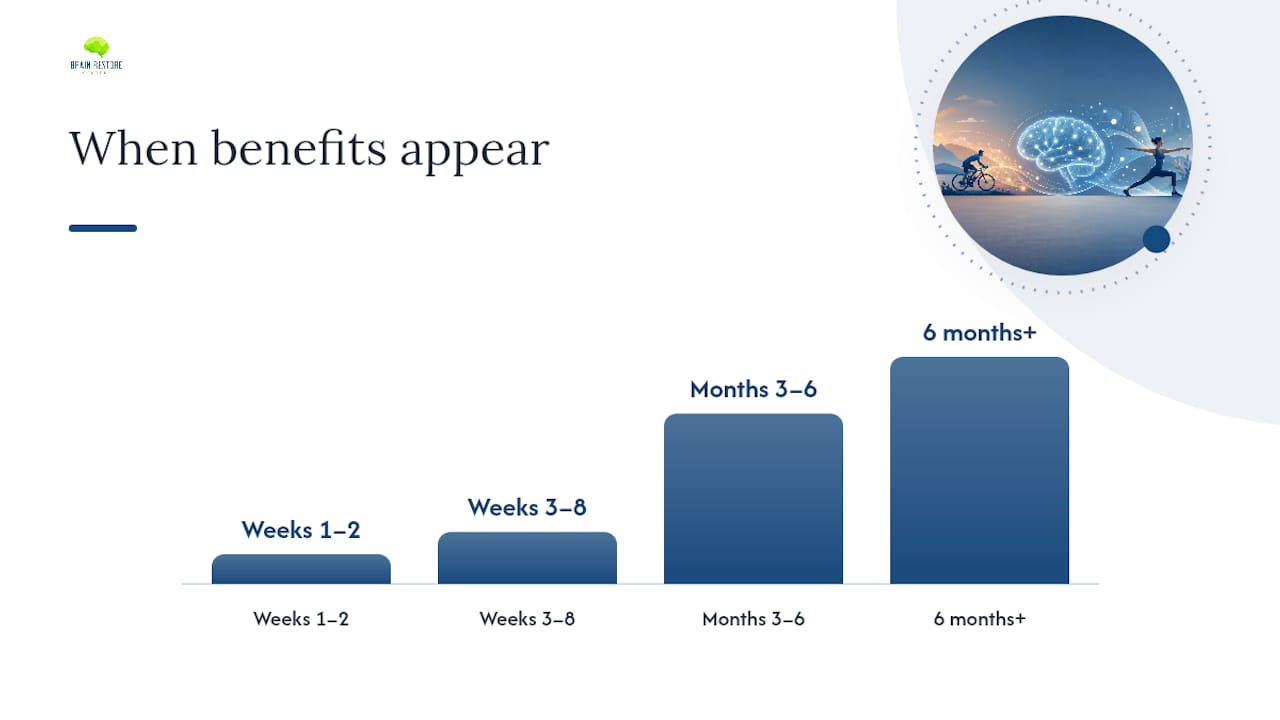
Expect a clear signal within 2–4 weeks if you track consistently. Harvard Health notes that structural brain changes tied to memory and executive function take roughly six months of regular moderate exercise to accumulate, but you can detect meaningful attention improvements much sooner through simple self-monitoring.
Timeline:
Simple tracking tools:
For additional strategies that support the routine, the clinic’s guide to boosting brain function covers sleep, nutrition, and supplement options that complement physical activity.
Most people with persistent brain fog get generic advice: sleep more, exercise, reduce stress. That advice is not wrong, but it is incomplete for anyone whose cognitive symptoms have a neurological or metabolic root.
Exercise creates the neurochemical conditions for recovery. Neurofeedback, photobiomodulation, and functional medicine address the underlying dysregulation that exercise alone cannot reach. Patients who combine a consistent movement habit with targeted neuromodulation tend to see faster, more durable gains than those who rely on either approach in isolation.
The practical reality is that brain-fog patients often struggle with the motivation and consistency that exercise requires. A personalized plan, built from a QEEG assessment and a functional medicine review, gives clinicians the data to set realistic expectations, adjust intensity safely, and layer in therapies at the right time. That is a very different experience from following a generic routine and hoping for the best.
If you have been consistent for 8–12 weeks and your focus has not measurably improved, that is not a failure of effort. It is a signal that the picture is more complex and worth a professional look. Integrative care models exist precisely for that situation.
Brain fog that persists despite a solid exercise routine often has a neurological or metabolic driver that a workout cannot address. Brainrestoremeridian, in Meridian, Idaho, offers a direct route to answers: QEEG brain mapping to identify dysregulated brainwave patterns, neurofeedback to retrain them, photobiomodulation to support neurological recovery, and functional medicine to uncover metabolic contributors like thyroid dysfunction or chronic inflammation.
At your first appointment, the team builds a personalized plan from your assessment data, not a template. You leave with measurable goals, a clear timeline, and therapies that work alongside your exercise habit rather than replacing it. If you are ready to move beyond guesswork and get a clinical picture of what is driving your brain fog, book an evaluation at Brainrestoremeridian and take the next concrete step toward reclaiming your focus.
This article is general information, not a substitute for advice from a qualified doctor. Consult a qualified healthcare professional about your own circumstances before acting on anything here.