Creatine After Brain Injury: Research and Safety Considerations
August 30, 2026

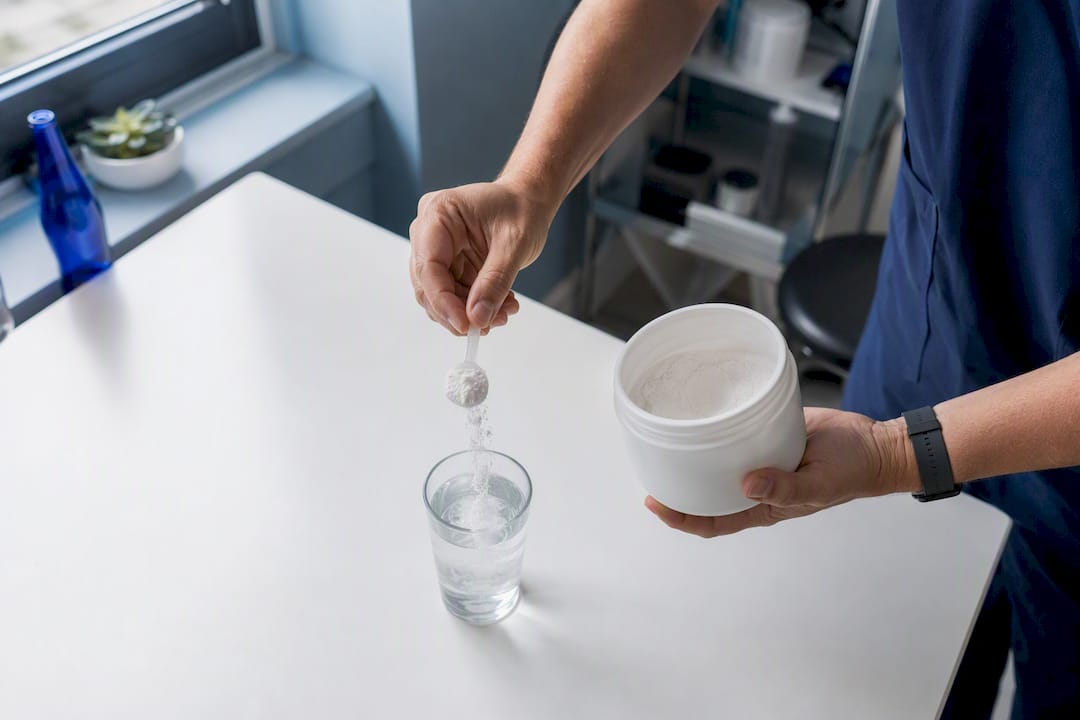
Creatine shows real neuroprotective promise in animal models and small human trials after traumatic brain injury and concussion, but it remains unproven as a standard TBI treatment. Animal studies point to reduced tissue damage; pediatric case series and adult pilot trials, tracked in part through Clinicaltrials records and reviewed on NCBI Bookshelf, show encouraging but preliminary signals. Talk with your clinician, including the team at Brainrestoremeridian, before adding it to a recovery plan.
TL;DR:
- Human evidence for creatine’s effectiveness in TBI is limited, with small pilot trials showing feasibility and safety but no definitive proof of benefit.
- Animal studies suggest creatine can reduce brain tissue damage by nearly 50 percent, but translating these results to humans remains unproven.
- Creatine’s role in recovery relies on buffering brain energy supply, especially by supporting mitochondrial function, which drops after injury.
- Dosing varies, with pediatric protocols typically around 0.4 g/kg and adult studies using 3 to 5 grams daily, but optimal regimens are still under research.
- Creatine may benefit those in high-risk professions or with persistent symptoms, but should only be used under clinician supervision with baseline kidney testing.
The evidence splits cleanly into two tiers, and understanding that split matters more than any single statistic. Animal research is consistent and often striking. Human research is smaller, earlier stage, and not yet powered to prove clinical benefit.
Rodent studies dosed with creatine before induced brain trauma show measurably less cortical damage and better mitochondrial function than untreated controls. Pediatric case reports out of Greece, led by researcher Sakellaris, found that children given creatine after moderate to severe TBI spent less time in intensive care and showed better functional recovery at follow-up. Adult data is thinner: one pilot randomized trial tested 5 grams of creatine monohydrate daily for seven weeks in people with mild TBI and found the approach feasible, with symptom scores trending favorably, though not reaching statistical significance.
Statistic to watch: that near 50 percent reduction in brain damage is an animal-model figure, not a guarantee for human patients. It tells you the mechanism is worth taking seriously. It does not tell you what dose or timing will replicate that result in a person.
The brain runs on a constant, high-demand energy supply, and a traumatic injury interrupts that supply right when neurons need it most. Creatine’s job in the body is to buffer ATP, the cell’s primary energy currency, through the creatine-phosphocreatine system. When phosphocreatine stores are adequate, cells can regenerate ATP fast enough to survive the metabolic chaos that follows impact.
After a concussion or TBI, brain creatine levels actually drop, a finding documented in imaging studies of post-injury patients. That drop lines up with what researchers call the post-traumatic energy crisis: mitochondria struggle, reactive oxygen species accumulate, and lactate builds up faster than the tissue can clear it. A 2025 review ties creatine’s mechanism directly to this cascade, arguing that better-buffered energy reserves could blunt secondary injury before it compounds.
Pro Tip: Because neural creatine uptake lags behind muscle uptake, supplementation started before a high-risk event, like a contact sport season, may raise brain creatine more reliably than a single dose taken right after injury.
Human evidence remains the weak link, and it is worth being honest about why. Studying acute brain injury is logistically hard: patients arrive at unpredictable times, severity varies widely, and ethical constraints limit early intervention research. Still, the studies that exist point in a consistent direction.
The most cited pediatric work comes from Sakellaris and colleagues, who gave children with moderate to severe TBI an initial dose around 0.4 g/kg followed by daily maintenance over six months. Documented outcomes included shorter intensive care stays and better cognitive and functional scores at three to six months, with no reported adverse effects, according to the summary in the NCBI Bookshelf chapter.
Adult evidence is newer and smaller in scale. The pilot randomized controlled trial registered on ClinicalTrials.gov tested 5 grams of creatine monohydrate daily for seven weeks in adults with mild TBI. Researchers confirmed the protocol was feasible and safe, and symptom scores on standard post-concussive scales moved in a favorable direction, but the sample was too small to establish efficacy.
The number that matters here: zero reported serious adverse events across these small trials is reassuring, but a favorable safety signal in a handful of patients is not the same as proof of benefit. Larger trials using magnetic resonance spectroscopy, or MRS, to directly measure brain creatine levels will decide whether the mechanism translates into measurable recovery gains.
Dosing protocols vary across the research, and that variation itself tells you the field hasn’t settled on a standard regimen yet. Creatine monohydrate is the form used in nearly every trial, largely because it has the longest track record and the most consistent absorption data.
Tolerability across these studies has been good. Reported issues mirror what shows up in general creatine research: mild gastrointestinal discomfort in some users and a theoretical concern around renal load in people with preexisting kidney disease. No trial to date has flagged serious renal harm in otherwise healthy participants.
Pro Tip: If you’re considering creatine after a concussion, ask your clinician for a baseline renal panel first. It’s a five-minute blood draw that gives you and your provider an objective marker to recheck if you stay on supplementation for more than a few months.
A basic clinical checklist before starting:
Not everyone weighing creatine for brain injury recovery fits the same profile, and the research supports differentiating by situation rather than treating this as one-size-fits-all.
The honest answer is that no trial to date has been large enough, or used objective enough measurement tools, to settle the question of clinical efficacy. That is the single biggest gap in this field.
Until those trials exist, the responsible move is to treat creatine as a promising adjunct worth discussing with a clinician, not a substitute for established concussion and TBI care.

Creatine isn’t the only supplement drawing research interest for brain injury recovery, and it’s worth seeing where it stands relative to the alternatives patients ask about most.
Omega-3 fatty acids, particularly the DHA form, have the longest history in TBI research, with animal studies showing anti-inflammatory effects and some human data suggesting benefit when started early after injury. The mechanism differs from creatine’s energy-buffering role: omega-3s primarily target inflammation and cell membrane repair, while creatine targets ATP availability during the acute energy crisis. That distinction matters for anyone considering both, since they’re addressing different points in the injury cascade rather than competing for the same effect.
Other agents under investigation, including N-acetylcysteine and various antioxidant compounds, generally have thinner human evidence than either creatine or omega-3s. None of these supplements has reached the point of replacing standard concussion management, which still centers on cognitive rest, graded return to activity, and monitored recovery.
The practical takeaway: creatine and fish oil after concussion are more often complementary than competing choices in the research literature, each targeting a distinct piece of post-injury biology. Readers curious about how these options stack up in more detail can find further comparison in Brainrestoremeridian’s breakdown of supplements supporting neurological health. Mitochondrial support in general, a mechanism shared by creatine and several longevity-focused compounds, is worth understanding on its own terms, and background on mitochondrial protection helps explain why this cellular target keeps showing up across brain-health research.
Turning research protocols into a practical plan requires translating trial doses into something a clinician can actually monitor over time.
Start with a conversation, not a supplement bottle. Bring your clinician the specifics: when the injury happened, current symptoms, kidney health history, and any medications that affect renal clearance. From there, most evidence-aligned protocols mirror what trials have used: a fixed daily dose in the 3 to 5 gram range for adults, taken consistently rather than cycled, with reassessment at the two-to-three-month mark.
Timing relative to injury shapes expectations. Someone starting creatine weeks or months after a concussion, once acute symptoms have settled, is in a different situation than someone using it prophylactically before a contact sport season. The slow uptake of creatine into brain tissue means consistency over months matters more than any single high dose.
Pair supplementation with objective tracking where possible. If a clinic offers cognitive assessment or neurofeedback, use it as a way to observe whether function is actually improving, rather than relying on symptom recall alone. A structured concussion recovery checklist can help keep supplementation, rest, and graded return to activity coordinated instead of layered on haphazardly. Reassess renal markers periodically, especially if the regimen extends beyond six months.
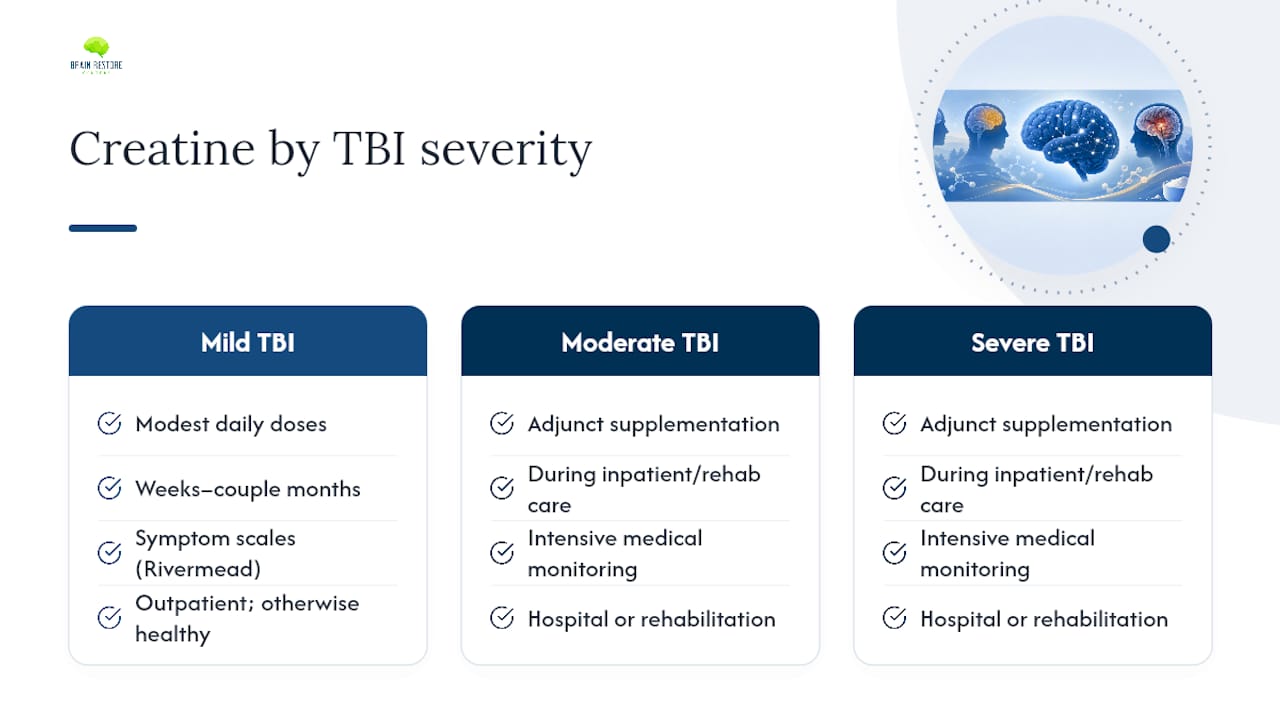
Mild TBI and severe TBI are not the same condition, and the research reflects that difference in how creatine has been studied and applied.
For mild TBI and concussion, the adult pilot trial data offers the most direct guidance: modest daily doses, monitored over weeks to a couple of months, with attention to symptom scales like the Rivermead Post-Concussion Questionnaire. Most people in this category are otherwise healthy, which makes the safety profile more favorable and the decision to try supplementation lower risk, provided a clinician is involved.
Moderate to severe TBI, the population studied most in the pediatric Sakellaris trials, involves a different risk calculus entirely. These patients are typically already under intensive medical care, with other interventions, medications, and monitoring in place. Creatine supplementation in this context has appeared as an adjunct within a supervised hospital or rehabilitation setting, not a standalone intervention a family adds on their own. Anyone considering creatine TBI recovery support for a moderate to severe injury should treat it strictly as a physician-directed decision, integrated with the broader treatment plan rather than layered on independently.
Repeat mild TBI, common in athletes and military populations, raises a distinct question the research hasn’t fully answered: whether prophylactic use before repeated exposure offers cumulative protection. The mechanistic case is plausible given how slowly brain creatine accumulates, but dedicated trials in this specific population remain limited.
At Brainrestoremeridian, creatine is never treated as a standalone fix. When it fits a patient’s history and lab results, it’s discussed as one piece of a broader plan that may include neurofeedback, hyperbaric oxygen therapy, and progressive rehab, always under physician oversight with baseline testing and documented consent. That multidisciplinary structure is what lets our team weigh a promising supplement against your actual injury profile, not a generic protocol…
Here’s the tension worth naming directly: creatine has one of the most biologically coherent stories in TBI supplement research, and yet it still isn’t proven. Both things are true at once, and readers deserve better than an article that picks one and ignores the other.
The mechanistic case is genuinely strong. A near 50 percent reduction in animal-model brain damage is not a marginal finding, and the logic connecting phosphocreatine buffering to post-traumatic energy crisis holds up under scrutiny from multiple independent reviews. That’s rare in supplement research, where mechanisms often sound plausible but don’t survive contact with actual trial data.
What frustrates me about how this topic gets covered elsewhere is the tendency to round “promising” up to “proven,” especially in pediatric case series where sample sizes are small and controls are imperfect. The Sakellaris data is encouraging. It is not the same evidentiary weight as a multi-site randomized trial with MRS confirmation. Treating early signals as settled science does patients a disservice, because it sets up either false confidence or, worse, a backlash when a larger trial eventually shows a smaller effect than the early data suggested.
The right posture here is patience paired with proactive conversation. If you’ve had a concussion or TBI and you’re curious about creatine, that curiosity is well founded. Bring it to a clinician who can look at your kidney function, your medication list, and your actual recovery trajectory before you start anything. The science is moving toward an answer. It just isn’t there yet, and pretending otherwise helps no one.
— Chad
Questions about your next step?
Our Meridian team can help you understand the evaluation process and which care options may fit your needs.
Schedule a Brain Health ConsultationPrefer to speak with our team? Call 208-639-1397