Laser Therapy: 9 to 12 Sessions and When Patients Should Be Reassessed
October 3, 2026

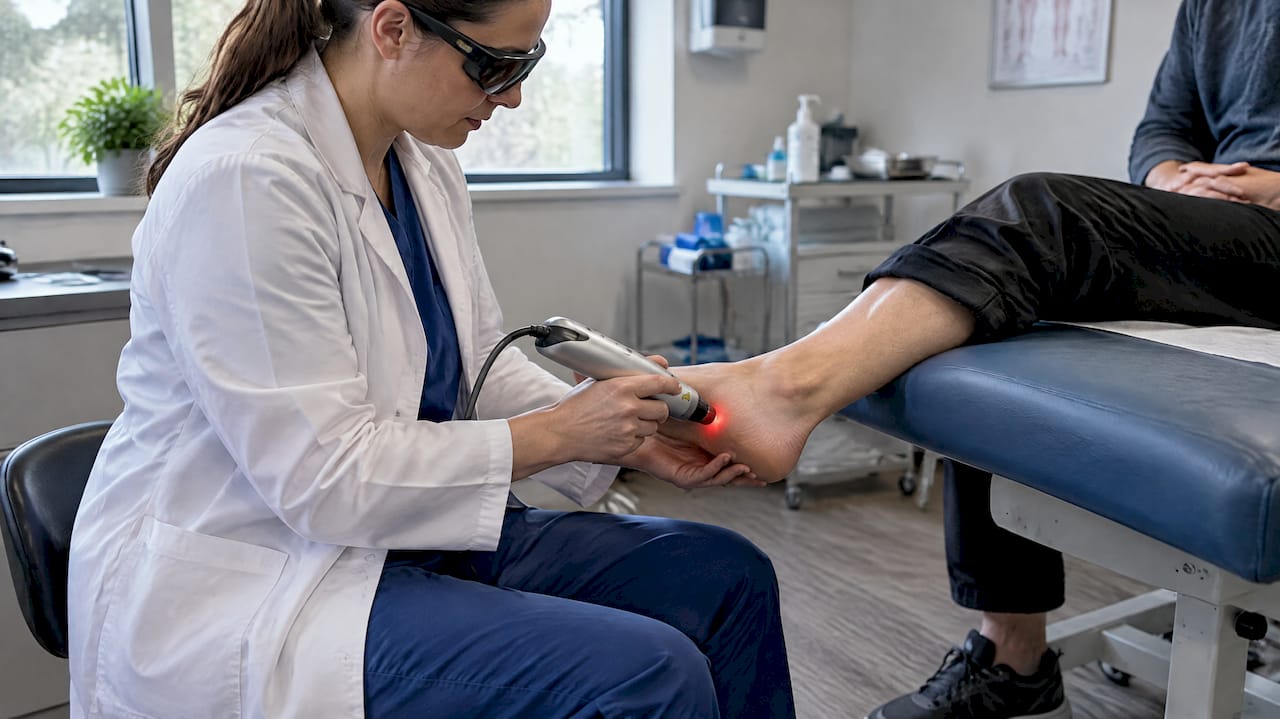
Most laser therapy treatments are delivered as a short course. You might expect anywhere from a couple sessions for a specific procedural use to a longer run of multiple sessions for chronic pain or nerve-related conditions. The exact number depends on your diagnosis, the device settings your clinician chooses, and how your body responds, which is why a good provider reassesses partway through rather than locking you into a fixed number from day one.
TL;DR:
- The optimal number of laser therapy sessions varies widely depending on the condition, with some requiring as few as two treatments and others needing nine or more over several weeks.
- Device settings such as wavelength, energy density, and power output influence treatment length and frequency, allowing clinicians to customize protocols without fixed session counts.
- Progress is typically monitored at mid-course, at the end, and during follow-up periods to assess symptom relief and functional gains before deciding to extend treatment.
- Laser devices used in clinics are generally Class IIIb or IV, requiring trained operators and proper safety measures, including eye protection for both patients and practitioners.
- Cost considerations depend on the total sessions needed, with longer courses suited for chronic or nerve conditions and shorter treatments for acute issues, emphasizing the importance of a personalized treatment plan.
A typical visit is simple and calm. You check in, the clinician confirms the treatment area, you both wear protective eyewear if the device calls for it, and the laser is applied directly to the skin over the target tissue. There is usually brief monitoring afterward, then you are free to go.
Preparation is minimal. Clinicians may ask you to skip strong topical creams or lotions on the treatment area beforehand so nothing interferes with light absorption.
Pro Tip: Wear loose, easy-to-remove clothing to your appointment so the clinician can access the treatment area quickly and you get the most out of your scheduled time.
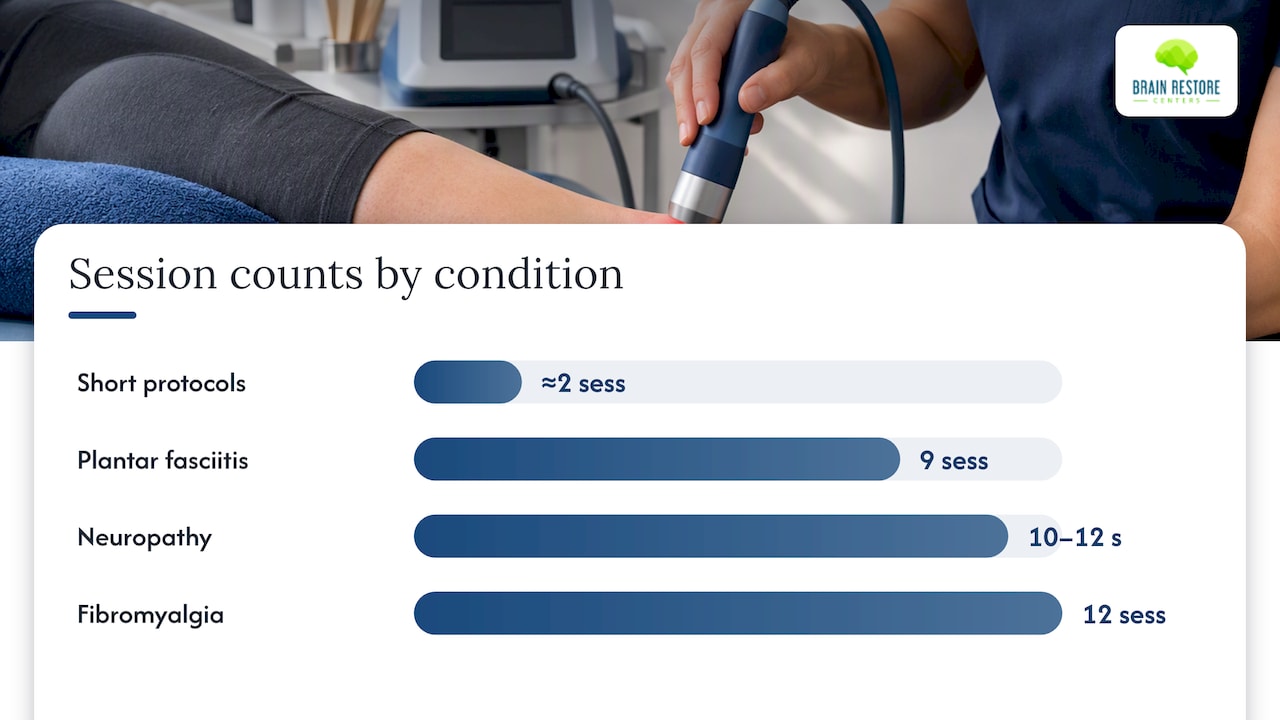
Session counts vary enormously by diagnosis, and the research reflects that. There is no universal number that fits every patient.
One sourced figure worth remembering: the plantar fasciitis trial above used nine sessions over three weeks, a schedule that illustrates how a short, structured course can still produce lasting results.
This spread exists because conditions differ in depth, tissue type, and chronicity. A clinician’s job is to match the protocol to your diagnosis rather than reach for a generic number.
Two clinics can recommend different session counts for the same condition and both be reasonable, because the laser itself has several adjustable variables.
A clear example comes from the plantar fasciitis research, where researchers compared a 25-watt device against a 10-watt device delivering the same energy density of 10 J/cm2. The higher-power device delivered that dose faster, producing similar outcomes in less treatment time. This tells you that session length can shrink without changing the actual dose your tissue receives, and it is why clinicians adjust frequency and duration instead of prescribing a one-size-fits-all count.
Most research protocols build in checkpoints rather than running straight through without pause. The fibromyalgia trial, for example, assessed patients after session six, again at the end of the full course, and once more two weeks later.
Clinicians distinguish between symptom relief, which is how you feel day to day, and functional improvement, which is what you can actually do, like walk farther or sleep without being woken by pain. A useful rule of thumb: measure both against your starting point before agreeing to extend the course. If neither has moved by the end of the initial series, continuing the same protocol unchanged rarely makes sense.
Laser devices are not all the same, and the FDA’s guidance on laser products explains why that matters. Professional-grade lasers used in clinical settings are often Class IIIb or Class IV, and the FDA notes these require trained operators and specific safety measures, including labeling that identifies power output and hazard class.
Pro Tip: Ask any clinic what laser class their device falls under. A straight answer is a good sign they take dosing and safety seriously.
Total cost depends directly on how many sessions your protocol calls for, so it helps to think in terms of a course rather than a single visit. Our cold laser cost guide breaks down typical per-session pricing to help you plan.
Low-level laser therapy at Brain Restore Meridian follows the same logic the research supports: start with a protocol grounded in published session ranges, then adjust based on your actual response. For neuropathy, that often means a schedule in the 10 to 12 session range that clinic-cited evidence associates with meaningful benefit. For musculoskeletal pain, clinicians draw on trial-based schedules, like the nine-session plantar fasciitis protocol, as a starting reference point rather than a rigid rule.
Clinicians calibrate wavelength, energy density, and power to your specific diagnosis and tissue depth, then set a reassessment point before committing you to additional sessions. That is the difference between guessing at a number and building a plan around what the dose and your response actually show.
Laser therapy is generally well tolerated, and most people experience nothing beyond mild warmth during treatment. Still, extending a course without reassessment carries its own considerations worth understanding.
Repeated sessions over a short window can occasionally lead to temporary skin sensitivity or mild redness in the treated area, particularly with higher energy densities. This tends to resolve on its own and rarely requires any intervention.
The more meaningful risk with multiple sessions is less about tissue reaction and more about time and expectation. Continuing a protocol past the point where a clinician has checked your progress means you could be paying for sessions that are not adding benefit, especially if your pain or function has plateaued. This is exactly why the checkpoint system matters: it protects you from open-ended treatment that drifts without a clear therapeutic reason.
Eye exposure remains the most serious risk category, which is why the FDA’s guidance on professional-grade lasers emphasizes trained operators and proper eye protection at every session, not just the first one. Skipping that protection even once, on the assumption that a familiar routine is automatically safe, is where avoidable harm tends to happen.
The honest takeaway from the trial data is that session count is the wrong first question. The right one is whether your clinician is matching dose to diagnosis and checking your progress at defined points, because a nine-session plantar fasciitis protocol and a twelve-session fibromyalgia protocol look nothing alike for good reason.
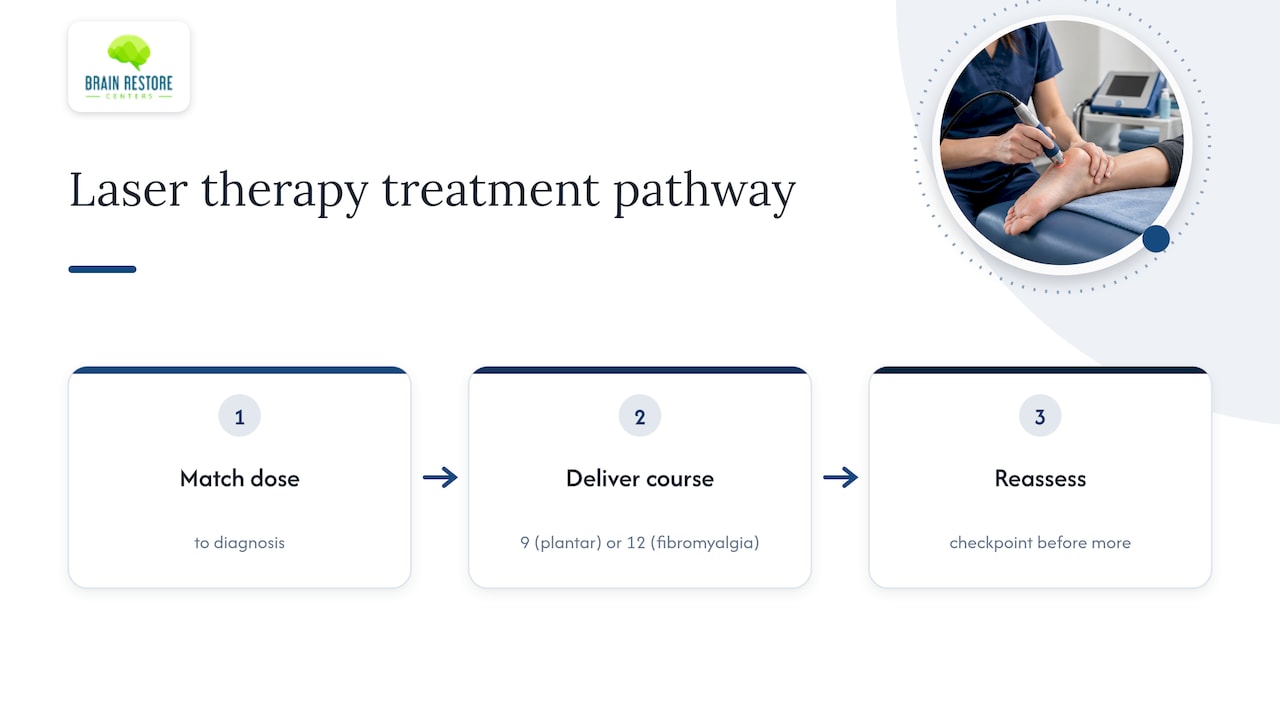
Conventional advice often treats laser therapy like a fixed package: buy ten sessions, show up, done. That approach ignores what the research actually models, which is an initial course followed by a real decision point. If you are not functionally better by the end of that first course, more of the same protocol is unlikely to change that.
Prioritize finding a clinician willing to explain their device settings and commit to a reassessment date before you start, over finding the lowest price per session. The dose and the checkpoint matter more than the number on the package.
— Chad
If you are weighing laser therapy for pain, neuropathy, or as part of a broader recovery plan, a focused evaluation beats guessing at a session count on your own. An initial visit typically includes an intake conversation, a physical exam, and a proposed first course built around your specific diagnosis rather than a generic package.
Request a low-level laser therapy consultation to get a plan built around your own diagnosis and response, not a fixed session count.
This article is general information, not a substitute for advice from a qualified doctor. Consult a qualified healthcare professional about your own circumstances before acting on anything here.
It depends heavily on your condition: short procedural uses may need only a couple of exposures, while chronic pain or neuropathy often calls for a structured course of nine sessions over three weeks or a 10 to 12 session neuropathy protocol. Your clinician should reassess partway through rather than committing you to a fixed total upfront.
Results can be inconsistent because protocols vary so widely by condition and device, with systematic review evidence showing session counts ranging from 3 to 14 across different trials. The other drawback is cost, since a full course of multiple sessions adds up, especially if insurance does not cover the treatment.
Duration varies by condition and how your body responded to the initial course, which is why trials build in follow-up checkpoints, such as the two-week follow-up used in the fibromyalgia trial. Clinicians use these checkpoints to decide whether additional maintenance sessions are warranted.
Avoid applying strong topical creams or irritants to the treated area right after a session unless your clinician specifically approves it. There is generally no downtime required, but following any aftercare instructions your provider gives you helps protect the results of the session.