Clinic Playbook: Use CPT Codes to Win Neurofeedback Coverage
September 1, 2026


Short answer: usually no, but it depends. Most U.S. insurers still classify neurofeedback as experimental, so coverage stays uncommon and varies widely by payer and diagnosis. Exceptions happen when a licensed provider bills the correct CPT code and backs the claim with strong medical necessity documentation. The sections below walk through exactly which factors move the needle and the steps that actually improve your odds.
TL;DR:
- Insurance coverage for neurofeedback is limited and depends on proper CPT coding, strong medical necessity documentation, and treatment of documented disorders like ADHD or PTSD.
- Medicare rarely covers neurofeedback, while Medicaid coverage varies widely by state, and private insurers’ acceptance varies even within the same plan or region.
- Patients need to pursue preauthorization, confirm billing codes beforehand, and be prepared to appeal denials with peer-to-peer reviews and specific outcome evidence.
- Out-of-pocket costs for neurofeedback typically range from $100 to $200 per session, with programs often requiring 15 to 30 sessions and separate charges for initial diagnosis and brain mapping.
- A high-quality superbill and detailed documentation significantly increase the chances of reimbursement, but success depends primarily on insurer paperwork and procedural persistence.
Whether your plan pays for neurofeedback comes down to a handful of specific factors, and most denials trace back to one of them. Understanding these levers before you start treatment saves you money and frustration later.
Insurer medical policy language sets the tone from the start. Many carriers, including Blue Cross Blue Shield of Michigan, label neurofeedback (EEG biofeedback) as “experimental/investigational,” citing insufficient evidence that it changes net health outcomes. That single word, experimental, is usually the wall you’re up against.
Your diagnosis matters just as much as the treatment itself. Insurers respond better when neurofeedback treats a documented disorder, ADHD, PTSD, migraine, or traumatic brain injury, rather than general “brain optimization.” The International Society for Neurofeedback and Research draws a clear line between wellness marketing and clinical treatment, and insurers draw that same line when reviewing claims.
Billing codes decide whether a claim even gets processed correctly:
Provider credentials round out the picture. In-network licensure, an active NPI, and BCIA certification all strengthen your case, while out-of-network providers face a steeper climb.
Pro Tip: Ask your provider which CPT code they plan to bill before your first session, then call your insurer directly to confirm that code is accepted for your specific diagnosis.
Coverage patterns differ sharply depending on who’s paying, and lumping “insurance” into one category leads to bad assumptions.
Medicare doesn’t offer broad coverage for neurofeedback. CMS has no national coverage determination specific to the treatment, and most claims get classified as “not medically necessary.” Providers can still bill using a GA modifier paired with an Advance Beneficiary Notice (ABN), which documents the service and lets it show up in utilization records even when Medicare denies payment. This matters more than it sounds. It creates a paper trail for future appeals or supplemental coverage.
Medicaid coverage is fragmented state by state. Some state programs reimburse neurofeedback under specific behavioral health codes; most don’t cover it at all. There’s no shortcut here beyond checking your own state’s Medicaid policy documents or asking your provider’s billing office to verify.
Private insurers show the most variability of any payer type:
Getting neurofeedback covered rarely happens on the first try. Providers who succeed usually follow a specific sequence, and skipping steps almost always costs time later.
Pro Tip: Keep copies of every denial letter. The insurer’s exact wording tells you precisely what your appeal needs to counter, and vague rebuttals rarely move a medical director.
Understanding how operant conditioning shapes neurofeedback protocols also helps you write a more convincing treatment plan for your letter of medical necessity, since insurers want specifics, not generalities.
Plan for the possibility that you’ll pay most or all of this yourself. Session costs typically run $100 to $200 each, and full programs commonly span 15 to 30 sessions, which adds up quickly.
A few cost factors catch people off guard:
Ask about package pricing before you commit to a full program. It’s usually the single biggest lever you control on total cost.
A denial doesn’t mean you’re stuck paying full price with no recourse. A properly formatted superbill, listing the CPT code, ICD-10 diagnosis, your provider’s NPI, dates of service, and fees, gives you what you need to submit a claim yourself for possible partial reimbursement.
Some clinics report patients gaining approval after preauthorization or when billing under combined psychotherapy-biofeedback codes, which is worth raising with your own provider’s billing team.
At Brainrestoremeridian, our multidisciplinary team builds documentation the way insurers actually expect to see it: clear qEEG data, licensed clinician oversight, and letters of medical necessity written around your specific diagnosis. When patients face a preauthorization request or an appeal, we prepare the clinical rationale and provide itemized superbills so nothing gets held up on paperwork. Before your first coverage consultation, bring prior treatment records and any denial letters. Those details shape our whole approach.
Most advice on this topic treats insurance coverage like a yes-or-no switch. It isn’t. It’s a documentation contest, and the providers who win it aren’t necessarily doing better clinical work, they’re doing better paperwork. That’s an uncomfortable truth for a treatment with real evidence behind it for conditions like ADHD and anxiety, but it’s the reality of how medical necessity gets adjudicated.
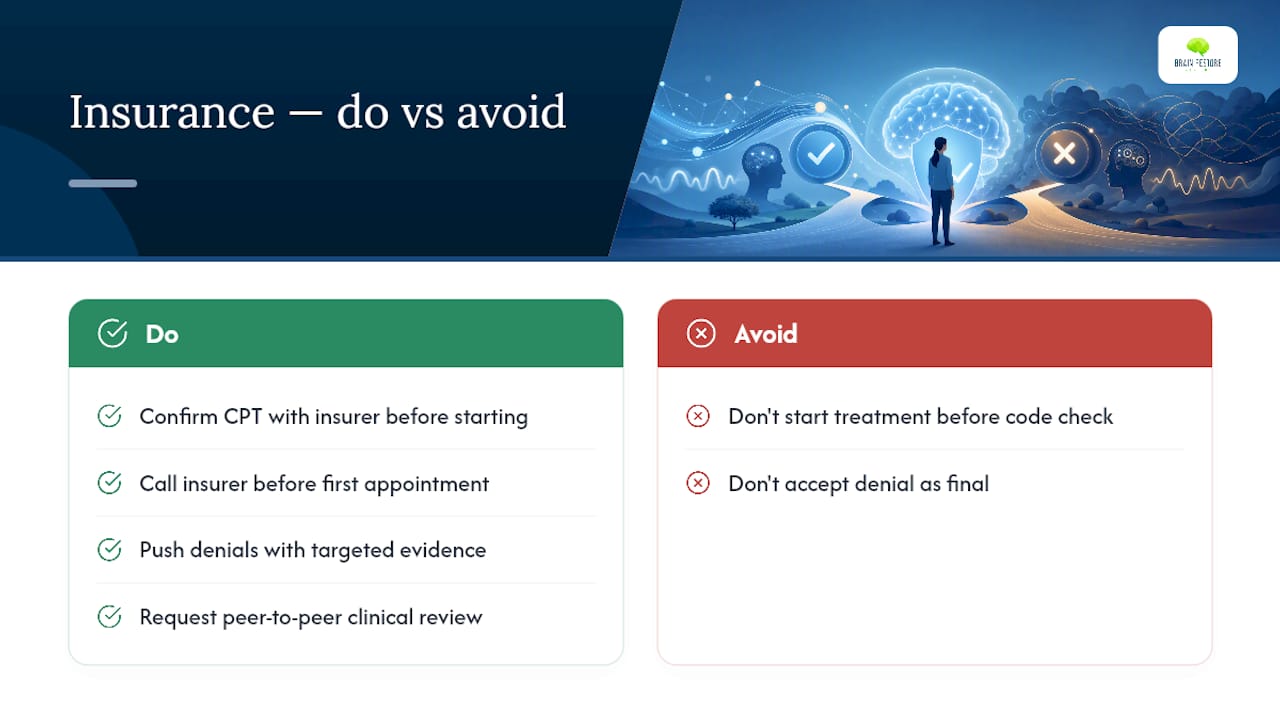
The biggest mistake I see is patients starting treatment before confirming CPT codes with their insurer. By the time they discover the code doesn’t match their diagnosis, they’ve already paid for sessions that could have been billed correctly from day one. Prioritize the preauthorization call over the first appointment.
The second mistake is treating a denial as final. Insurers deny first and reconsider when providers push back with specific, targeted evidence rather than generic appeals. A peer-to-peer review with a clinician who cites real outcome measures changes outcomes more often than people assume.
— Chad
Chasing down CPT codes, medical necessity language, and appeal deadlines on your own is a lot to manage while you’re also trying to get better. Brainrestoremeridian handles the documentation side directly, so you’re not building a letter of medical necessity from scratch or guessing which billing code your insurer will accept.
Our clinicians combine qEEG brain mapping with individualized neurofeedback protocols and provide the itemized superbills and letters of medical necessity that insurers ask for during preauthorization and appeals. We can’t promise your plan will pay, no clinic honestly can, but we can make sure your claim gives you the strongest possible shot. If you’re weighing whether neurofeedback fits your situation, whether for anxiety or another diagnosis, schedule a coverage consultation with our team and bring your prior treatment history and any denial letters you’ve already received. For a broader look at how Medicare coverage limits affect out-of-pocket costs generally, Medicare Part B guidance is worth a read before your consultation.
This article is general information, not a substitute for advice from a qualified doctor. Consult a qualified healthcare professional about your own circumstances before acting on anything here.