Patients' 5 Science Questions on Photobiomodulation for Brain Injury
September 23, 2026

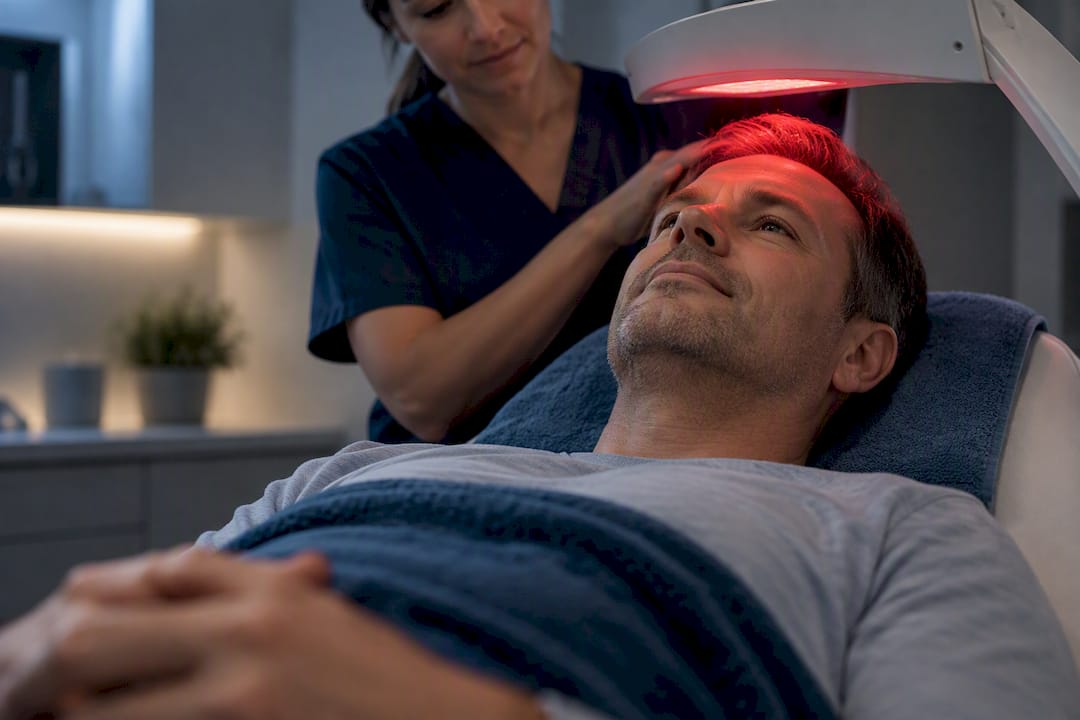
Photobiomodulation for brain injury shows real promise for specific outcomes like cognitive processing, mood, and cerebral blood flow, but it isn’t a proven cure and the evidence base remains uneven. If you’re considering it, the most responsible path is a conversation with a clinician who can supervise treatment, track objective outcomes, and rule out contraindications. Skipping that step and self-treating with an unverified device is where the real risk lives.
TL;DR:
- Wavelengths around 810 nanometers show the most consistent improvements, but current evidence remains limited by small sample sizes and protocol variability.
- Regular treatment appears necessary, as gains from LED therapy tend to fade quickly once sessions stop, indicating it may serve more as maintenance than a cure.
- Accurate dosing and placement based on individual anatomy are critical, but many studies lack detailed reporting of parameters, complicating standardization efforts.
- More extensive, well-controlled trials with objective measures and neuroimaging are needed to confirm PBM’s effectiveness beyond preliminary findings.
- Safety is generally good with mild, infrequent side effects, but unsupervised use or exaggerated claims should be approached with caution until stronger evidence develops.
The honest answer is: encouraging, but not settled. Researchers have been testing red and near-infrared light on brain tissue for over a decade, and the picture that emerges from human studies is one of real signal mixed with real noise.
A comprehensive review of cellular mechanisms and clinical evidence found that transcranial PBM using red-to-near-infrared wavelengths modulates mitochondrial activity and reduces neuroinflammation, with documented improvements in cognition and mood across several human studies. The same review on photobiomodulation and TBI recovery is blunt about a core problem: protocols vary so much from study to study that comparing results head-to-head is genuinely difficult. One team’s “high dose” is another team’s “moderate dose,” and that inconsistency is the single biggest obstacle to drawing firm conclusions.
Case reports offer some of the most compelling, albeit limited, data available. Several documented case reports of patients with chronic traumatic brain injury who used nightly transcranial LED treatment at home reported sustained improvements in cognitive function, including sharper memory and better attention. The catch: when these patients stopped treatment for more than a week, their gains started to fade. That detail from the case reports on LED therapy and chronic TBI matters enormously for anyone weighing whether PBM is a one-time fix or an ongoing maintenance therapy, and it suggests the latter.
Pilot randomized trials tell a more cautious story. A sham-controlled pilot study of transcranial LED therapy in adults with chronic symptoms following mild traumatic brain injury found that some participants reported subjective improvement, but objective neuropsychological testing showed limited change. With only nine participants, the sham run-in pilot study simply didn’t have the statistical power to separate a real treatment effect from expectancy and natural symptom fluctuation. That’s not a failure of PBM. It’s a reminder that small trials, however well-designed, can’t answer big questions on their own.
Broader reviews synthesizing both animal and human data support a similar conclusion. Evidence covering wavelengths from 600 to 1100 nanometers suggests PBM can improve regional cerebral blood flow, reduce inflammatory markers, and support cognitive and functional recovery in both preclinical models and human volunteers, according to a review on photobiomodulation for TBI and stroke. A newer systematic review focused specifically on cognitive outcomes in TBI patients found that small, well-controlled crossover designs using objective testing and neuroimaging are feasible and can help distinguish genuine physiological effects from expectancy, a design standard the systematic review on cognitive outcomes argues the field needs more of.
Here’s how the outcomes break down by strength of evidence:
What ties all of this together is a methodological pattern. Nearly every human study to date has a small sample, ranging from single-digit case reports to pilot trials with a few dozen participants. Larger, adequately powered, sham-controlled trials with objective endpoints are still the missing piece. Until those exist, PBM for brain injury sits in a scientifically legitimate but still-developing category, more established than a fringe therapy, less established than a first-line treatment.
The biological rationale for photobiomodulation rests on a molecule most people have never heard of: cytochrome c oxidase. This enzyme sits inside mitochondria and acts as the final gatekeeper in the chain that produces ATP, your cells’ primary energy currency. Red and near-infrared light, particularly in the 660 to 810 nanometer range, gets absorbed by cytochrome c oxidase, and that absorption appears to boost mitochondrial energy output in stressed or injured neurons.
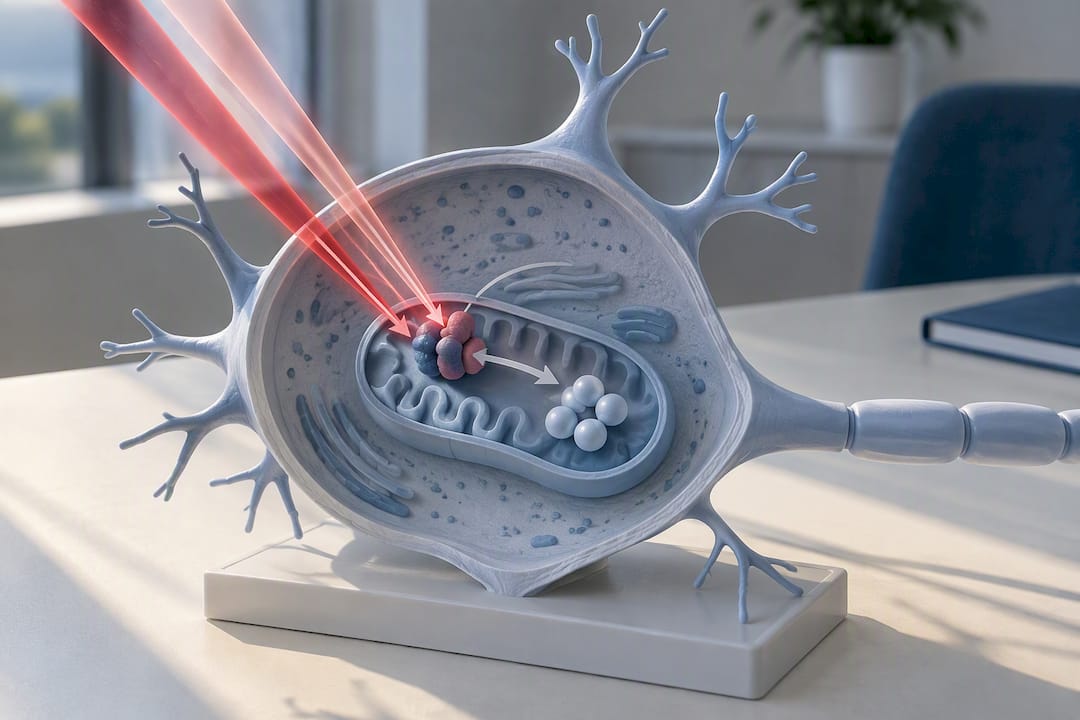
Think of it like giving a struggling generator a small, targeted jolt of fuel efficiency. It doesn’t rebuild the generator, but it can help it run better while the surrounding systems recover.
That energy boost doesn’t happen in isolation. Reviews of preclinical and human data describe several downstream effects that follow the initial mitochondrial response:
The review covering PBM mechanisms in TBI and stroke also points to a bridge between cellular mechanism and clinical outcome: functional imaging. Studies using fMRI and SPECT have documented that PBM can shift activation patterns within the default mode network, the brain’s resting-state hub involved in memory, self-referential thought, and attention regulation, along with improved regional cerebral perfusion. That imaging evidence matters because it gives researchers something objective to measure beyond a patient’s self-report.
Pro Tip: If you’re evaluating PBM research, look specifically for studies that pair a clinical outcome (like a memory test score) with an imaging or blood biomarker. Studies that show both are far more convincing than those relying on symptom questionnaires alone, since questionnaires are more vulnerable to placebo effects.
None of this means PBM works like a switch you flip and inflammation disappears. The mitochondrial and anti-inflammatory effects described in the research are supportive processes, not a cure for structural brain damage. They may help tip the balance toward recovery in a brain that’s already trying to repair itself, which is a meaningfully different claim than reversing injury outright.
If you read enough PBM research, you’ll notice the same numbers repeating: 810 nanometers, a handful of joules per square centimeter, a few dozen milliwatts. None of that means much without context, so here’s how to think about the parameters that actually show up in the literature.
Wavelength selection matters more than intensity. A preclinical study comparing wavelengths in a rodent model of mild traumatic brain injury found that 810 nanometers produced the largest and most consistent functional improvements, outperforming both 660 nanometers alone and combined 660/810 nanometer protocols. That finding from the preclinical study on 810 nm efficacy is one reason 810 nm has become something of a default choice in near-infrared brain protocols, though 660 nm remains common in devices designed for more superficial tissue penetration.
1064 nanometers is the emerging frontier, not the established standard. Near-infrared light at this longer wavelength theoretically penetrates deeper into brain tissue than 810 nm, which matters for reaching structures beyond the cortical surface. But human efficacy and safety data for 1064 nm remain limited compared with the more established 810 nm body of evidence, according to emerging research on deeper-penetrating wavelengths. Treat any device marketed heavily on 1064 nm claims with appropriate skepticism until more human trials catch up.
Irradiance and energy density define the actual dose, not just the wavelength. Studies report irradiance (measured in milliwatts per square centimeter) and energy density (joules per square centimeter) across a fairly wide range, and session counts vary from single treatments to daily protocols lasting 20 to 30 minutes over several weeks. An adolescent concussion trial is testing daily 20 minute PBM sessions over a period tracked against MRI and brain connectivity endpoints, according to the Clinicaltrials.
Pulsing versus continuous wave delivery remains an open question. Some protocols use continuous light exposure; others pulse the light at specific frequencies, theorized to interact differently with cellular signaling. The research hasn’t converged on a clear winner, and most published human studies simply don’t report enough detail to compare the two approaches fairly.
Placement follows anatomy, not guesswork. Effective protocols typically target scalp regions overlying areas relevant to the default mode network and frontal executive function, sometimes referencing landmarks like the bregma point in animal studies. Precise, reproducible placement is one more variable that separates a rigorous clinical protocol from an at-home device used without guidance.
The deeper issue, and one worth understanding before you commit to any PBM regimen, is that “dose” in PBM research isn’t as simple as it sounds. The light energy that reaches a neuron depends on the device’s output, the distance from scalp, and how much the skull attenuates the signal, a factor that varies by skull thickness and even hair density. Preclinical dose response data show that both underdosing and overdosing can reduce efficacy, meaning there’s a real window rather than a “more is better” relationship, as noted in the preclinical dosing research. Compounding the problem, many published studies simply omit key details like irradiance, spot size, or distance to scalp, according to the review on PBM parameter reporting gaps. If you’re working with a clinician, ask them to document every parameter used in your sessions. That record is what lets your care team adjust intelligently and what lets researchers eventually build the standardized protocols this field still lacks.
The safety profile reported across published studies is reassuring. Adverse events tend to be rare, mild, and typically limited to things like temporary scalp warmth or mild headache, rather than anything approaching a serious complication. That said, “reported as generally mild in studies” is not the same as “risk-free for everyone,” and the distinction matters.
A few safety and interpretation issues deserve direct attention:
There are also patient-specific red flags worth raising with any provider before starting treatment. Uncontrolled seizure disorders, rapidly changing medication regimens, and any treatment plan without clinical monitoring are reasons to pause and ask more questions. PBM’s mechanism involves biologically active processes in brain tissue, and a lack of oversight removes your ability to know whether you’re responding, plateauing, or experiencing something that needs medical attention.
If you want to read more on how laser-based approaches fit into a broader brain health strategy, Brainrestoremeridian’s guide to laser therapy’s role in brain health covers additional clinical context.
You essentially have two paths: supervised treatment at a clinic, or a home-based LED device you manage yourself. Each comes with real trade-offs.
Clinic-based treatment typically means a calibrated laser or LED array, a clinician who documents wavelength, irradiance, and session duration, and some form of outcome tracking, whether that’s cognitive testing, symptom questionnaires, or imaging. That structure is exactly what the research suggests matters most: consistent parameters and objective measurement over time. At-home devices offer convenience and, based on the case report data discussed earlier, may support maintenance once a benefit has been established. But they generally lack the monitoring and parameter verification that let you know whether the device is delivering a dose anywhere near what the research studies used.
Before starting treatment anywhere, ask your provider these questions:
If you’re interested in enrolling in a clinical trial rather than pursuing commercial treatment, ClinicalTrials.gov is the standard place to search. The adolescent concussion PBM trial is one active example, testing daily sessions against MRI-based connectivity endpoints, and searching that database by condition and intervention type will surface others as they open.
On cost and expectations: insurance coverage for PBM specifically remains inconsistent, and most clinics treat it as part of a broader program rather than a standalone billable service. Realistic timelines from the case report literature suggest that meaningful subjective change, when it happens, tends to build over weeks of consistent sessions rather than appearing after a single treatment.
Pro Tip: Ask any provider to show you the specific study their protocol is modeled on, including the wavelength and dose used in that study. If they can’t point to a specific source, that’s a meaningful gap in how rigorously they’re applying the evidence.
The single biggest need in this field is scale. Almost every promising finding described above comes from a study with a sample size measured in single or low double digits. Larger, sham-controlled randomized trials that pair objective cognitive testing with neuroimaging endpoints would let researchers finally separate genuine physiological effect from expectancy and natural recovery, something the current literature simply can’t do with confidence yet.
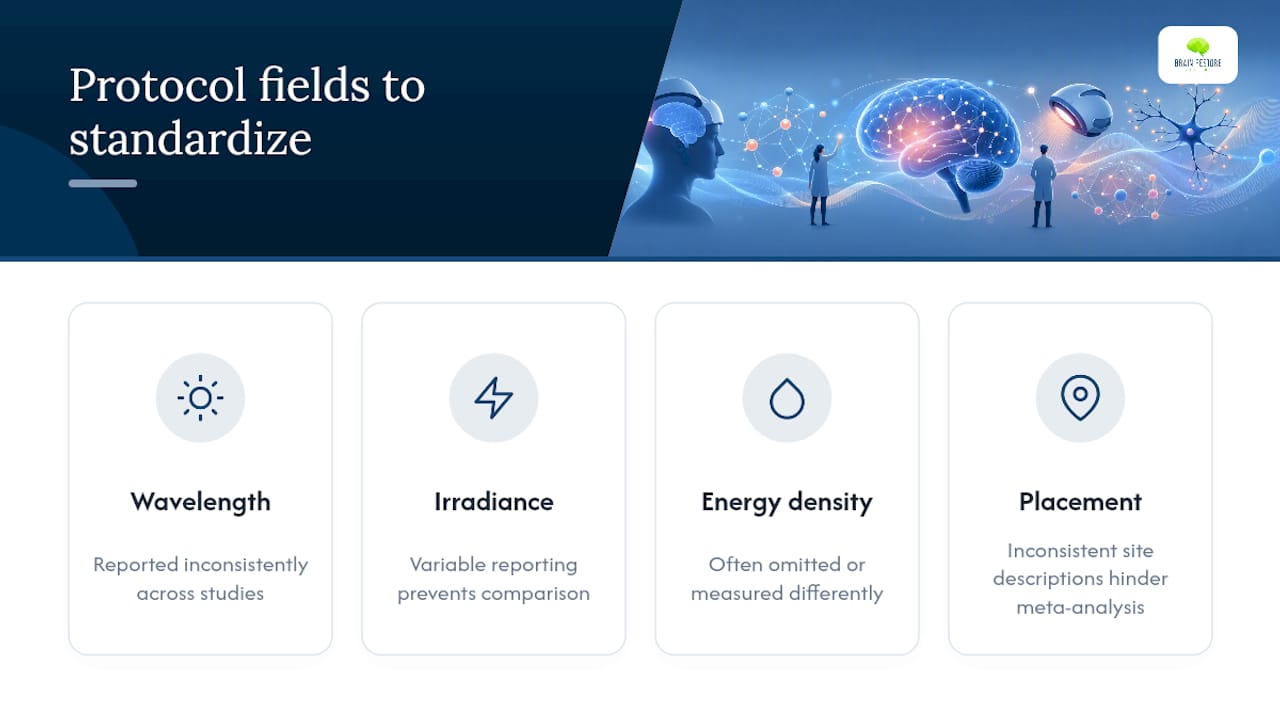
Standardization is the second urgent gap. Because studies report wavelength, irradiance, energy density, and placement so inconsistently, meta-analyses struggle to compare results meaningfully. A field-wide reporting standard, something closer to how clinical drug trials must report dosing, would let researchers build on each other’s work instead of starting over with each new protocol.
Deeper-penetrating wavelengths represent a genuine technical frontier. The early evidence around 1064 nanometers suggests it could reach brain structures that 810 nm light doesn’t fully access, but that potential is still mostly theoretical in humans and needs dedicated safety and efficacy work before it moves from promising to proven.
The most intriguing long-term direction may be personalization through artificial intelligence. Researchers behind one of the field’s more comprehensive reviews have suggested that AI-driven optimization of wavelength, pulse frequency, and dose, tailored to an individual’s skull thickness, injury pattern, and treatment response, could solve the standardization problem from a different angle entirely, according to the review discussing AI-guided parameter optimization. Instead of a one-size protocol applied to everyone, adaptive dosing informed by real-time response data could make PBM meaningfully more precise than it is today. That technology isn’t clinically available yet, but it’s a clear signal of where credible researchers think the field needs to head.
— Chad
Photobiomodulation is offered as one tool within a broader, multidisciplinary approach to brain restoration that can include neurofeedback, functional medicine, and hyperbaric oxygen therapy.
The typical workflow starts with a thorough assessment of injury history, symptoms, and goals, followed by shared decision-making about photobiomodulation and how it fits alongside other therapies. When included, treatment occurs under clinical supervision with outcome tracking to monitor progress.
We don’t recommend PBM as a universal answer for every brain injury case. Some patients benefit more from starting with neurofeedback or functional medicine work first, depending on what your evaluation reveals. That’s the point of an integrated program: matching the tool to the person, not the other way around.
Reading about mitochondrial mechanisms and irradiance ranges only gets you so far when what you actually need is a clinician looking at your specific injury and history. Supervised photobiomodulation is offered as part of an integrated care model within a multidisciplinary approach rather than as an unsupervised device treatment.
A consultation at our Meridian clinic starts with understanding your injury timeline, current symptoms, and prior treatment attempts. From there, we build a plan that may include low level laser therapy alongside neurofeedback, hyperbaric oxygen therapy, or functional medicine work, whichever combination fits what your evaluation actually shows. Progress gets tracked over time, not guessed at.
If you’ve been living with lingering cognitive symptoms, mood changes, or memory concerns after a brain injury, the next step is a Brain Health Consultation through our Brain Restore Program. Reach out to schedule an evaluation and find out whether supervised PBM belongs in your recovery plan.
If you want to go straight to the source material behind this article, these are the core studies and reviews worth your time:
This article is general information, not a substitute for advice from a qualified doctor. Consult a qualified healthcare professional about your own circumstances before acting on anything here.
Red and near-infrared light therapy shows measurable benefits for certain outcomes, particularly cognitive processing, mood, and cerebral blood flow, in preclinical and small human studies. It hasn’t been proven as a universal treatment, and results vary depending on wavelength, dose, and how consistently treatment is delivered, as detailed in the review on PBM mechanisms and evidence.
There’s no single best therapy for every case of traumatic brain injury, since outcomes depend heavily on injury severity, symptoms, and timing. Many patients benefit from a combination approach, such as the multidisciplinary model used at Brainrestoremeridian’s Brain Restore Program, which pairs supervised photobiomodulation with neurofeedback and functional medicine based on individual assessment.
Clinical management typically starts with a thorough evaluation of symptoms and injury history, followed by a combination of rest, targeted rehabilitation, and emerging supportive therapies like photobiomodulation or neurofeedback. Ongoing outcome tracking, whether through symptom questionnaires, cognitive testing, or imaging, helps clinicians adjust the plan as recovery progresses.
Memory loss after brain injury is often addressed through cognitive rehabilitation, neurofeedback training, and emerging approaches like photobiomodulation, which has shown improvements in working memory and executive function in several studies. A brain scan evaluation can also help identify which regions are affected, guiding a more targeted treatment plan.
Published studies report that adverse events from photobiomodulation are generally rare and mild, most commonly limited to temporary scalp warmth. Anyone with uncontrolled seizures, rapidly changing medications, or no clinical supervision should discuss those specific risks with a provider before starting treatment.