6–9 Month Outlook: Clinician Guide to Brain Fog After COVID
September 20, 2026


Yes, persistent cognitive difficulties after COVID-19 are real, measurable, and shared by a meaningful share of people who get infected. Most people see gradual improvement within six to nine months, though some notice symptoms well beyond a year. Your first steps are simple: track what you’re experiencing (when it happens, what triggers it, how long it lasts), and see your primary care provider or a neurologist if the fog persists past a few months or interferes with work, driving, or daily tasks.
TL;DR:
- Most people recover from COVID-related brain fog within six to nine months, but some may experience symptoms lasting beyond a year, especially with severe initial illness.
- Elevated brain injury markers and structural brain changes have been documented in patients a year post-infection, confirming biological effects behind cognitive symptoms.
- Pacing, consistent sleep, managing mood disorders, and structured cognitive rehab are core strategies, with some benefit from targeted therapies like neurofeedback or hyperbaric oxygen.
- Factors increasing the risk of prolonged symptoms include extended bed rest, hospitalization with ICU stay, and coexisting anxiety or depression.
- Objective evaluation involves detailed symptom tracking, targeted testing, and referrals to specialists, rather than relying solely on brief screening tools.
Brain fog after COVID isn’t a formal diagnosis. It’s a shorthand patients and clinicians use for a cluster of cognitive symptoms, including trouble concentrating, sluggish thinking, memory lapses, and difficulty finding the right word mid-sentence. When these symptoms persist for three months or longer after the initial infection, they typically fall under the umbrella of Long COVID, which is defined in part by that three-month persistence window.
The standard term clinicians and researchers use in published literature is “post-COVID cognitive dysfunction” or “post-COVID neurocognitive impairment.” Brain fog is the everyday language for the same experience, and this article uses both because patients search for one and clinicians document the other.
How common is it? Estimates vary by study design and how long after infection researchers checked in with patients.
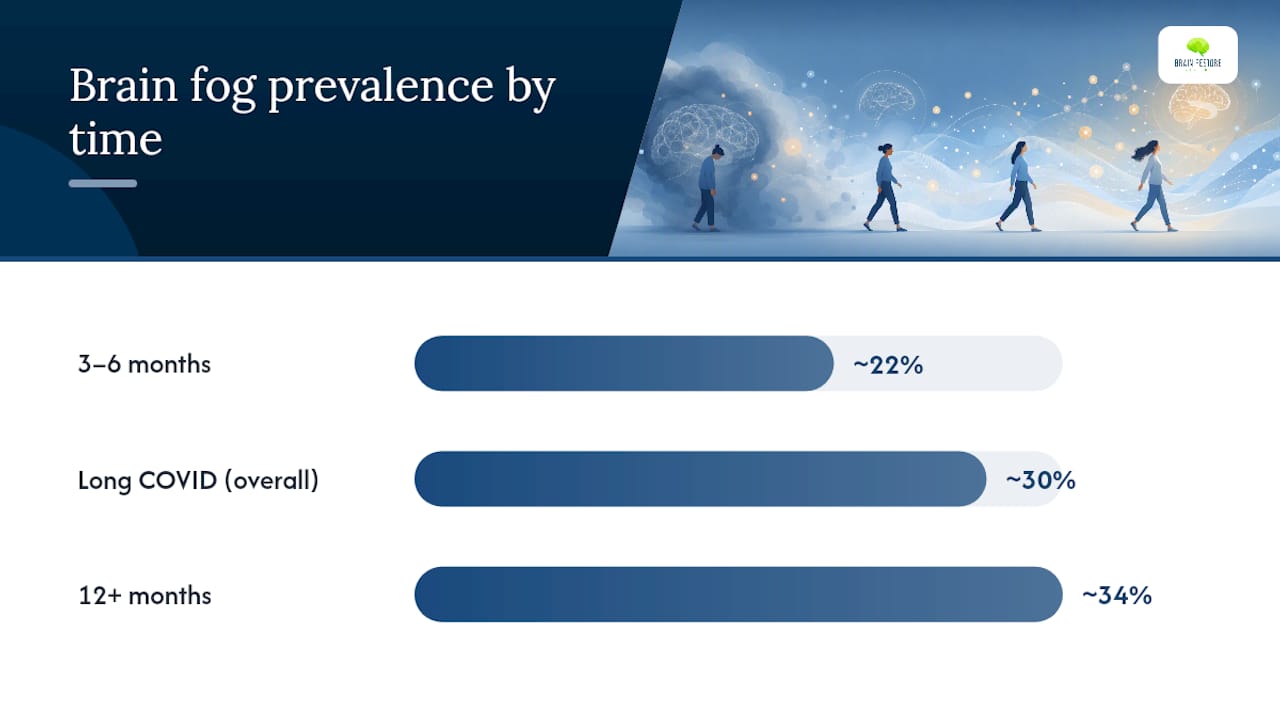
About 30% of people with Long COVID report brain fog, and that number tends to climb the longer researchers follow patients.
One systematic review found the reported rate moved from roughly 22% at three to six months post-infection to close to 34% beyond the twelve-month mark, according to a systematic review of intervention modalities for long-COVID brain fog. That upward trend doesn’t necessarily mean the condition is getting worse for any one person. It more likely reflects that cognitive symptoms are the type of Long COVID complaint that tends to linger while other symptoms, like loss of smell or shortness of breath, resolve faster.
At a population level, CDC surveillance data estimated that a substantial percentage of U.S. adults were living with Long COVID as of 2024, with cognitive complaints ranking among the commonly reported symptoms in that group. That translates to millions of people navigating some version of what you’re dealing with right now.
Study-to-study variability is worth naming honestly. Some research relies on self-reported symptom checklists; other studies use structured neuropsychological testing. Different populations (hospitalized versus outpatient, older versus younger, vaccinated versus unvaccinated) produce different numbers. No single percentage tells the whole story, but the consistent theme across studies is that cognitive symptoms are common enough, and durable enough, to take seriously as a distinct clinical entity rather than a vague complaint.
Brain fog rarely looks like the dramatic memory loss people picture. It’s subtler and, in some ways, more frustrating because it’s harder to explain to a boss, a spouse, or even yourself.
The most common pattern clinicians see is executive dysfunction. That’s the mental machinery responsible for planning, organizing, multitasking, and switching between tasks smoothly. You might notice you can no longer keep three browser tabs of thought open at once, or that a task that used to take twenty minutes now eats an hour because you keep losing your place.
Short-term memory lapses and word-finding trouble show up constantly in patient reports. You walk into a room and forget why. You’re mid-sentence and the word you need simply isn’t there, even though you can describe exactly what you mean. Some people describe it as talking through static.
Brain fog rarely travels alone. It tends to show up alongside:
One pattern deserves special attention: post-exertional symptom worsening, sometimes shortened to PEM. For a subset of patients, pushing through a demanding mental or physical task doesn’t just tire them out. It triggers a crash hour or a day later, with cognitive symptoms spiking well past baseline. This matters enormously for how you plan your week, because “just push through it” is often the wrong advice for this specific pattern.
Pro Tip: Keep a simple daily log for two weeks: rate your mental clarity on a 1 to 10 scale three times a day, and note what you did in the hours before a dip. That log becomes one of the most useful things you can hand a clinician, and it often reveals triggers you’d never have noticed otherwise.
Researchers don’t have one clean answer for why COVID leaves cognitive symptoms behind, but the picture has come into sharper focus over the past two years, largely thanks to biomarker and imaging studies that give clinicians something more concrete than a symptom checklist.
The leading explanations center on immune-mediated injury and neuroinflammation rather than the virus directly infecting brain tissue. Evidence for the virus itself crossing into the brain in large numbers remains limited. What has stronger support is an indirect pathway: the infection triggers an immune and inflammatory response that affects blood vessels, the blood brain barrier, and supporting brain cells, and that disruption is what seems to produce lingering cognitive effects.
A prospective multicenter study gave this theory real weight. Researchers measured blood markers of brain injury, specifically neurofilament light chain and glial fibrillary acidic protein, in patients roughly a year after hospitalization for COVID-19.
Patients showed elevated levels of both markers compared with uninfected controls, along with measurable reduction in gray matter volume in the anterior cingulate cortex, a brain region tied to attention and executive function.
That combination, elevated injury markers plus structural volume loss, according to the posthospitalization cognitive deficits study published in Nature Medicine, gives clinicians something to point to that isn’t just a patient’s subjective report. It tells you the deficits some patients experience have a biological substrate, not just a psychological one.
Severity of the acute illness raises risk, but it doesn’t set the floor. Hospitalization, low oxygen levels, and prolonged bed rest during the initial infection are all associated with a higher likelihood of persistent cognitive symptoms later. That said, plenty of people who had mild, outpatient cases of COVID still develop brain fog. Mild illness is not a guarantee of a clean cognitive recovery, and that’s an important point for anyone who assumes their “mild case” rules out lasting effects.
The honest caveat here is heterogeneity. Not every patient with brain fog has abnormal biomarkers, and not every patient with abnormal biomarkers has noticeable symptoms. Researchers are still working out which biological signatures predict which clinical courses, and that uncertainty is part of why individualized evaluation matters more than a one-size-fits-all protocol.
Most people improve. The typical recovery window runs several months, often around six to nine, with steady, if uneven, gains in concentration and mental stamina over that stretch. That’s the reassuring baseline, and it holds true for a majority of people who develop cognitive symptoms after infection.
A meaningful minority don’t follow that timeline. Research tracking patients over longer periods has documented impaired cognitive function persisting well beyond a year after diagnosis. That’s not the norm, but it’s common enough that “just give it a few more weeks” isn’t always the right advice, especially past the one-year mark.
Certain factors predict a longer, rockier recovery:
| Risk factor | Why it matters |
|---|---|
| Extended bedridden period during acute illness | Associated with 2 to 3 times higher prevalence of long-term impaired cognitive function, per an observational study on acute COVID-19 severity |
| Encephalopathy or altered mental status during infection | Linked to more severe and persistent cognitive deficits |
| Coexisting anxiety or depression | Compounds cognitive symptoms and can slow perceived recovery |
| Hospitalization requiring intensive care | Correlates with greater biomarker elevation and imaging changes |
If your recovery has plateaued rather than continuing to improve, that’s worth flagging to a clinician rather than assuming it’s simply your new baseline. Plateaus can mean several things: an underlying sleep disorder, an untreated mood component, or a need for more structured cognitive rehabilitation rather than time alone. Relapses, meaning a return of fog after a period of feeling better, are also common and don’t necessarily mean you’re back at square one. They often trace back to overexertion, poor sleep, or an intercurrent illness, and they tend to settle once the trigger is addressed.
There’s no single blood test or scan that confirms brain fog after COVID. Diagnosis is a process of ruling out other explanations and documenting the pattern carefully, which is exactly why a structured visit matters more here than in conditions with a clear-cut lab marker.
A detailed history and symptom diary come first. Clinicians want specifics: when symptoms started relative to your infection, what tasks trigger them, whether they fluctuate, and whether physical or mental exertion makes them worse the next day. A two-week log, like the one mentioned earlier, speeds this step up considerably.
Standard cognitive screening tools get used, but they have real limits. Tests like the Montreal Cognitive Assessment were built to catch dementia-level impairment, not the subtler executive dysfunction typical of post-COVID fog. A review on cognition and Long COVID found that subjective complaints frequently exceed what standard batteries detect, meaning a normal screening score doesn’t rule out a real problem.
Targeted testing fills the gap when screening looks normal but symptoms persist. This can include neuropsychological testing focused specifically on processing speed and executive function, blood work to rule out thyroid dysfunction or anemia, and, in select cases, neuroimaging to look for structural changes.
Referral to specialists happens when symptoms are significant or testing reveals something concrete. Common referral pathways include neurology for further workup, speech-language pathology or occupational therapy for cognitive rehabilitation, and rehabilitation medicine for a structured, graded recovery plan.
The practical takeaway: if a doctor runs a quick screening test, finds nothing abnormal, and tells you everything is fine, that’s not necessarily the end of the conversation. Ask about function-based assessment, meaning tests or observations tied to your actual work and daily tasks, since that’s often where the deficit actually shows up.
Treatment for brain fog after COVID works best as a staged plan, not a single fix. Start with the safest, best-supported strategies, add structured rehabilitation, consider medications under a clinician’s guidance, and stay realistic about which emerging therapies are proven versus promising.
Pacing is the single most consistently recommended strategy across clinical guidance, and it’s also the one patients resist the most. The instinct when you feel a little better is to catch up on everything you missed. Yale Medicine clinicians specifically warn against this, describing a “brain budgeting” approach where you allocate mental energy deliberately across a day rather than spending it all at once, according to their guidance on managing Long COVID brain fog. If you notice that mental or physical overexertion triggers a crash the next day, a pattern called post-exertional malaise, pacing isn’t optional advice. It’s the difference between steady progress and a repeating cycle of overdoing it and crashing.
Beyond pacing, a handful of fundamentals show up in nearly every clinical recommendation:
Pro Tip: If you notice a crash the day after a mentally demanding event, like a long work call or a big family gathering, don’t just rest more that day. Build in a lighter day the day before, too. Patients who “pre-pace” around known demands report fewer crashes than those who only rest reactively.
Speech-language therapy and occupational therapy aren’t just for stroke or traumatic brain injury patients. Both disciplines offer structured practice tasks aimed at rebuilding processing speed, working memory, and executive function, and they can tailor exercises to your specific job demands, whether that’s managing a spreadsheet-heavy role or a job that requires constant verbal quick-thinking. A structured cognitive rest and rehabilitation approach developed for concussion recovery shares real overlap with what’s used for post-COVID cognitive symptoms, since both address graded return to demanding mental tasks rather than an abrupt jump back to full capacity.

Some clinicians report benefit from N-acetylcysteine (NAC) and guanfacine in selected patients with persistent cognitive symptoms, and both show up in clinical practice reports from Yale Medicine’s Long COVID program. These aren’t FDA-approved treatments for post-COVID brain fog specifically, and the evidence supporting them is still developing. If your doctor suggests one, understand it as a considered, individualized decision rather than a proven standard of care.
A systematic review of intervention modalities for long-COVID brain fog looked specifically at noninvasive brain stimulation and hyperbaric oxygen therapy. The findings were encouraging but far from conclusive: both showed promising early results, but the review’s authors flagged that the trials were small, varied widely in design, and need to be replicated in larger, more rigorous studies before either approach can be called a standard treatment.
Neurofeedback is another modality showing up in post-COVID recovery discussions, typically as part of a broader multidisciplinary plan rather than a standalone cure. The honest framing for all three, brain stimulation, hyperbaric oxygen, and neurofeedback, is that they represent reasonable options to discuss with a clinician who can evaluate whether your presentation fits the profile these studies examined, not guaranteed fixes.
Watch for red flags: any clinic promising a guaranteed cure, a single-session fix, or refusing to explain what evidence supports their specific protocol. A legitimate multidisciplinary approach should be able to describe, in plain terms, which parts of your care plan have stronger evidence behind them and which are considered adjunctive or still under investigation. If a cognitive dysfunction recovery guide or clinic page can’t answer that question directly, that’s worth noticing.
The biomarker and imaging findings from the past two years have shifted how clinicians talk to patients about post-COVID brain fog. Elevated neurofilament light chain, elevated GFAP, and measurable gray matter reduction give clinicians objective language to use instead of vague reassurance. When a patient asks “is this in my head,” the honest answer, backed by the Nature Medicine posthospitalization study, is often no. There’s a measurable biological signature behind at least a subset of these cases.
That shift matters clinically because it changes how multidisciplinary teams build a care plan. Rather than treating cognitive complaints as a single undifferentiated problem, clinicians increasingly separate the dysexecutive pattern (trouble with planning, multitasking, and processing speed) from memory-focused deficits, since the two respond to different rehabilitation strategies. Real-world functional examples, like struggling specifically with multitasking at work versus forgetting appointments, help target therapy more precisely than a generic memory test.
The consistent thread across recent studies is that subjective patient reports and objective testing don’t always agree, and that gap itself is clinically meaningful rather than a sign the patient is exaggerating.
A comprehensive evaluation for post-COVID cognitive symptoms typically pulls together a detailed history, targeted cognitive screening, and, where the picture calls for it, functional medicine bloodwork to rule out thyroid, nutritional, or metabolic contributors that can worsen cognitive symptoms independent of COVID itself. That’s the kind of integrated evaluation approach that combines neurofeedback, photobiomodulation, and functional medicine under one coordinated plan rather than sending you to three unconnected specialists.
The realistic outcome framing worth holding onto: most patients see genuine improvement with a structured, paced approach. Full resolution isn’t guaranteed for everyone on a fixed timeline, but meaningful gains in daily function are the expected outcome for the majority of people who get evaluated and follow a consistent plan.
The gap between how brain fog feels and how it looks from the outside is often the hardest part. You can appear perfectly fine in a five-minute conversation while struggling to manage a full workday, and that mismatch creates real friction with employers, family, and even yourself.
At work, the most common impact isn’t total incapacity. It’s a drop in efficiency and reliability on tasks that used to feel automatic. Meetings that require holding multiple threads of conversation, deadline-heavy projects, and jobs requiring quick verbal responses tend to expose the deficit fastest. Some patients find themselves working longer hours to produce the same output, which quietly accelerates fatigue and worsens the underlying problem.
At home, brain fog shows up in smaller but persistent ways: forgetting where you put your keys multiple times a day, losing track of a conversation with your kids, or feeling too mentally drained by evening to manage household logistics you used to handle without thinking. Driving is worth naming specifically, since slowed processing speed and divided attention can affect reaction time in ways that matter for safety.
If your job allows it, requesting accommodations, like reduced meeting load, flexible scheduling around your best cognitive hours, or written follow-ups to verbal instructions, can meaningfully reduce the daily strain while your recovery continues.
Watching someone you love struggle with cognitive symptoms that don’t show up on any visible scan can be confusing for caregivers too. The most useful thing you can offer isn’t a cure. It’s structure and patience.
Start by believing the symptoms without needing proof. Brain fog is invisible in a way that’s genuinely hard for outside observers to grasp, and skepticism from family, even well-meaning skepticism, tends to make the psychological burden heavier.
Practical support matters more than most people expect:
Caregivers also need to protect their own energy. Supporting someone through a slow, nonlinear recovery is genuinely draining, and caregiver burnout tends to sneak up gradually rather than announce itself. It’s reasonable, and often necessary, to build in your own breaks and your own support system alongside the person you’re caring for.
Cognitive symptoms rarely arrive alone. Anxiety and depression show up frequently alongside post-COVID brain fog, and the relationship runs in both directions. Struggling to think clearly is frightening, especially when it affects your ability to work or parent the way you used to, and that fear itself can spiral into anxiety that makes concentration even harder.
Depression tends to creep in more gradually, often tied to grief over lost capacity. Patients describe mourning the version of themselves who could juggle a demanding job, a full social calendar, and a sharp memory without a second thought. That grief is legitimate, even when the underlying medical picture is expected to improve.
Treating the mood component directly is not a distraction from treating the cognitive symptoms. It’s part of the same plan. Anxiety and depression both worsen attention, processing speed, and memory independent of any post-COVID biological changes, which means an untreated mood disorder can make brain fog look and feel worse than it would otherwise. If your fog has stayed flat despite following pacing and rehabilitation strategies, an unaddressed mood component is worth raising with your clinician before assuming the cognitive treatment plan has failed. For readers navigating chronic fatigue alongside a mental health component, a resource on chronic fatigue and the psychiatry versus psychology distinction offers useful context on when each type of specialist fits best.
Brain fog overlaps with several other post-COVID presentations, and sorting out which label fits matters because treatment approaches differ.
Post-COVID brain fog is primarily a cognitive complaint: trouble concentrating, slowed thinking, memory lapses, word-finding difficulty. Myalgic encephalomyelitis or chronic fatigue syndrome, which some Long COVID patients go on to develop, centers on profound physical and mental exhaustion with post-exertional malaise as a defining feature, and cognitive symptoms often ride alongside that fatigue rather than standing as the primary complaint.
New-onset anxiety or depression following COVID is a distinct, though frequently overlapping, presentation. The distinguishing question clinicians ask is whether low mood or worry came first and cognitive symptoms followed, or the reverse. Both patterns are common, and both deserve treatment regardless of which came first.
Autonomic dysfunction, sometimes called dysautonomia or POTS, produces symptoms like lightheadedness, rapid heart rate on standing, and temperature regulation problems. This can worsen cognitive symptoms indirectly, since reduced blood flow to the brain during autonomic episodes can mimic or intensify brain fog. A thorough evaluation should screen for this rather than attributing every symptom to cognitive dysfunction alone.
The differentiation matters clinically because a treatment plan built for straightforward brain fog won’t necessarily address underlying autonomic dysfunction or an unaddressed mood disorder. This is exactly why a structured evaluation, rather than a self-diagnosis based on symptom overlap, gives you a more reliable path forward.
Medical treatment and rehabilitation matter most, but daily habits set the floor your recovery builds on. Skipping meals, running dehydrated, or relying on caffeine to push through fog tends to make symptoms worse rather than better.
Hydration deserves specific attention because mild dehydration alone can mimic or worsen brain fog symptoms, including slowed thinking and headache. Consistent water intake throughout the day, rather than large amounts consumed sporadically, supports steadier mental energy.

Steady blood sugar matters more than any single “brain food.” Skipping meals and then eating a large, carbohydrate-heavy meal can produce an energy crash that closely resembles a cognitive dip, which makes it hard to tell whether you’re experiencing post-COVID fog or simply a blood sugar swing. Regular, balanced meals with protein, fiber, and healthy fats tend to produce steadier mental energy across the day than a caffeine-and-sugar pattern.
Alcohol is worth reconsidering during active recovery. It disrupts sleep quality even when it feels relaxing in the moment, and poor sleep is one of the most reliable amplifiers of cognitive symptoms on this list. Limiting or pausing alcohol intake for a stretch is a low-cost experiment worth trying if you haven’t already.
None of these lifestyle changes replace medical evaluation or structured rehabilitation. They’re the foundation that makes the rest of your treatment plan work better, not a substitute for it.
Patients describing brain fog after COVID are often bracing for skepticism before they even finish the sentence. That bracing is understandable, and it’s also exactly backward. The biomarker research alone should settle the question of whether these symptoms are real: measurable brain injury markers and structural volume changes don’t show up in people who are imagining a problem.
What tends to get lost in more alarmist coverage of Long COVID is the genuinely encouraging part of the data. Most people improve. Recovery isn’t usually a straight line, and a plateau at month four doesn’t mean you’re stuck there permanently, but the trajectory for the majority of patients bends upward over six to nine months.
A multidisciplinary approach earns its place here because post-COVID brain fog rarely has one single cause. Someone’s fog might be driven mostly by unaddressed sleep disruption, another person’s by a lingering mood component, another’s by a genuine biological injury pattern that benefits from structured cognitive rehabilitation and targeted therapies like neurofeedback. Treating all three the same way wastes time that patients, understandably, don’t want to waste.
The conservative, honest position is this: expect gradual improvement, expect some setbacks along the way, and get evaluated properly rather than assuming either extreme, that it’s nothing or that it’s permanent. Both extremes are usually wrong, and the actual answer for most people sits somewhere more hopeful in between.
— Chad
If you’re past the point of waiting it out and want a real evaluation, some clinics offer a coordinated team approach that looks at your brain, metabolic health, and nervous system together instead of sending you to multiple separate offices.
The Brain Health Consultation and Brain Restore Program starts with a detailed evaluation designed to build a plan around your specific pattern of symptoms, not a generic checklist. From there, care can draw on neurofeedback, hyperbaric oxygen therapy, functional medicine bloodwork, and progressive rehab, matched to what your evaluation actually shows rather than applied as a one-size-fits-all package. If your recovery has stalled and you suspect there’s more going on than the acute infection itself, a brain scan evaluation for memory and cognitive symptoms can help clarify what’s driving the plateau.
Before your visit, bring your symptom log, a timeline of your COVID infection and any hospitalization, and a list of what daily tasks have gotten harder. Scheduling an evaluation at a specialized clinic is the next concrete step if pacing and time alone haven’t moved the needle.
Most people see steady improvement within six to nine months of onset. Some patients report impaired cognitive function persisting up to 32 months after diagnosis, particularly those who had a more severe acute illness.
There’s no single fix. The most consistently recommended approach combines pacing to avoid post-exertional crashes, consistent sleep, treating any underlying anxiety or depression, and structured cognitive rehabilitation through speech-language or occupational therapy, following clinical guidance from Yale Medicine. Some patients also benefit from evaluation at a multidisciplinary clinic, such as through the Brain Restore Program, for a more individualized plan.
Research points mainly to immune-mediated injury and neuroinflammation rather than the virus directly invading brain tissue. A study in Nature Medicine found elevated brain injury markers and reduced gray matter volume in patients a year after hospitalization, supporting a measurable biological cause in at least a subset of cases.
“COVID brain” is an informal term for the same cognitive symptom cluster commonly called brain fog: trouble concentrating, memory lapses, slowed thinking, and word-finding difficulty following COVID-19 infection. It’s typically classified as part of Long COVID when symptoms persist three months or longer, affecting an estimated 30% of long COVID patients.
For most people, no. Cognitive symptoms tend to improve gradually over months rather than staying fixed, though recovery isn’t always a straight line and some patients experience plateaus or relapses along the way. A minority of patients, especially those with more severe acute illness, report symptoms lasting well beyond a year, which is why ongoing evaluation matters if improvement stalls.