20 Minutes a Day: Vestibular Exercises Matched to Your Diagnosis
October 1, 2026

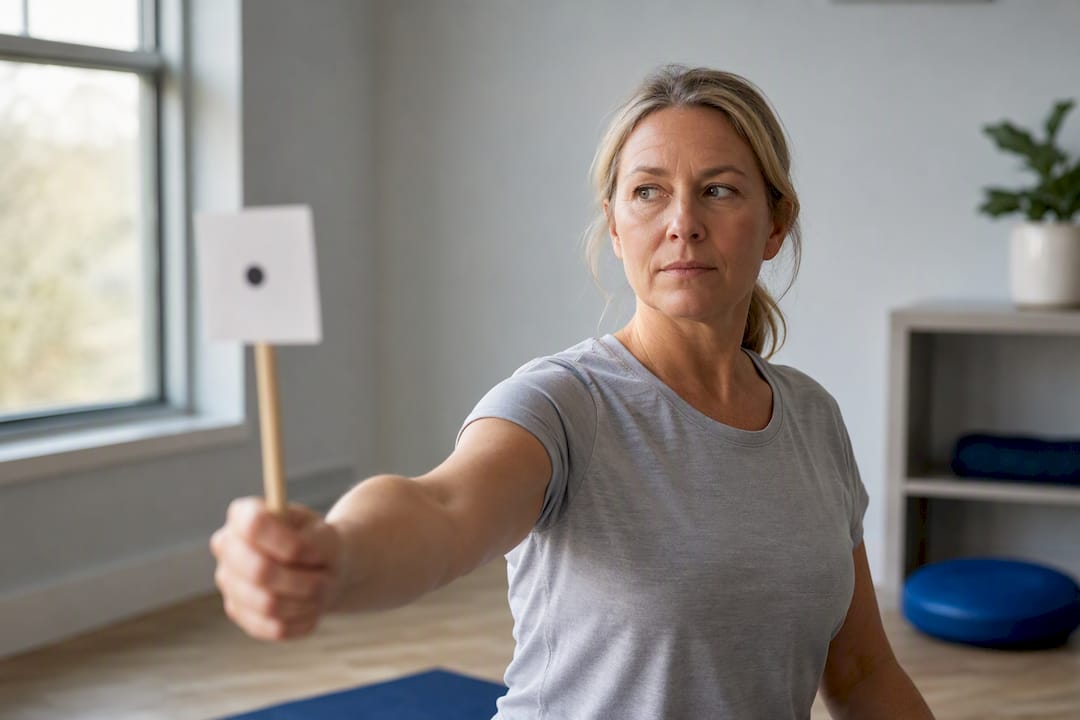
If your vision blurs when you turn your head, gaze-stabilization exercises are the right starting point. If motion or busy environments trigger your dizziness, habituation drills help more. If you feel unsteady on your feet, balance and gait training matter most. You can safely begin seated versions of these at home, but see a clinician promptly if you have brief spinning tied to rolling over in bed, or any sudden neurological symptoms.
TL;DR:
- Gaze stabilization exercises are most effective when your head movements are slow and controlled, with the target at a distance where focus is just manageable.
- Habituation exercises should be performed in short, frequent sets to gradually decrease sensitivity to motion triggers, with immediate professional evaluation for intense or brief spinning spells.
- Balance and gait training require progressing from static to dynamic exercises, with safety measures like support or assistive devices to prevent falls during improvement.
- Emergency symptoms like sudden weakness, facial drooping, or vision loss indicate urgent medical care, while ongoing dizziness warrants a detailed clinical assessment for tailored treatment.
Vestibular rehabilitation retrains the coordination between your inner ear, eyes, brain, muscles, and joints. When that teamwork breaks down, you get dizziness, blurry vision during head movement, or a wobbly sense of balance. According to Cleveland Clinic, this kind of therapy retrains that coordination to reduce dizziness, stabilize vision, and improve balance, lowering your risk of falling in the process.
The exercises fall into four main groups, and matching the right one to your symptoms is what makes the difference between progress and frustration.
The evidence behind this approach is strongest for peripheral vestibular hypofunction, a reduced signal from the inner ear’s balance organs. These exercises manage the resulting symptoms and often restore function significantly, though they do not reverse the underlying inner ear damage itself. Think of it less as a cure and more as retraining your brain to compensate, the way physical therapy retrains a joint after an injury.
Two exercises anchor this category. Both require moving your head, not just your eyes, because eye tracking alone does not change the reflex you are trying to retrain.
Start with slow, small head movements and gradually increase speed and range as your vision stays clear.
Pro Tip: Keep the target at a distance where you can just barely maintain focus, that edge is where the retraining actually happens.
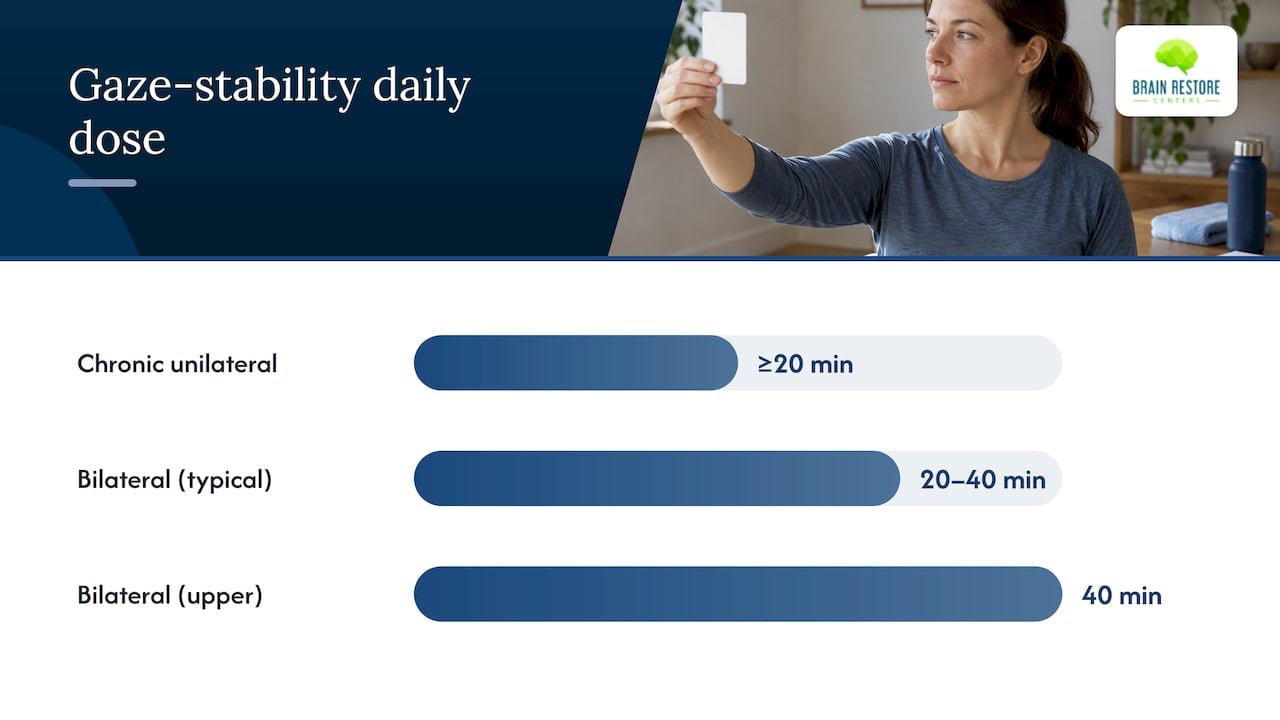
Guideline dosing: The Academy of Neurologic Physical Therapy’s clinical practice guideline suggests gaze-stability practice three to five times daily for people with chronic unilateral hypofunction, totaling at least 20 minutes a day for four to six weeks, while bilateral hypofunction often calls for 20 to 40 minutes daily over about five to seven weeks. These are clinician-guided targets, not one-size-fits-all numbers.
The most common mistake is tracking with your eyes while barely moving your head, which does little for the reflex you’re trying to rebuild. The same guideline specifically advises against using eye-only movements like saccades or smooth pursuit in isolation for this purpose. If neck pain limits your range, keep the movement pain-free and build tolerance gradually rather than forcing it.
Habituation works differently than gaze stabilization. Instead of retraining a reflex, it repeatedly exposes you to the specific movement that triggers your dizziness, at a controlled dose, until your brain stops overreacting to it.
The classic example is the Brandt-Daroff exercise: sit on the edge of a bed, lie down quickly onto one side with your nose angled slightly upward, hold for about 30 seconds or until dizziness settles, return to sitting, then repeat on the other side.
One important caveat: if your spinning is brief, intense, and specifically triggered by rolling over in bed or lying down and sitting up, that pattern points toward benign paroxysmal positional vertigo. In that case, canalith repositioning performed by a clinician, not habituation, is usually the priority.
Balance training works best as a ladder of progressions rather than a single drill repeated forever. Static work builds your base; dynamic work translates that stability into walking.
Pro Tip: Have someone nearby for your first attempt at any new progression, and never try single-leg or eyes-closed balance work near stairs.
If unsteadiness is significant, a cane or walker used temporarily during these drills is not a setback, it’s a sensible way to keep practicing safely while your balance improves.

You don’t need equipment to begin. This sequence is designed to be gentle enough to start the same day you read this, while still giving your system something to adapt to.
Once seated sets feel manageable, move to the same head movements while standing with support, then to short hallway walks with gentle head turns.
Keep a simple log of symptom intensity before and after each session. The goal is a manageable challenge, not exhaustion: if you feel wiped out for hours afterward, scale back the dose before you scale up the difficulty.
Not every kind of dizziness responds to the exercises above, and starting with the wrong one can waste weeks. If lying down, rolling over, or sitting up triggers brief, intense spinning that resolves within a minute, that pattern is classic for benign paroxysmal positional vertigo. The American Academy of Otolaryngology-Head and Neck Surgery describes canalith repositioning maneuvers like the Epley or Semont, performed in-office, as the usual first-line treatment, and many patients improve after a single session.
Certain symptoms need immediate attention rather than a home routine. Call 911 if you notice any of the following, which the CDC lists among possible stroke signs:
Beyond emergencies, seek an evaluation if your dizziness is new, worsening, recurring after past BPPV episodes, or causing falls. If you’ve read this far and still aren’t sure which category your symptoms fall into, that uncertainty itself is a good reason to get assessed rather than guess. Our vertigo treatment guide walks through how clinicians distinguish BPPV from other causes before choosing a treatment path.
We start every vestibular case with a detailed history, positional testing, and a gait and balance exam, because the same symptom, dizziness, can come from several different problems that need different exercises. Supervised progression matters because dosing that’s too light stalls recovery and dosing that’s too aggressive can discourage a patient from continuing. When your home routine isn’t working or your symptoms won’t resolve, that’s the signal to come in for a proper look.
— Chad
You don’t have to guess which exercises fit your symptoms. Our team evaluates your specific pattern of dizziness, performs canalith repositioning in-office when BPPV testing calls for it, and builds a personalized vestibular exercise program you progress safely under supervision.

If your dizziness has lingered despite trying exercises on your own, or you’d rather start with an accurate diagnosis, book a Brain Health Consultation and let’s figure out the right plan for you.
This article is general information, not a substitute for advice from a qualified doctor. Consult a qualified healthcare professional about your own circumstances before acting on anything here.
There isn’t one best exercise, the right choice depends on your symptoms. Gaze stabilization helps when head movement blurs your vision, while habituation and balance training target motion-triggered dizziness or unsteadiness respectively.
You don’t reset it in one step, you retrain it gradually through repeated, targeted movement matched to your specific symptom pattern. Gaze-stabilization and habituation exercises done consistently over several weeks, as described by the Academy of Neurologic Physical Therapy, are the standard approach for peripheral hypofunction.
Start seated with target-focused head turns, diaphragmatic breathing, and short habituation sets, then progress to supported standing and walking as symptoms allow. Stanford Medicine’s guidance recommends practicing these progressions a few times daily and building up gradually.
For peripheral vestibular hypofunction, these exercises are well supported for reducing dizziness and improving balance and function, according to Cleveland Clinic. They work less well as a first step for BPPV, which usually responds better to a canalith repositioning maneuver.