
Physical Symptoms Linked to Depression: What to Watch For
August 8, 2026


Depression shows up in your body far more often than most people realize. The physical symptoms linked to depression fall into several clear groups: persistent fatigue, disrupted sleep, appetite and weight changes, unexplained aches and pain (headaches, back pain, muscle and joint pain), gastrointestinal complaints, sexual or libido changes, psychomotor slowing or agitation, and cardiovascular-type symptoms like palpitations or chest tightness. These are not side effects of feeling sad. They are direct expressions of how depression alters brain chemistry, inflammation pathways, and nervous system regulation. According to a landmark review by Trivedi et al., many patients with depression present to primary care with somatic complaints first, and mood symptoms only emerge later, if at all.
If your physical symptoms are new, worsening, or unexplained after a standard medical workup, bring them to your clinician. Act immediately if you experience any of the following:
Depression’s physical effects span nearly every system in the body. Research confirms that somatic symptoms fall into two broad categories: painless (or vegetative) and painful. Understanding both helps you recognize patterns that might otherwise be dismissed as unrelated health problems.
This is the most reported somatic symptom. You may sleep eight or nine hours and still wake feeling exhausted. Simple tasks feel physically heavy. This is not laziness; it reflects disrupted neurochemistry and sleep architecture that depression produces at a biological level.
Depression commonly causes both insomnia and hypersomnia. You might lie awake for hours, wake repeatedly through the night, or sleep far longer than usual and still feel unrefreshed. In one large European study cited in a PMC review of somatic symptoms, broken or decreased sleep was commonly reported by patients with depression.

Some people lose their appetite almost entirely; others find themselves eating compulsively, particularly high-carbohydrate foods. Both patterns are common. Significant unintentional weight loss or gain, especially without a dietary explanation, warrants clinical attention.
Tension-type headaches and migraines occur at higher rates in people with depression. The pain is often described as a dull, persistent pressure around the forehead or temples. These headaches tend to be resistant to standard OTC pain relief when the underlying mood disorder goes untreated.
Chronic low-back pain without a clear structural injury is one of the most frequent presentations. Muscles may ache diffusely, and joints can feel stiff or sore. Harvard Health notes that people with depression have a significantly increased risk of developing chronic pain, and the relationship runs in both directions.

Nausea, bloating, constipation, diarrhea, and stomach cramping are all reported with depression. The gut and brain share extensive neural and hormonal communication pathways, which is why mood disorders so often produce digestive distress that does not resolve with diet changes alone.
Some people with depression move and speak noticeably more slowly than usual. Others experience the opposite: a restless, agitated quality that makes sitting still feel impossible. Clinicians call these psychomotor retardation and psychomotor agitation. Both are physical, observable signs, not just subjective feelings.
Palpitations, a racing heart, chest tightness, and elevated resting heart rate can all accompany depression. These symptoms often send people to urgent care or cardiology before anyone considers a mood disorder. Depression is also linked as an independent risk factor for cardiovascular issues through inflammatory and autonomic pathways.
Reduced interest in sex, difficulty with arousal, and delayed or absent orgasm are common physical manifestations of depression. These changes are frequently underreported because patients feel embarrassed, yet they significantly affect quality of life and relationship health.
Slowed thinking, difficulty concentrating, and a sense of mental heaviness often accompany the physical slowdown. While these overlap with emotional symptoms, they have a clear physical dimension: reaction times slow, word retrieval falters, and processing speed drops.
A brief but important note on overlap: every symptom listed above can also arise from purely medical causes. Hypothyroidism produces fatigue and weight gain. Anemia causes exhaustion. Irritable bowel syndrome drives GI complaints. A clinician should rule out medical causes before attributing physical symptoms to depression, not the other way around.
The connection between mood and body is not metaphorical. It runs through three well-documented biological pathways.
Neurotransmitter dysregulation is the most direct link. Serotonin and norepinephrine regulate both mood and pain perception. When their signaling is disrupted, as it is in depression, the brain’s ability to modulate pain signals weakens. This is why the same neurotransmitters that lift mood also reduce pain, and why dual-action antidepressants (SNRIs like duloxetine or venlafaxine) often help both. The Trivedi review published in PMC documents this pathway in detail and explains why somatic symptoms carry high positive predictive value for underlying depression.
Inflammation and HPA-axis dysregulation form the second pathway. Depression activates the hypothalamic-pituitary-adrenal axis, keeping cortisol elevated and triggering low-grade systemic inflammation. Elevated inflammatory markers contribute to fatigue, pain sensitivity, gut motility changes, and cardiovascular stress. You can think of it as the body’s stress-response system stuck in a low-level “on” position. Understanding how chronic stress feeds into this cycle helps explain why stress management is not optional in depression treatment.
Behavioral and lifestyle effects complete the picture. Depression reduces physical activity, disrupts sleep, and alters eating patterns. Each of those changes independently worsens pain, fatigue, and gut function. Inactivity stiffens muscles and joints. Poor sleep amplifies pain sensitivity. Irregular eating destabilizes blood sugar and gut microbiome balance. These effects compound each other, which is why the physical burden of depression can feel so much larger than the emotional one.
The short answer: very common, and often the primary reason someone seeks care.
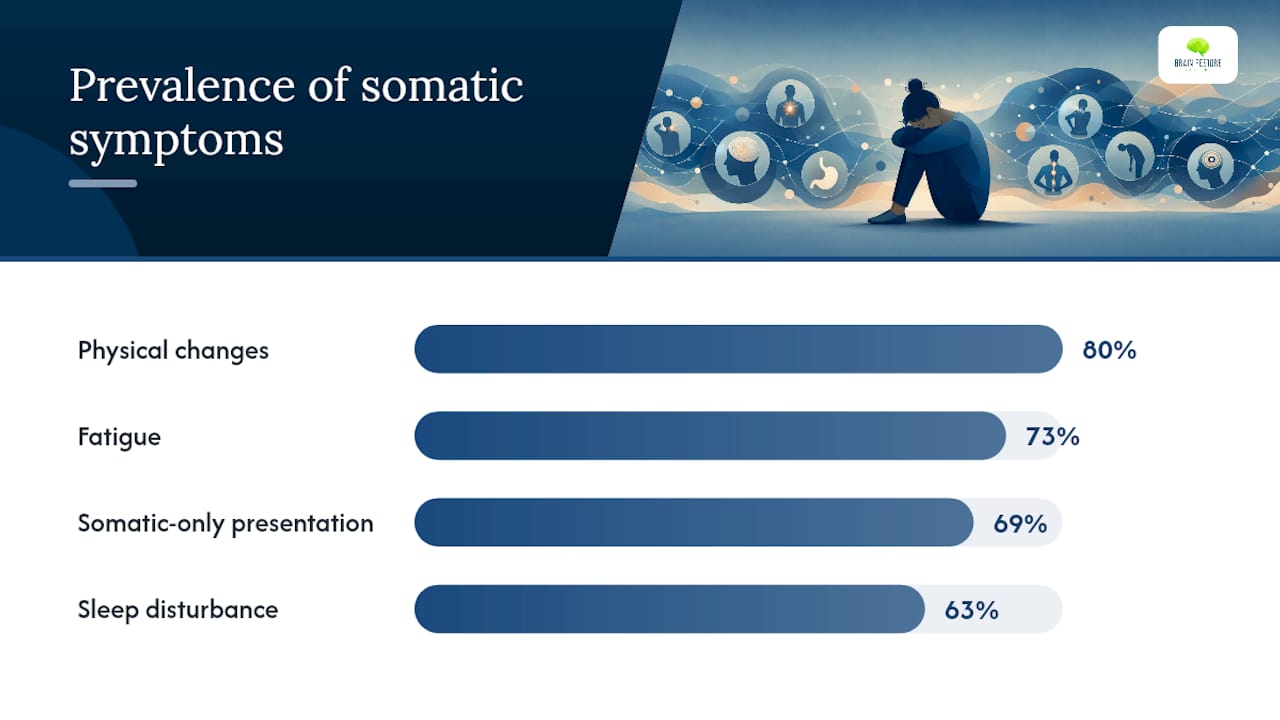
A WHO multicenter study cited in the Trivedi review found that roughly 69% of patients with depression presented to primary care with somatic-only complaints. Mood symptoms were secondary or absent at first contact. Separately, research on somatic presentations found that fatigue was reported by 73% and sleep disturbance by 63% of patients in the DEPRES II study. One patient-facing review notes that up to 80% of people with depression may experience physical changes.
| Symptom | Reported prevalence in depression |
|---|---|
| Fatigue / listlessness | 73% (DEPRES II study) |
| Broken or decreased sleep | 63% (DEPRES II study) |
| Somatic-only primary care presentation is very common, as shown by WHO multicenter study findings. | |
| Physical changes of any kind are experienced by up to 80% of people with depression, as noted in patient-facing reviews and multicenter research. |
Who is most likely to present this way?
Men tend to report physical symptoms, such as chest tightness, digestive issues, or a racing heart, more often than classic emotional complaints like sadness or hopelessness. NIMH notes this pattern contributes to missed or delayed diagnoses in men. Older adults frequently attribute physical symptoms to aging rather than mood, which delays evaluation further. People who already live with chronic pain face a compounding challenge: depression triples the risk of chronic pain, and chronic pain triples the risk of depression. When multiple unexplained physical complaints cluster together, especially fatigue, pain, and sleep disruption, the probability of an underlying mood disorder rises substantially.
A thorough evaluation starts with a detailed history. Your clinician will ask when symptoms began, whether they are constant or episodic, what makes them better or worse, and how they affect your daily function. A review of systems covers mood, sleep, appetite, energy, concentration, and any thoughts of self-harm. A focused physical exam follows.
Basic laboratory tests commonly ordered to exclude medical causes include:
Red flags that require urgent or emergency evaluation:
A practical communication tip: before your appointment, write down your three most disruptive physical symptoms, when they started, and how they affect your daily life. Clinicians can act on specifics far more effectively than on general statements like “I feel terrible.” Mention mood changes even if they feel secondary to you, because that context often changes the diagnostic picture entirely. Rating scales that capture both physical and emotional symptoms, such as the PHQ-9 or the HAMD, help clinicians track progress over time and define whether full remission has been reached.
Physical symptoms are not just inconvenient add-ons to depression. Their presence at the start of treatment predicts a longer and more complicated course. Research shows that the intensity and number of painful somatic symptoms at baseline predict a poorer antidepressant response and a longer time to remission. Residual physical symptoms, particularly fatigue and pain, are among the strongest predictors of relapse even after mood improves.
Full remission requires addressing somatic complaints alongside emotional ones. The table below maps treatment types to the symptom categories they most directly target.
| Treatment | Symptom targets | Evidence level |
|---|---|---|
| SNRIs (duloxetine, venlafaxine) | Pain, fatigue, mood, sleep | Strong (RCT data) |
| SSRIs (sertraline, escitalopram) | Mood, sleep, GI symptoms | Strong (RCT data) |
| Cognitive behavioral therapy (CBT) | Pain amplification, sleep, mood | Strong (RCT data) |
| Graded exercise | Fatigue, pain, mood, sleep | Moderate-strong |
| Sleep behavioral interventions (CBT-I) | Sleep disturbance, fatigue | Strong |
| Multimodal pain programs | Chronic pain, psychomotor symptoms | Moderate |
| Neurofeedback | Pain, sleep, mood regulation | Emerging/moderate |
| Functional medicine evaluation | Inflammatory drivers, nutritional deficits | Emerging |
Pro Tip: At your next clinical visit, bring a written list of your top three physical symptoms and rate each on a 0–10 scale. This gives your clinician a measurable baseline and makes it far easier to assess whether treatment is working for your body, not just your mood.
Multidisciplinary care, combining a prescribing clinician, a therapist, and a physical or integrative health provider, consistently outperforms single-modality treatment for patients whose depression includes significant somatic burden. The depression-gut-hormone connection is one reason why functional medicine evaluation adds value that standard psychiatric care alone may miss.
Depression’s physical symptoms are the dominant presentation in primary care, and treating them alongside mood is what drives full, lasting remission.
| Point | Details |
|---|---|
| Somatic symptoms are the norm | Up to 80% of people with depression experience physical changes, with around 69% presenting with somatic-only complaints in primary care settings as documented in multicenter studies. |
| Fatigue and sleep top the list | Fatigue and sleep disturbance are among the most frequently reported somatic symptoms in clinical studies. |
| Pain and depression amplify each other | People with depression carry roughly three times the risk of chronic pain, and vice versa. |
| Physical symptoms predict treatment difficulty | More painful somatic symptoms at baseline predict a longer time to remission and higher relapse risk. |
| Brainrestoremeridian offers integrated evaluation | The clinic combines neurofeedback, functional medicine, and multimodal pain approaches to address both mood and physical symptoms together. |
Most conversations about depression still center on mood. That framing leaves a lot of patients undiagnosed and undertreated, because the majority of people who walk into a primary care office with depression are not saying “I feel hopeless.” They are saying “I’m exhausted all the time,” “my back won’t stop hurting,” or “my stomach has been a mess for months.”
What strikes me most about the research on somatic presentations is not the prevalence numbers themselves, though up to 80% is striking and 69% present with somatic-only complaints in multicenter studies. It is the downstream consequence: when physical symptoms are missed or dismissed, the depression goes untreated, and the physical symptoms worsen. The pain-depression cycle is genuinely bidirectional and self-reinforcing. Treating only the mood without addressing the pain, the sleep, and the fatigue is like patching one side of a leaking pipe.
The other thing worth saying plainly: residual physical symptoms after a course of antidepressants are not a sign that treatment worked well enough. They are a sign that treatment is not finished. Persistent fatigue or pain after mood improves is one of the strongest predictors of relapse. Patients who feel “better but not right” deserve continued evaluation, not reassurance that they are fine.
The most effective path forward is one that maps the full symptom picture, physical and emotional, and treats both with equal seriousness. That is not a radical idea. It is just good medicine.
If you have been living with unexplained fatigue, persistent pain, disrupted sleep, or digestive symptoms alongside low mood, a standard office visit that ends with a prescription is rarely the whole answer. Brainrestoremeridian, located in Meridian, Idaho, takes a different approach: a comprehensive intake that maps both your neurological and physical symptom burden, followed by a coordinated care plan that may include neurofeedback for mood and pain regulation, functional medicine evaluation to identify inflammatory or nutritional contributors, chiropractic care, laser therapy, and rehabilitative support.

New patients begin with a thorough evaluation, not a rushed 15-minute appointment. The goal is to understand what is driving your symptoms at a root level, not just manage them one at a time. If you are ready to address the full picture, including the physical symptoms that depression leaves behind, you can schedule an evaluation with Brainrestoremeridian to get started.
Please note: if you are experiencing a medical emergency, suicidal thoughts, chest pain, or sudden neurological symptoms, call 911 or go to your nearest emergency room immediately. This clinic does not provide emergency services.
The sources below are vetted, authoritative, and worth bringing to your next clinical appointment if you want to discuss the evidence with your provider.
The Link Between Depression and Physical Symptoms (PMC, Trivedi et al.): — The foundational peer-reviewed review documenting somatic presentation rates, neurotransmitter mechanisms, and the clinical significance of physical symptoms in depression. Start here if you want the research backbone.
Somatic Symptoms in Depression (PMC): — Covers prevalence data including the 73% fatigue and 63% sleep disturbance figures, prognostic implications of painful symptoms, and the importance of monitoring residual somatic complaints during treatment.
Physical Symptoms of Depression: Can Depression Contribute to Pain? (Harvard Health): — A clinician-written, patient-friendly overview of the pain-depression relationship, including the three-times-higher risk finding and practical behavioral strategies.
Depression (NIMH): — The National Institute of Mental Health’s consumer guide covering diagnostic criteria, symptom lists, and treatment options. Useful for understanding how physical symptoms fit into the official diagnostic picture.
The Link Between Depression and Physical Symptoms (PubMed record): — The PubMed citation record for the Trivedi review, useful if your clinician wants to pull the full journal article or verify the source directly.
This article provides general health information and is not a substitute for professional medical advice. Please consult a qualified clinician to evaluate your specific symptoms and confirm any diagnosis or treatment plan.
Questions about your next step?
Our Meridian team can help you understand the evaluation process and which care options may fit your needs.
Schedule a ConsultationPrefer to speak with our team? Call 208-639-1397