Return to Work After TBI: Your Staged Recovery Plan
June 26, 2026


Returning to work after TBI is a medically supervised, graded process that supports both brain recovery and workforce re-entry. The Brain Injury Association of America (BIAA) confirms that return timing varies widely, from days to months, depending on injury severity and job demands. The Royal Australian College of General Practitioners (RACGP) and the University Health Network’s Canadian Concussion Centre both recommend starting before full symptom resolution, using functional goals rather than waiting to feel “normal.” This guide gives you a practical, step-by-step framework to re-enter the workforce safely, manage cognitive challenges, and protect your recovery along the way.
A clinician evaluation is the non-negotiable first step before any return-to-work plan begins. Your treating physician or neuropsychologist should assess concentration, memory, screen tolerance, and physical stamina. These findings form the baseline that shapes every decision that follows.
Several specific tools support this process:
Vocational rehabilitation services add another layer of support. These programs, often available through state agencies or hospital-based transitional programs, help you identify which roles fit your current capacity and build skills where gaps exist. Community reentry programs serve a similar purpose for those whose injuries require longer recovery timelines.
Pro Tip: Ask your clinician to complete a written Return to Work form before your first day back. A written document protects you legally and gives your employer clear, specific guidance rather than vague verbal instructions.
Understanding how cognitive rest affects recovery is also part of this preparation phase. Knowing your brain’s current limits helps you set realistic expectations before you walk back through the door.

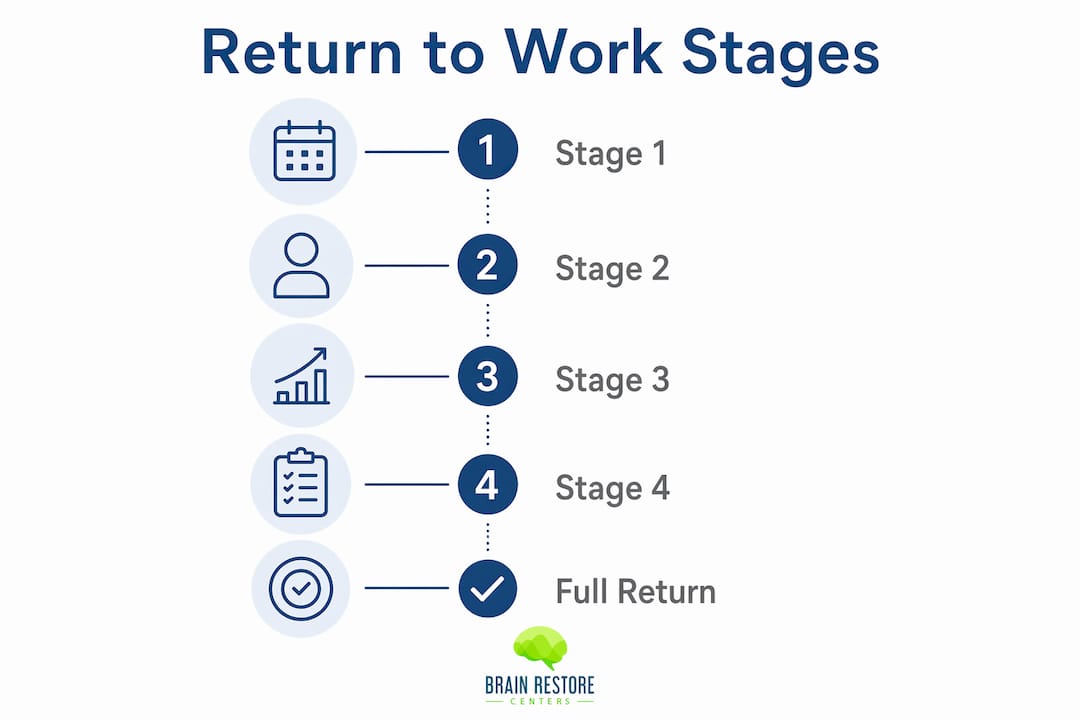
A staged return-to-work plan is the most effective framework for employment after brain injury. The RACGP recommends graded activity starting before full symptom resolution, using non-consecutive shifts and regular progress reviews. The goal is building cognitive endurance the same way you would rebuild physical strength after surgery: slowly, with rest, and with clear milestones.
A practical staged schedule looks like this:
| Stage | Hours per Day | Days per Week | Focus |
|---|---|---|---|
| Stage 1 | 2–4 | 2 (non-consecutive) | Low-demand tasks only |
| Stage 2 | 3–4 | 3 | Add one moderate task |
| Stage 3 | 5–6 | 4 | Short meetings with breaks |
| Stage 4 | Full day | 5 | Full duties with accommodations |
Clinician reviews every 1–2 weeks are not optional. They allow your care team to adjust the pace based on how your symptoms respond. Functional goals, such as “complete one 30-minute report without a headache,” are more useful than symptom-only goals like “feel better.” The Canadian Concussion Centre at UHN specifies rest breaks every 20–60 minutes as a standard accommodation during early return phases.
Negotiating with your employer is part of this process. The RACGP notes that workplaces may resist graduated plans without insurance or regulatory pressure. Coming prepared with written clinician documentation and a specific proposed schedule makes that conversation much easier.
Pro Tip: Frame your return-to-work proposal around what you can deliver, not what you cannot do. Employers respond better to “I can complete X task for Y hours” than to a list of restrictions.
Workplace accommodations for TBI address the specific cognitive symptoms that make a standard work environment difficult: attention deficits, fatigue, memory problems, and sensitivity to light and noise. MDGuidelines reports that successful return-to-work outcomes are strongly linked to employer flexibility and the use of structured accommodations.
The most effective accommodations fall into three categories:
| Symptom | Recommended Accommodation |
|---|---|
| Attention deficits | Written task lists, single-task assignments, quiet workspace |
| Fatigue | Flexible hours, scheduled rest breaks, reduced shift length |
| Memory difficulties | Written instructions, email summaries, digital reminders |
| Light sensitivity | Reduced overhead lighting, screen filters, private workspace |
| Noise sensitivity | Noise-canceling headphones, quiet room access, remote work |
The UHN Canadian Concussion Centre specifically recommends limiting meetings to 30–60 minutes with scheduled breaks. This detail is frequently overlooked. A two-hour meeting with no break can undo a full week of careful symptom management.
Employer culture matters as much as formal policy. MDGuidelines highlights that ongoing employer support and a willingness to adjust accommodations over time are key predictors of long-term workforce success after brain injury.
Recovery after TBI is non-linear. Setbacks are common and do not mean you have failed. The RACGP specifically recommends returning to earlier stages of the graded plan when symptoms worsen, rather than stopping work entirely. Stepping back one stage is a clinical strategy, not a defeat.
Practical strategies for managing setbacks include:
“Returning to work as soon as possible, if able, can actually speed recovery. The key is gradual planning with limits on cognitive load.” — Canadian Concussion Centre, UHN
Understanding why inflammation affects your recovery timeline can also help you make sense of why some weeks feel harder than others. Biological factors, not just effort, drive the pace of healing.
Setting realistic expectations about cognitive endurance is critical. Your brain is rebuilding capacity. Pushing through severe symptoms does not accelerate recovery. It delays it.
A staged, clinician-guided return-to-work plan is the most effective path to sustainable employment after traumatic brain injury, combining graded schedules, workplace accommodations, and regular medical reviews.
| Point | Details |
|---|---|
| Start with a clinical assessment | Get neuropsychological testing and a written Return to Work form before your first day back. |
| Use a staged schedule | Begin with 2–4 hours on 2 non-consecutive days and increase gradually based on symptom tolerance. |
| Request specific accommodations | Noise-canceling headphones, written instructions, and meeting limits of 30–60 minutes reduce cognitive overload. |
| Step back, not out, during setbacks | Return to an earlier stage of the graded plan when symptoms worsen rather than stopping work completely. |
| Review progress every 1–2 weeks | Frequent clinician check-ins allow timely adjustments and protect your recovery trajectory. |
Most people I work with expect returning to work to feel like flipping a switch. They assume that once they feel “good enough,” they can go back to full duties and pick up where they left off. That expectation causes more setbacks than almost any other factor.
The patients who do best are the ones who treat the return-to-work process as part of their rehabilitation, not the end of it. They negotiate with their employers from a position of preparation, not apology. They bring written documentation, a proposed schedule, and a clear list of accommodations. That approach changes the entire dynamic of the conversation.
The other thing I have seen consistently is that mental health support is underused. Cognitive symptoms get most of the attention, but the anxiety and grief that come with losing your previous work capacity are real and they slow recovery. Addressing both the neurological and emotional dimensions of TBI gives you a much stronger foundation.
Finally, do not underestimate the therapeutic value of being at work, even in a limited capacity. Purposeful activity, social connection, and routine all support brain recovery in ways that rest alone cannot provide. The goal is not to push through symptoms. The goal is to stay engaged at a level your brain can sustain and build from there.
— Chad
Recovering from a traumatic brain injury takes more than time. The right clinical support can meaningfully improve your cognitive function, reduce symptoms, and help you build the endurance you need to sustain work activity.
Brainrestoremeridian offers integrated brain health restoration combining neurofeedback, photobiomodulation, and functional medicine, therapies specifically designed to support neurological recovery after brain injury. Neurofeedback trains your brain’s electrical activity patterns, which can improve attention, reduce fatigue, and support the cognitive endurance you need at work. Photobiomodulation uses light energy to support cellular repair in brain tissue. These approaches complement your staged return-to-work plan by addressing the underlying neurological factors that drive your symptoms. If you are in the Meridian, Idaho area, Brainrestoremeridian’s team can build a personalized recovery plan around your specific cognitive profile and work demands.
Return timing varies widely. Some people return within days with short-term support, while others need months and may need to change roles entirely. Medical input is required to determine safe timing for your specific situation.
Yes. The RACGP recommends beginning a graded return before full symptom resolution. Early, staged return is therapeutic and can improve functional outcomes when managed carefully.
The most effective accommodations include flexible scheduling, written instructions, quiet workspaces, noise-canceling headphones, and meeting limits of 30–60 minutes with scheduled breaks. These directly address the cognitive symptoms most common after brain injury.
Step back to an earlier stage of your graded return-to-work plan rather than stopping work entirely. Notify your clinician and employer promptly so accommodations can be adjusted before symptoms escalate further.
Neurofeedback targets the brain’s electrical activity patterns and can improve attention, reduce fatigue, and support cognitive endurance. These are the exact functions most affected by TBI and most critical for sustained work performance.
Questions about your next step?
Our Meridian team can help you understand the evaluation process and which care options may fit your needs.
Schedule a Brain Health ConsultationPrefer to speak with our team? Call 208-639-1397