How to Communicate Mental Health Needs to Your Provider
June 22, 2026


Effectively communicating your mental health needs to a provider is the single most direct path to faster diagnosis and better treatment. Many patients leave appointments feeling unheard, not because their provider lacked skill, but because the visit lacked structure. The clinical term for this process is patient-provider communication, and research consistently shows that clear, prepared descriptions of your symptoms, their duration, and their daily impact give providers the information they need to help you. This guide gives you a practical framework to walk into any appointment ready to be heard.
Preparation is the most underused tool in mental health care. Patients who arrive with organized notes get more from a 15-minute appointment than those who try to recall everything on the spot. Symptom descriptions that include duration and daily impact help providers make accurate diagnoses and build effective treatment plans.
Before your appointment, write down the following:
Tracking this information over one to two weeks before your visit gives your provider a timeline, not just a snapshot. Symptom timelines showing onset and functional impact help clinicians distinguish a stress reaction from persistent anxiety or depression. That distinction directly shapes whether they recommend therapy, medication, or further testing.
Pro Tip: Apps like Daylio or a simple notes app on your phone work well for daily mood and symptom tracking. Even three data points per day, mood, sleep quality, and energy level, give your provider a clearer picture than memory alone.
You can also review informed healthcare decision frameworks to understand what questions to prioritize before you walk in.
Direct, plain language is the most effective communication tool you have in a clinical setting. You do not need clinical vocabulary or a formal diagnosis to communicate effectively. Providers use your description to ask follow-up questions and decide next steps without requiring formal terminology.
Start with a clear opening statement. These phrases work well:
After your opening, explain the functional impact. Tell your provider how the symptom changes your day. “I’ve missed three days of work this month” carries more clinical weight than “I’ve been feeling off.” Providers are trained to assess severity through functional impairment, so concrete examples accelerate that process.
Ask direct questions during the visit. Patients who ask specific questions get more specific answers. Try:
Pro Tip: If you feel nervous or tend to minimize your symptoms in the moment, write your opening statement on paper and read it aloud to your provider. This is not unusual. Providers see it regularly and appreciate the clarity.
Fear of dismissal is real, but presenting clear, direct information that shows symptom severity and functional impact significantly reduces the chance of being brushed off. You can also read about what providers routinely investigate when patients present anxiety symptoms, which can help you frame your concerns more confidently.

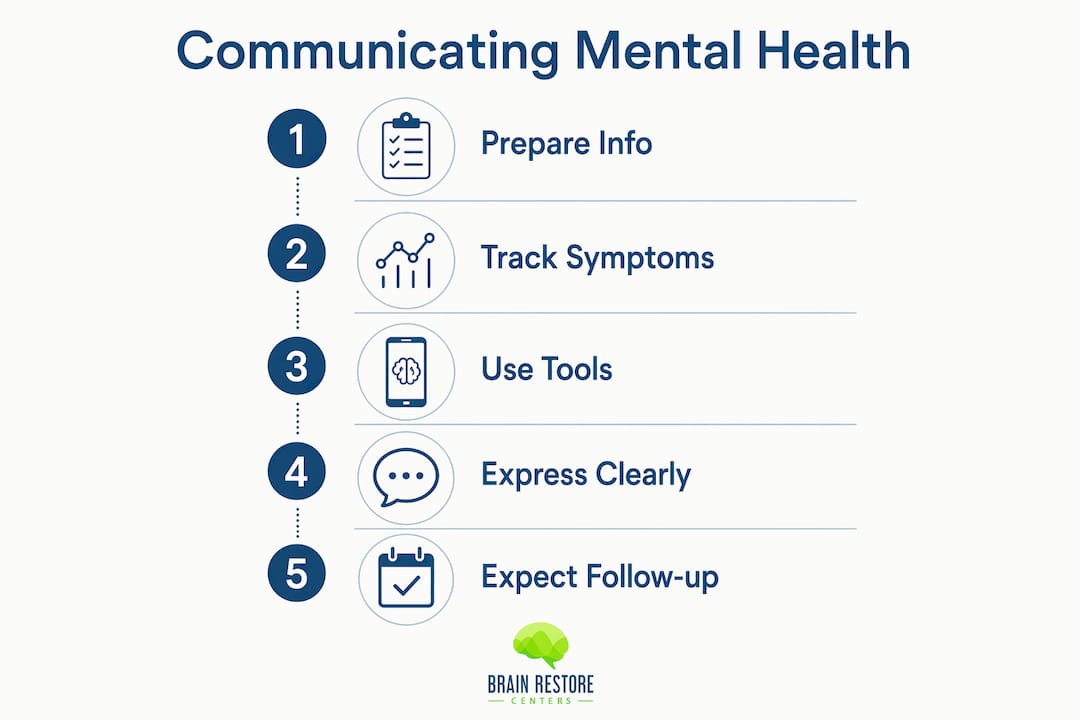
Standardized screening tools translate your subjective experience into objective clinical data. Completed screening tools help clinicians incorporate objective information rather than relying solely on verbal recall. Bringing your scores to an appointment gives your provider a documented starting point.
| Screening Tool | Condition Assessed | Format | Where to Find It |
|---|---|---|---|
| PHQ-9 | Depression | 9 questions, scored 0–27 | Available free online via SAMHSA |
| GAD-7 | Generalized anxiety | 7 questions, scored 0–21 | Available free online via SAMHSA |
| PCL-5 | PTSD symptoms | 20 questions | Available via the National Center for PTSD |
| MDQ | Bipolar disorder screening | 13 questions | Available via the Depression and Bipolar Support Alliance |
Complete the tool honestly and bring a printed or digital copy to your visit. More importantly, share your interpretation of the score. Explicitly sharing your concerns about your scores prompts clinicians to treat results as meaningful starting points rather than background data. Say something like, “My PHQ-9 score was 14. I wasn’t sure if that was serious, but it felt accurate to how I’ve been feeling.”
Between appointments, track medication adherence and side effects in writing. Sharing detailed medication adherence patterns and reasons for missed doses greatly improves your provider’s ability to interpret your symptoms. Clinicians cannot reliably reconstruct adherence without patient logs. A simple note that reads “Missed dose on Tuesday because of nausea” gives your psychiatrist far more to work with than a verbal estimate.
Pro Tip: The app Steadyline is designed specifically for tracking psychiatric symptoms and medication between visits. It generates summaries you can share directly with your provider.
Tracking patterns in sleep, mood, medication adherence, and side effects between visits provides the kind of focused, time-linked context that helps clinicians differentiate ongoing conditions from temporary stress responses.
After you express your mental health concerns, your provider will typically ask follow-up questions to clarify severity, duration, and history. This is normal and not a sign of doubt. Primary care providers routinely screen for anxiety and depression and can guide patients toward therapy, medication, or specialist referrals based on what you share.
Expect your provider to discuss one or more of the following next steps:
If a treatment suggestion feels unclear or uncomfortable, say so directly. “I’m not sure I understand how this medication works. Can you explain what to expect?” is a fully appropriate question. Asking your primary care provider directly for referrals improves your connection to the right treatment. If you feel dismissed, that reflects on the provider, not on the validity of your experience. Seeking a specialist or second opinion is always a reasonable next step.
Crisis resources: If you are in a mental health crisis right now, calling or texting 988 connects you to free, confidential support 24 hours a day, 7 days a week, without police involvement unless safety is at immediate risk. You can also text CONNECT to 741741 to reach the Crisis Text Line, which typically connects you to a trained counselor within five minutes.
Preparing clear symptom descriptions, using standardized screening tools like the PHQ-9 or GAD-7, and asking direct questions are the three most effective ways to communicate mental health needs to a provider.
| Point | Details |
|---|---|
| Prepare before your visit | Write down symptoms, duration, daily impact, and any treatments already tried. |
| Use plain language | Describe how you feel in your own words. Clinical vocabulary is not required. |
| Bring screening tool scores | PHQ-9 and GAD-7 results give providers objective data to act on immediately. |
| Track between appointments | Log mood, sleep, medication adherence, and side effects to improve follow-up visits. |
| Advocate for yourself | Request referrals or second opinions if your concerns are not addressed clearly. |
The most common mistake I see is patients waiting until a crisis to speak up. They minimize symptoms for months, telling themselves it is just stress, and then arrive at an appointment unable to organize what they want to say because so much has built up. The result is a visit that feels rushed and incomplete.
The fix is not complicated. You do not need to sound like a clinician. You need to sound like someone who has been paying attention to themselves. A provider who hears “I’ve been waking up at 3 a.m. four nights a week for the past six weeks and I can’t get back to sleep” has something concrete to work with. A provider who hears “I haven’t been sleeping well” has almost nothing.
What I also want you to know is that your primary care provider is a stronger ally than most patients realize. They know your health history, they can rule out physical causes of mood symptoms, and they can connect you to the right specialist faster than going it alone. Learning how to have productive doctor conversations is a skill worth building, and it pays off every time you need care.
If a provider dismisses you, find another one. That is not failure. That is self-advocacy working exactly as it should.
— Chad
Mental health and brain function are deeply connected. When anxiety, depression, or cognitive fog persist despite standard care, an integrated approach often fills the gap that medication and talk therapy alone cannot.
Brainrestoremeridian, located in Meridian, Idaho, offers comprehensive brain health restoration that combines neurofeedback, photobiomodulation, and functional medicine into one personalized care plan. These therapies address the neurological and physiological factors that standard mental health visits often miss. If you are looking for care that goes deeper than a symptom checklist, Brainrestoremeridian’s team is ready to work with you. You can also explore natural approaches to anxiety and depression as a starting point for understanding your options.
Open with a direct statement that names the symptom, how long it has lasted, and how it affects your daily life. For example: “I’ve been feeling anxious most days for the past two months, and it’s affecting my sleep and work.”
No. Providers use your description to ask follow-up questions and determine next steps. You only need to describe what you are experiencing in your own words.
The PHQ-9 is a nine-question depression screening tool scored from 0 to 27. Bringing your completed score gives your provider objective data and signals that you have been tracking your symptoms seriously.
Ask directly: “Would a referral to a therapist or psychiatrist be appropriate for what I’ve described?” Primary care providers routinely connect patients to mental health specialists and can do so in the same visit.
Call or text 988 for free, confidential crisis support available 24 hours a day. You can also text CONNECT to 741741 to reach the Crisis Text Line, which connects you to a trained counselor within minutes.