Mental Fatigue Treatment: Reclaim Your Cognitive Edge
July 16, 2026


Mental fatigue is defined as a neurobiological state in which sustained cognitive effort depletes the brain’s capacity for attention, decision-making, and emotional regulation. Effective mental fatigue treatment requires active restoration of neural resources, not simply stopping work or sleeping in. The four primary fatigue types, attention fatigue, decision fatigue, emotional fatigue, and systemic depletion, each respond to different interventions. Persistent symptoms lasting over two weeks require professional evaluation to rule out underlying neurological or systemic causes. Understanding which type you are dealing with is the first step toward getting better.
Mental fatigue is not one condition. It is four distinct biological states, and treating the wrong one wastes time and energy.
Attention fatigue develops when the prefrontal cortex sustains focus for too long without recovery. You lose the ability to filter distractions, and even simple tasks feel effortful. Decision fatigue arises from executive network depletion, meaning the brain’s valuation circuits wear down after repeated choices. Pre-commitment strategies and batching decisions address this type far better than rest alone.

Emotional fatigue builds from prolonged interpersonal demands, conflict, or suppressed stress. It drains the limbic system and often masquerades as burnout. Systemic depletion is the deepest state, driven by chronic sleep debt, nutritional deficits, or illness, and it requires longer recovery timelines than the other three types.
Common contributors across all four types include cognitive overload, irregular sleep, and unmanaged emotional stress. Caffeine addresses none of them at the root level. It blocks adenosine receptors temporarily, creating the sensation of alertness, but the underlying depletion remains and often worsens.
Matching treatment to the fatigue type ensures faster, more effective recovery. Generic advice like “take a break” fails because it does not address the specific neural system that is depleted.
Pro Tip: Keep a three-day fatigue log. Note the time of day symptoms peak, what you were doing beforehand, and whether sleep helped. Patterns in that log will tell you which fatigue type you are dealing with.
Short-term cognitive fatigue solutions work by actively restoring the nervous system, not by distracting it. The key distinction is between true recovery and pseudo-rest.
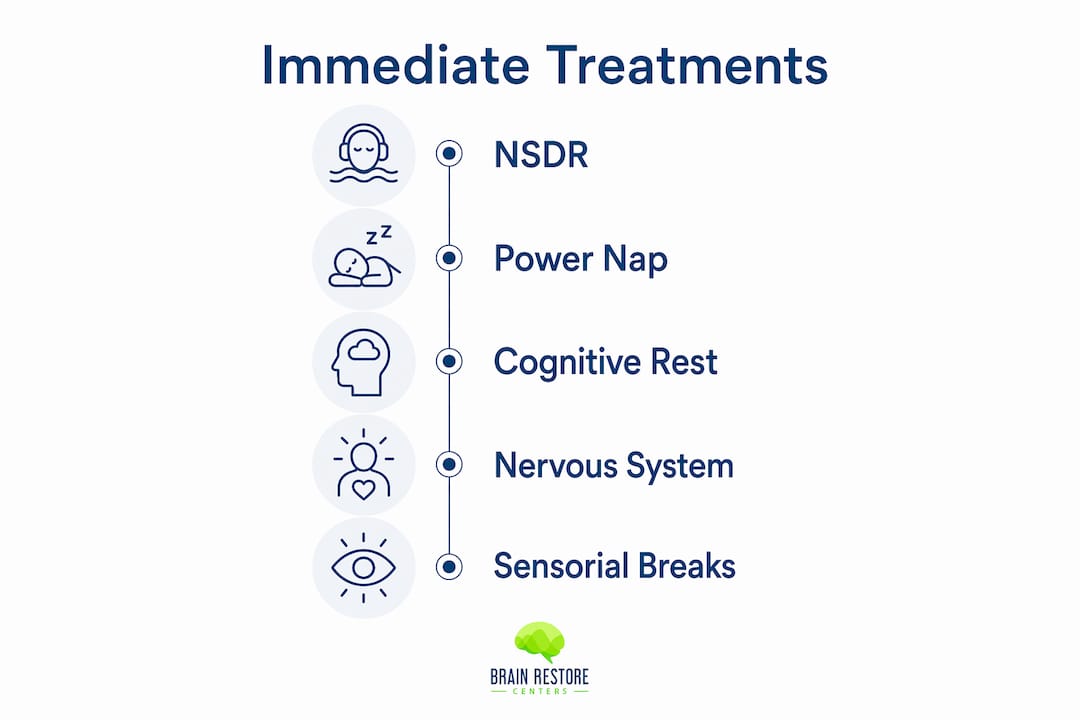
Scrolling social media activates prefrontal networks and prevents the default mode network from doing its restorative work. That means your “break” is actually extending the depletion. True rest requires disengagement from screens and work-related thinking entirely.
These protocols restore alertness and cognitive capacity within minutes to hours:
Pro Tip: If you feel the urge to check your phone during a break, that is a signal your nervous system has not disengaged. Put the phone in another room for the duration of the break.
Long-term cognitive resilience is built through consistent daily habits, not occasional recovery sessions. Mental fatigue recovery is a lifestyle architecture challenge, requiring structures that protect sleep and decision capacity every day.
The prefrontal cortex operates at peak capacity in the first 2–3 hours after waking. Scheduling demanding cognitive tasks to this window preserves executive function and reduces fatigue accumulation across the day. Administrative tasks, emails, and routine decisions belong in the afternoon when cognitive resources are naturally lower.
Sleep continuity matters more than total sleep duration for brain recovery. Keeping your bedroom at 65–68°F and dimming screens 90 minutes before bed measurably improves cognitive restoration overnight. These two changes alone address a significant portion of chronic mental tiredness in people who believe they sleep enough hours.
Moderate-intensity aerobic exercise of 20–30 minutes improves cognitive flexibility and mood after demanding mental work. Timing is critical. High-intensity exercise late in the evening raises cortisol and disrupts sleep architecture, which reverses the cognitive benefit. For neurological health support, dietary choices also matter. Omega-3 fatty acids, magnesium, and B vitamins support neurotransmitter production and reduce systemic inflammation that contributes to brain fog.
| Lifestyle habit | Mechanism | Timing |
|---|---|---|
| Front-load deep work | Prefrontal cortex peaks 2–3 hours post-waking | First 90 minutes of workday |
| Decision batching | Reduces executive network depletion | Morning or set daily windows |
| Sleep environment control | Improves sleep continuity and cognitive restoration | 65–68°F, screens off 90 min before bed |
| Aerobic exercise | Improves cognitive flexibility and mood | Morning or early afternoon |
| Micro-breaks | Prevents sustained attention decline | Every 90 minutes during work |
Personalized mental exhaustion remedies outperform generic protocols because they target the specific system that is depleted. A daily fatigue audit takes less than five minutes and gives you the data to make better decisions about your recovery.
Recognizing early fatigue signals and acting on them prevents full depletion, which is far harder to recover from than early-stage tiredness. The goal is to intervene at the first sign, not after you have pushed through for three more hours.
Run this audit each morning and again at midday:
When the audit flags depletion, defer deep cognitive work and apply the appropriate protocol. Attention fatigue responds to sensory downshifts and NSDR. Decision fatigue responds to pre-commitment and batching. Emotional fatigue responds to social withdrawal and low-stimulus rest. Systemic depletion requires sleep prioritization, nutrition, and, when symptoms persist, professional evaluation.
The principles of cognitive rest that apply after concussion also apply to chronic mental fatigue. The brain needs genuine downtime, not just a change of screen. Applying this principle consistently is what separates people who recover quickly from those who stay stuck in a fatigue cycle.
Pro Tip: Set a recurring midday alarm labeled “fatigue audit.” The act of pausing to assess, rather than pushing through automatically, is itself a recovery behavior that reduces cumulative depletion.
Effective mental fatigue treatment requires matching the intervention to the specific fatigue type, not applying generic rest or stimulants.
| Point | Details |
|---|---|
| Identify your fatigue type | Attention, decision, emotional, and systemic fatigue each require different recovery strategies. |
| Use active recovery protocols | NSDR, power naps, and the complete capture method restore cognitive capacity faster than passive rest. |
| Optimize sleep quality | Bedroom temperature of 65–68°F and screens off 90 minutes before bed improve cognitive restoration more than extra hours in bed. |
| Front-load demanding work | Schedule deep cognitive tasks in the first 2–3 hours after waking when prefrontal capacity is highest. |
| Seek professional help when needed | Symptoms lasting over two weeks require evaluation to rule out neurological or systemic causes. |
The most common mistake I see is treating mental fatigue as a willpower problem. People believe that if they just push harder, drink more coffee, or sleep in on the weekend, they will catch up. They rarely do.
Caffeine is the most misused tool in cognitive recovery. It creates the feeling of alertness while the underlying depletion deepens. When the adenosine finally floods back in, the crash is worse than the original fatigue. I have seen people run on caffeine for weeks, convinced they are managing well, until they hit a wall they cannot get through in a single weekend.
The other pattern I notice is that people treat recovery as formless. They take “breaks” that involve scrolling, watching stimulating content, or mentally rehearsing work problems. None of that counts as rest for the brain. The default mode network, which handles consolidation and restoration, only activates when you genuinely disengage.
What actually works is structure. A scheduled NSDR session, a consistent sleep environment, and a morning audit take less than 30 minutes of daily overhead. People who build these habits into their routine recover faster, sustain higher cognitive output, and report feeling more in control of their mental energy. That is not a coincidence. It is the result of treating the brain as a system that needs deliberate maintenance, not just occasional repair.
— Chad
If your mental fatigue persists despite consistent lifestyle changes, the cause may be deeper than habits alone. Brainrestoremeridian, located in Meridian, Idaho, offers advanced brain health therapies designed to address the neurological roots of cognitive exhaustion.

The clinic’s neurofeedback for brain regulation trains the brain to shift out of dysregulated states that sustain fatigue cycles. Photobiomodulation, also called low-level laser therapy, supports cellular energy production in neural tissue. Both therapies integrate with functional medicine to address nutritional, hormonal, and inflammatory contributors to chronic brain fog. The team at Brainrestoremeridian builds personalized brain health protocols that go beyond symptom management and target the underlying biology keeping you depleted.
A 10–20 minute NSDR session or power nap is the fastest evidence-supported method for restoring alertness. The complete capture method, writing down all open tasks, can also restore significant cognitive capacity within 15 minutes.
Sleep quality matters more than duration. Poor sleep continuity, caused by a warm room, late screen exposure, or disrupted sleep architecture, prevents full cognitive restoration even when total hours appear adequate.
Caffeine temporarily masks fatigue by blocking adenosine receptors but does not restore depleted cognitive resources. Reactive caffeine use can impair sleep quality and prolong the fatigue cycle, particularly for emotional fatigue.
Clinical guidelines recommend professional evaluation when symptoms persist for more than two weeks. Persistent fatigue may indicate an underlying neurological, hormonal, or systemic condition that requires targeted treatment.
Moderate-intensity aerobic exercise of 20–30 minutes improves cognitive flexibility and mood after demanding mental work. Timing matters. High-intensity or late-evening exercise can raise cortisol and worsen recovery.
Questions about your next step?
Our Meridian team can help you understand the evaluation process and which care options may fit your needs.
Schedule a Brain Health ConsultationPrefer to speak with our team? Call 208-639-1397