
Leaky Gut and Brain Fog: Evidence and Unanswered Questions
September 25, 2026


The connection between leaky gut and brain fog is biologically plausible, but not proven as a direct cause in humans based on current clinical evidence. Researchers point to three real pathways, inflammatory molecules like LPS, short-chain fatty acids, and vagus nerve signaling, that could plausibly link gut permeability to cognitive symptoms. If your brain fog is severe, worsening, or paired with other red flags, the right next step is a clinician evaluation, not a supplement stack.
TL;DR:
- Human evidence linking leaky gut to brain fog is mostly correlative, with no validated diagnostic test or proven treatment that directly resolves symptoms.
- Three pathways—LPS translocation, SCFA production, and vagus nerve signaling—are supported by mechanistic and animal research but lack definitive proof in adults.
- Factors like processed foods, antibiotics, stress, or nutritional deficiencies can increase gut permeability, but addressing these does not guarantee symptom improvement.
- Clinicians should prioritize ruling out common conditions such as thyroid issues, B12 deficiency, and celiac disease before considering gut-focused therapies.
- Effective interventions include diversifying fiber intake, managing stress and sleep, and correcting deficiencies, with meaningful results taking weeks or months to manifest.
Your gut lining is supposed to work like a selective gate, letting nutrients through while keeping bacterial byproducts contained. When that gate loosens, a molecule called lipopolysaccharide (LPS), a component of certain bacterial cell walls, can slip into the bloodstream. This process, called microbial translocation, triggers your immune system to release inflammatory cytokines. Those cytokines can activate microglia (the brain’s resident immune cells) and influence how the blood-brain barrier behaves, according to a review on diet, probiotics, and barrier function. That is one plausible route from your gut straight to your mental clarity.
A second pathway runs through short-chain fatty acids, or SCFAs, compounds your gut bacteria produce when they ferment fiber. Butyrate, one of the most studied SCFAs, appears to support both gut lining integrity and blood-brain barrier protection, and researchers describe it as having a neuroprotective role. Low fiber intake means fewer SCFAs, which may mean a less protected barrier on both ends.
The third route is neural rather than chemical. Your enteric nervous system, sometimes called your “second brain,” communicates directly with your central nervous system through the vagus nerve. Gut bacteria produce neuroactive metabolites that can influence this signaling, giving your microbiome a direct line of communication to your mood and cognition.
Here is what matters for you: these three mechanisms are well documented in mechanistic and animal research, but that is not the same as proof they cause brain fog in a typical adult.
Pro Tip: Fiber diversity matters more than fiber quantity. Feeding many different bacterial species tends to produce a broader mix of protective SCFAs than eating the same high-fiber food every day.
Most human data connecting leaky gut to nonspecific symptoms like brain fog are correlative, not causal. Reviews consistently note the absence of a validated diagnostic test for “leaky gut syndrome” as a standalone condition, according to a comprehensive review on leaky gut myths and management. That distinction shapes everything that follows.
Increased intestinal permeability is well documented in specific diseases. Inflammatory bowel disease (IBD) and celiac disease both show measurable, reproducible barrier dysfunction. Brain fog is different. It is a symptom, not a diagnosis, and no review has established that fixing gut permeability reliably resolves it.
Dietary factors, probiotics, and certain nutrients can influence barrier function in some models, but no therapy that restores the gut barrier has been proven to change disease outcomes in human trials, according to a review on intestinal barrier therapeutics.
That gap between mechanism and proof is exactly where marketing tends to outrun the science. Zonulin, a protein thought to regulate tight junctions between gut cells, has become a popular buzzword, and larazotide, a zonulin-blocking peptide, remains an investigational drug studied mainly in celiac disease trials. Neither has an FDA-approved use for treating general brain fog or a diagnosed condition called “leaky gut syndrome.”
In practice, this means clinicians treat the underlying disease, an infection, IBD flare, or celiac disease, rather than chasing a “leaky gut” label on its own.
Several everyday factors can loosen your gut barrier over time, and most are within your control or at least worth discussing with a clinician.
• Diets high in processed foods and low in fiber diversity tend to be associated with reduced tight-junction protein expression and lower SCFA production.
• Use of NSAIDs and repeated antibiotic courses may increase intestinal permeability.
• Chronic psychological stress, intense endurance exercise, and regular alcohol consumption can place strain on the gut lining.
• Conditions such as active IBD, celiac disease, and postinfectious states are among the more clearly documented causes of measurable permeability changes.
• Micronutrients like vitamin D and zinc contribute to epithelial integrity, and deficiencies may affect barrier function.
If gut symptoms won’t resolve with basic dietary tweaks, it’s worth reading about why digestive distress often needs more than diet changes alone to sort out.
A thorough workup starts broad before it gets narrow. Your clinician should review current medications, screen for sleep apnea, check thyroid function and vitamin B12 levels, run basic metabolic labs, and screen for depression or anxiety, since all of these commonly masquerade as “gut-related” brain fog. Thyroid dysfunction in particular is one of the most frequently missed contributors to cognitive sluggishness.
If celiac disease is on the list of suspects, testing order matters. You should not start a gluten-free diet before serology and biopsy testing, because early elimination can produce a false-negative result and force you into a gluten challenge later to get an accurate diagnosis, per ACG celiac disease guidance.
Barrier-specific tests exist, including intestinal permeability probe tests and zonulin or LPS blood markers, but they lack standardization across labs and are not considered diagnostic on their own.
Pro Tip: If you’ve already cut gluten and dairy without testing and still feel foggy, tell your clinician exactly what you removed and when. It changes what tests are still useful.
Refer to gastroenterology or an integrated brain-health clinic when symptoms are progressive, when labs turn up real abnormalities, or when first-line changes haven’t helped after several weeks. The Boise brain fog evaluation pathway outlines what that kind of workup typically involves.
Diet changes with the strongest support involve increasing fiber diversity, specifically microbiota-accessible carbohydrates (MACs) found in vegetables, legumes, and whole grains, rather than any single “superfood.” Mediterranean-style eating patterns are associated with better memory performance and more favorable gut microbial signatures compared with Western diets, according to a 2026 nutritional review on brain fog. Skip unsupported elimination diets unless a specific test result points you there.

Probiotics show strain-specific benefits rather than a universal effect. Certain Lactobacillus and Bifidobacterium strains have reduced markers of endotoxemia in select GI conditions, but results vary enough that a conversation with your clinician about which strain fits your situation beats grabbing whatever is on the shelf.
Sleep and stress deserve equal billing with diet. Because the gut-brain relationship runs in both directions, calming your nervous system through consistent sleep, cognitive behavioral therapy, or mindfulness practice can improve gut symptoms just as diet changes can improve mental clarity.
Set realistic expectations. Meaningful improvement in energy and mental clarity from dietary and lifestyle changes typically takes weeks to a few months, not days. Track your symptoms alongside any objective testing your clinician orders so you can tell what is actually working.
A multidisciplinary evaluation looks at more than your gut. Functional medicine assessment, neurological evaluation, and targeted GI testing work together, because brain fog rarely has one single cause. Findings from gut testing get folded into a broader brain restoration plan rather than treated as an isolated problem to fix in a vacuum.
Certain signs push a case from “watch and adjust” to “get evaluated now”: cognitive decline that keeps getting worse, abnormal results on objective testing, symptoms spanning multiple body systems at once, or no improvement after a genuine first-line effort with diet, sleep, and stress management. If you’re in that situation, a structured, comprehensive brain fog workup matters more than another round of self-directed elimination diets.
Here’s the honest tension in this topic: the mechanisms connecting gut permeability to brain function are genuinely compelling, and the marketing built around “leaky gut” has raced far ahead of what any review actually proves. Both things are true at once, and most articles online pick one side and ignore the other.
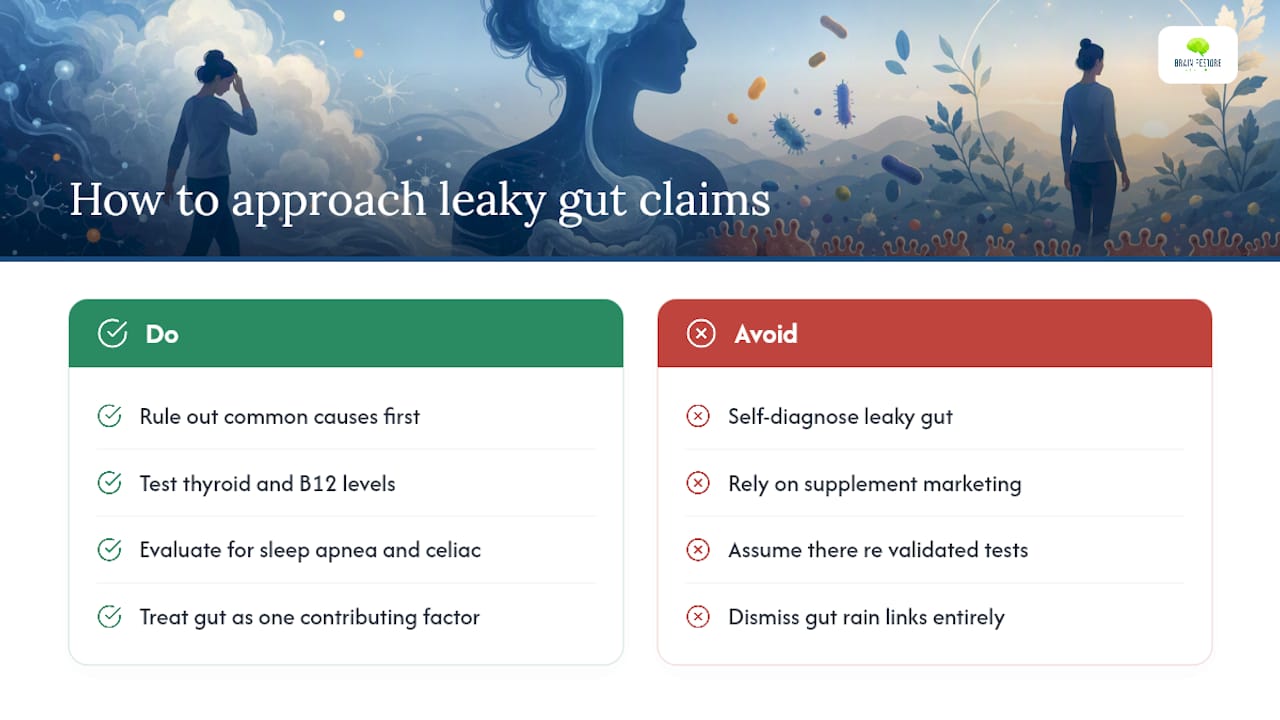
The conventional wellness narrative treats leaky gut as a diagnosis you can self-identify and self-treat with the right supplement bundle. That framing falls apart the moment you look at what reviews actually say: no validated test, no approved barrier-restoring drug, mostly correlative data. But the opposite reaction, dismissing gut-brain connections entirely, ignores real mechanistic evidence around LPS, SCFAs, and vagal signaling.
What should you prioritize first? Rule out the boring, well-documented causes: thyroid issues, B12 deficiency, sleep apnea, medication side effects, undiagnosed celiac disease. Only after that workup makes sense to treat your gut health as one contributing piece of a larger cognitive puzzle, not the whole answer.
— Chad
If you’ve tried the fiber, sleep, and stress basics and your brain fog isn’t budging, that’s the signal to stop guessing and start testing. A comprehensive brain health consultation can look at brain function and gut-related contributors together, combining functional medicine lab work, neurological assessment, and, where appropriate, neurofeedback or hyperbaric oxygen therapy as part of a broader plan.
Before your first visit, gather a timeline of when your symptoms started and how they’ve changed, a list of current medications and supplements, any recent lab results, and a rough picture of your sleep patterns over the last few weeks. That information lets your clinician build a workup around your actual history instead of starting from zero. An initial consult aims to identify which systems, gut, thyroid, sleep, or nervous system, are driving your symptoms so the plan that follows targets the right cause. You can review the Brain Restore Program and schedule a consultation directly through that page.
This article is general information, not a substitute for advice from a qualified doctor. Consult a qualified healthcare professional about your own circumstances before acting on anything here.
Commonly cited signs include bloating, food sensitivities, fatigue, joint pain, and brain fog, though none of these are specific enough to diagnose leaky gut on their own. Because validated diagnostic tests don’t exist for leaky gut syndrome as a standalone condition, these symptoms warrant a broader medical workup rather than a self-diagnosis.
No single vitamin reliably clears brain fog, but correcting a real deficiency in B12, vitamin D, or zinc can improve mental clarity when that deficiency exists. Testing first matters more than supplementing broadly, since taking vitamins you don’t need won’t address the actual cause.
There’s no fixed timeline because “repairing” gut permeability isn’t a proven, standardized treatment target the way healing a broken bone is. Dietary and lifestyle changes that support barrier function, more fiber diversity, better sleep, lower stress, typically show measurable improvement over weeks to a few months, not days.
There’s no single “reset,” but increasing fiber diversity, following a Mediterranean-style eating pattern, managing chronic stress, and improving sleep all support the gut-brain relationship from both directions. If symptoms persist despite these changes, a clinical evaluation through a service like the Brain Health Consultation can identify contributors that diet alone won’t fix.
Questions about your next step?
Our Meridian team can help you understand the evaluation process and which care options may fit your needs.
Schedule a Brain Health ConsultationPrefer to speak with our team? Call 208-639-1397


