Evidence Forward Z-Score Neurofeedback for Clinicians and Patients
September 22, 2026

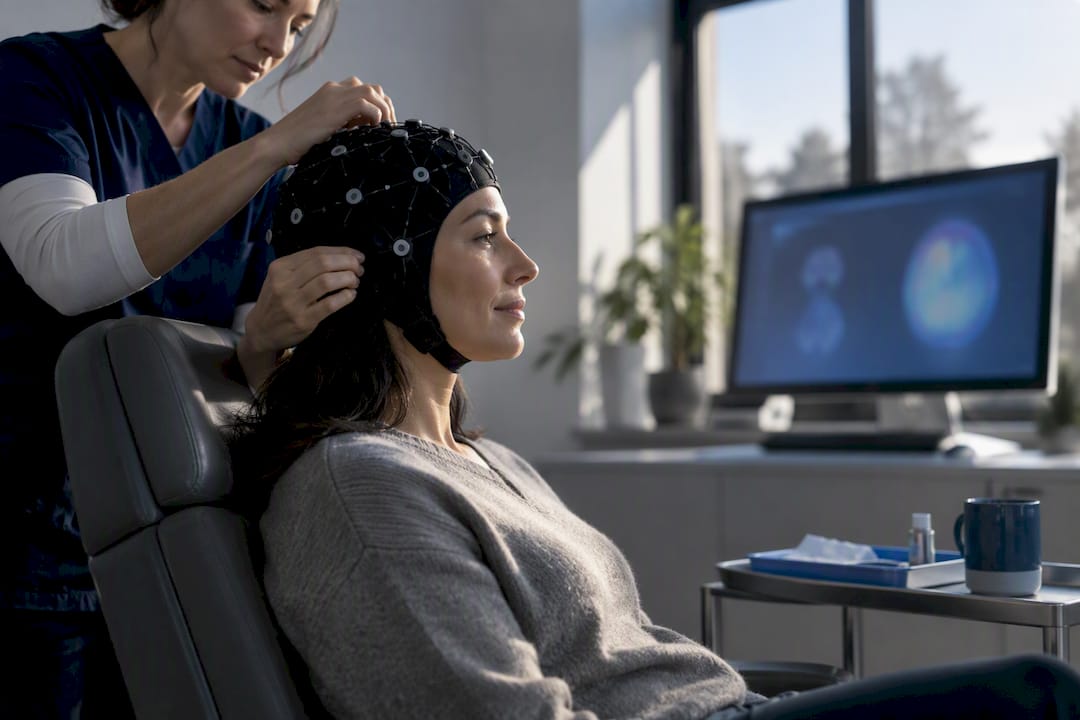
Z-score neurofeedback is a multichannel EEG training method that compares your live brain activity to an age-matched normative database and rewards your brain for moving toward that healthy average. Peer-reviewed studies and systematic reviews show promise for conditions like PTSD, ADHD, and post-concussion symptoms, though researchers still call for larger, more tightly controlled trials. This neurofeedback method is used as one tool among several, built on qEEG brain mapping and guided by individual data.
TL;DR:
- Z-score neurofeedback compares your brain activity to age-matched norms, targeting whole-brain patterns rather than isolated frequencies for more comprehensive regulation.
- Different variants like Live Z-Score Training, LORETA, and PZOK focus on surface or deeper brain structures, with protocols tailored based on initial qEEG mapping.
- Evidence supports modest benefits for PTSD and ADHD, with some measurable EEG changes linked to symptom reduction, but large-scale, high-quality trials are still needed.
- Adverse effects are rare and usually mild, though study quality varies and placebo effects remain a concern due to challenges in blinding in sham-controlled trials.
- Effective treatment depends on using proper normative databases, sufficient session doses, and experienced clinicians who base protocols on individual brain mapping results.
A z-score is a statistical measure of how far one value sits from an average, expressed in standard deviations. In quantitative EEG, that “value” might be your brainwave power at a specific frequency, the coherence between two brain regions, or the timing relationship (phase) between them. When your brain activity matches the norm for your age group, the z-score sits near zero. When it drifts high or low, the number climbs.
That comparison only works with a solid reference point. Clinics use normative databases built from EEG recordings of thousands of healthy people, organized by age, because a 10-year-old’s baseline brainwave pattern looks nothing like a 60-year-old’s. Your qEEG brain mapping session measures your brain against that matched group, not against a generic “normal” that ignores your age entirely.
Here’s where it gets genuinely sophisticated. A 19-channel montage, meaning 19 sensors placed across the scalp, doesn’t just track one brainwave frequency at one location. It calculates power, coherence, phase relationships, and asymmetry between hemispheres, often generating thousands of individual z-scores every second. One exploratory study using this approach computed thousands of z-scores across a single 19-channel session.
The training software watches all of those metrics simultaneously and gives feedback, usually a sound or visual cue, whenever enough of them shift toward the normative mean at once. This is what separates z-score training from older single-frequency protocols:
Understanding how operant conditioning shapes neurofeedback training helps explain why this reinforcement loop works the way it does: your brain learns from the reward, not from conscious effort.
“Z-score neurofeedback” isn’t one single protocol. Clinics use several distinct variants, and knowing which one you’re getting changes what to expect from treatment.
Clinicians typically start with surface-based LZT because it’s faster to set up and well-documented, reserving LORETA-based training for cases where a qEEG map points clearly to deeper structures. Protocol reports commonly describe a target window of about plus or minus 0.9 standard deviations, with reinforcement thresholds titrated between 40% and 60% of active metrics as treatment progresses.
The evidence for z-score neurofeedback is real, but it’s uneven, and any honest clinical explainer has to say so plainly.
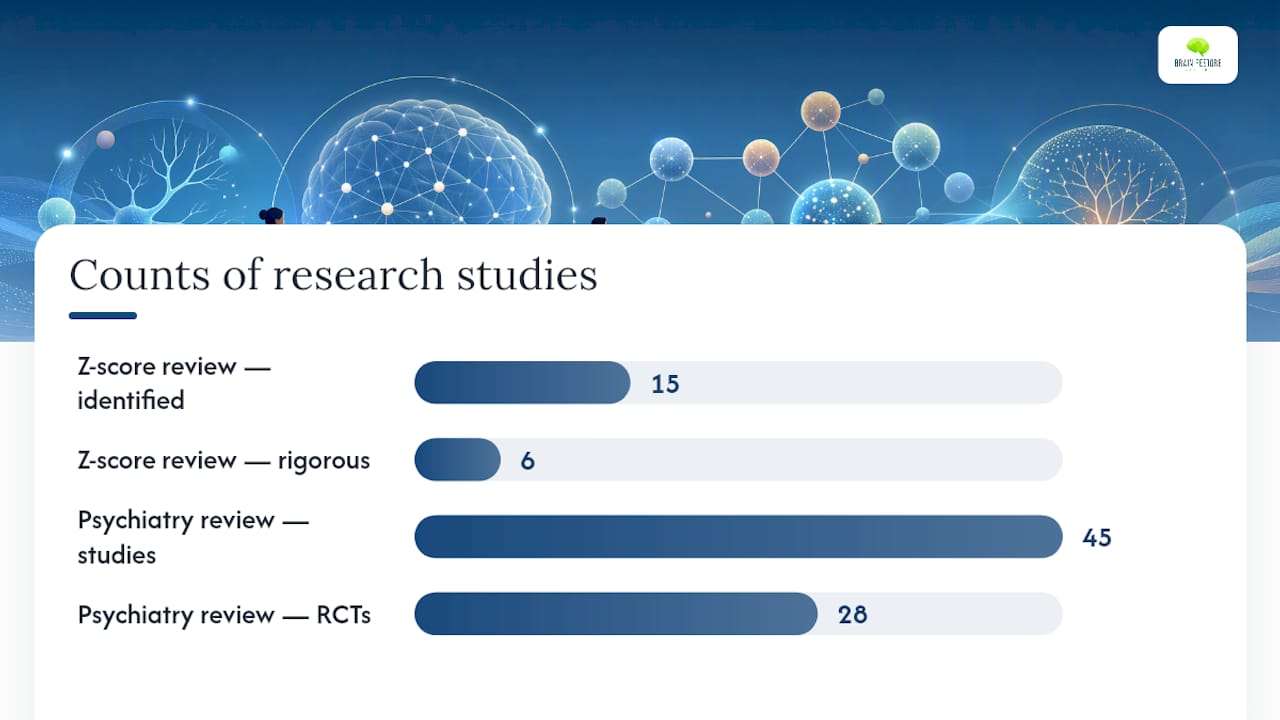
A 2019 review in Applied Psychophysiology and Biofeedback looked specifically at whether 19-channel z-score training outperforms traditional single-site neurofeedback protocols. The reviewers identified 15 relevant studies, but only 6 met rigorous, group-based clinical research criteria. Their conclusion: promising mechanistic rationale, but not yet the kind of head-to-head clinical superiority data that would settle the question.
A closer look: In one exploratory PPCS (persistent post-concussive symptoms) study, increased frontal and central alpha activity after Live Z-Score Training predicted measurable drops in both cognitive complaints and mood-related symptoms, based on penalized regression analysis of EEG changes.
That finding, from research tracking EEG changes following Live Z-Score Training, matters because it links a specific, measurable brain change to a specific symptom improvement rather than relying on self-report alone.
Zooming out further, a broader systematic review of neurofeedback in psychiatry covering work from 2015 through 2025 included around 45 studies and roughly 4,600 participants across 28 randomized controlled trials. The pattern that emerged:
None of this means z-score neurofeedback doesn’t work. It means the evidence base is still maturing, and any clinic that tells you otherwise isn’t reading the same research you just did.
Evidence quality varies a lot depending on the condition, and it’s worth knowing where you land before you start.
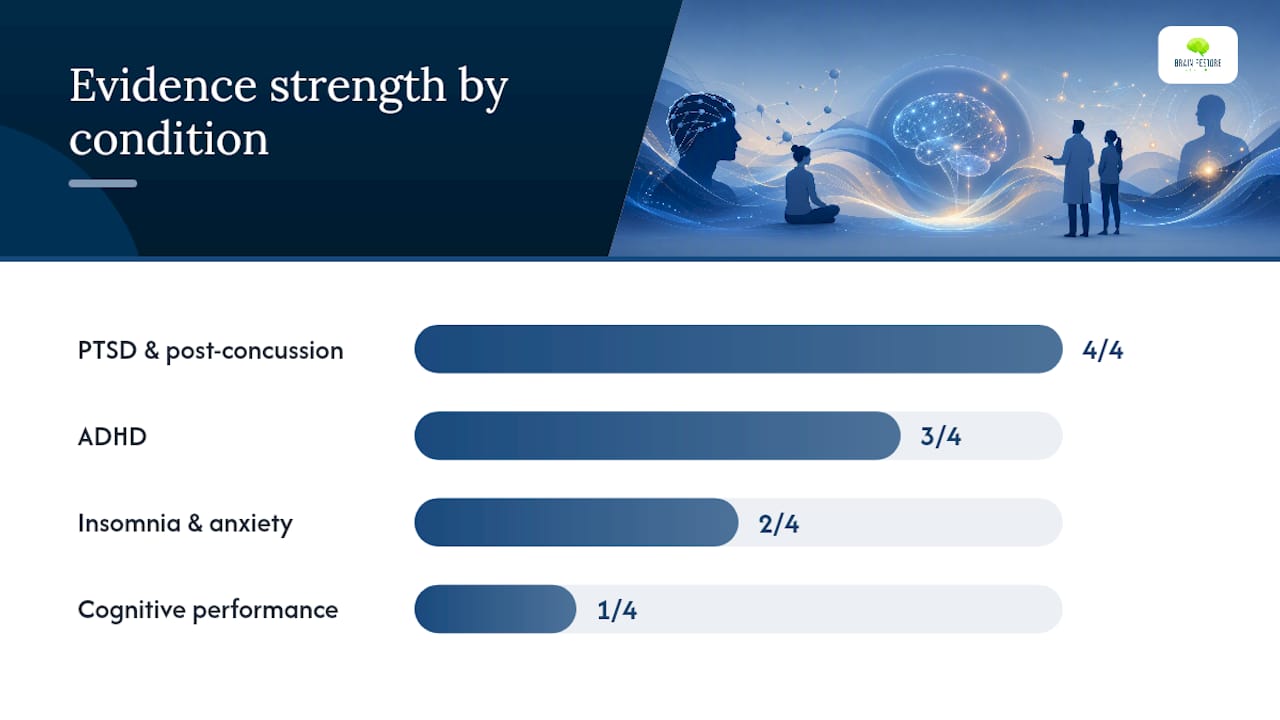
PTSD and post-concussion symptoms currently have the most encouraging data, including the alpha-symptom link mentioned above. ADHD trials show consistent, if modest, benefit across several of the reviewed studies. Insomnia and anxiety sit in a more preliminary category. Individuals report meaningful symptom relief, our anxiety neurofeedback resource covers this in more depth, but the controlled-trial base is thinner than for PTSD or ADHD. Cognitive performance improvement in otherwise healthy adults is the least studied use case of the group.
Here’s what improvement typically looks like across studied domains:
Pro Tip: Ask your clinician which symptom domain the research actually supports for your specific condition, not just for neurofeedback broadly. “It helps the brain” is not a treatment plan.
Session dose in reviewed trials is typically in the range of a moderate number of sessions for measurable change, with some protocols extending further for lasting results. Our guide on how many neurofeedback sessions you actually need breaks that timeline down further. In most clinical settings, z-score training works best as an adjunctive therapy, layered alongside functional medicine, medication management, or physical rehab, rather than replacing them outright.
Z-score neurofeedback carries a strong safety profile. Across the studies reviewed in the psychiatric neurofeedback systematic review, adverse events were uncommon and, when they occurred, typically mild and temporary, such as brief fatigue or a passing headache after a session. That said, rigorous adverse-event tracking is still underused across the literature, which is a gap worth acknowledging rather than glossing over.
The placebo question is where things get more contested. Critical appraisals point out that many sham-controlled trials struggle with genuine blinding, since experienced participants can sometimes tell whether they’re receiving real feedback. That raises a fair question: how much of the reported benefit comes from the specific EEG training, and how much comes from expectation, attention, and the therapeutic relationship itself? Commentary on this issue, including critical analysis of 19-channel and LORETA evidence, argues that adequately dosed, properly blinded trials remain the missing piece.
Before you dismiss a negative study or accept a glowing one at face value, ask these questions:
A negative trial with too few sessions or a poorly matched database tells you less about neurofeedback than about that particular study’s design.
The technology matters less than the clinician running it. A qEEG brain map should show your specific z-score deviations by region and frequency, not a generic summary, and it should directly inform which protocol variant you receive. Our qEEG brain mapping page walks through what a proper baseline assessment includes.
Before committing to a treatment plan, ask the clinic these questions:
Our full clinic evaluation checklist expands on each of these points in detail.
| What to check | Why it matters |
|---|---|
| Normative database provenance | Age-mismatched norms produce misleading z-scores |
| Channel count (4 vs. 19) | Determines whether training reaches deeper structures or surface only |
| Session reporting | Lets you track real progress, not just subjective impressions |
| Clinician credentials | EEG interpretation requires specific training beyond general practice |
Red flags include clinics that can’t explain their database source, that skip the initial brain mapping entirely, or that promise guaranteed results after a fixed number of sessions regardless of your baseline.
This neurofeedback may be recommended for patients recovering from concussion, managing persistent anxiety, or working through attention and focus challenges, often alongside broader functional medicine approaches. Baseline and follow-up z-scores are tracked session by session, since “feeling better” and “measurably closer to normative brain function” aren’t always the same, though they often move together. It is important to be candid about the still-building evidence base and to treat every case as data worth watching, not a settled formula.
Reading about z-scores is one thing. Seeing your own numbers, and understanding exactly where your brain deviates from a healthy age-matched baseline, is a different experience entirely. That clarity is the real advantage of starting with a proper qEEG map instead of jumping straight into generic sessions.
Our Brain Health Consultation starts with that baseline assessment, then builds a training plan around your specific z-score patterns, whether that means concussion recovery, anxiety management, or attention support. From there, we set session goals together and track your progress with the same standardized metrics discussed throughout this article, not vague impressions. If you’re ready to find out what your own brain map actually shows, schedule your consultation with our Brain Restore Program and take the first concrete step.
This article is general information, not a substitute for advice from a qualified doctor. Consult a qualified healthcare professional about your own circumstances before acting on anything here.
A normal z-score falls close to zero, typically within about plus or minus standard deviations of the age-matched normative mean. Scores beyond that range indicate the brain activity at that site or frequency deviates from what’s typical for your age group.
The main downsides are cost, time commitment, since meaningful change often requires 15 to 20 or more sessions, and an evidence base that’s still maturing for several conditions. Mild, temporary side effects like brief fatigue can occur, but serious adverse events are uncommon according to the psychiatric neurofeedback systematic review.
A z-score expresses how far a value sits from the mean in standard deviation units, with an average of zero and negative or positive values on either side. A t-score is a rescaled version of that same measure often used in clinical questionnaires to avoid negative numbers.
There’s no single universal success rate, since outcomes vary significantly by condition and study design. PTSD and several ADHD trials show the most consistent modest benefits in the systematic review data, while other conditions still need larger, more rigorous trials before a reliable figure can be stated.
Yes, Brainrestoremeridian builds its neurofeedback protocols around qEEG brain mapping and z-score analysis as part of the Brain Restore Program. Pricing details are available directly through the Brain Restore Program page.