Evidence-Backed Atlas Adjustment Benefits and What Still Lacks Proof
September 21, 2026


A precise atlas (C1) adjustment can ease certain headaches, calm neck-related pain, and improve balance for many patients, with research strongest in small clinical studies and case series rather than large trials. The physiological reasoning, involving nerve signaling and blood flow near the brainstem, is compelling but only partly proven. Whether it works for you depends on your specific condition and on choosing a practitioner trained in upper-cervical technique.
TL;DR:
- Small clinical studies suggest atlas adjustments may improve headaches, neck pain, and balance, but large-scale research and imaging confirmation are limited.
- Techniques like NUCCA and Atlas Orthogonal use low-force, precision measurement-based adjustments, with safety considerations for vascular or spinal instability.
- Benefits such as reduced headaches and dizziness are supported mainly by observation and small trials, with no definitive evidence for altering cerebrospinal fluid flow or nerve signaling.
- Post-visit care includes gentle mobilization, posture advice, and multiple adjustments over weeks for lasting change, with mild soreness being a common side effect.
- Proper practitioner training in upper-cervical techniques and medical clearance is crucial, especially for those with spinal or vascular health issues.
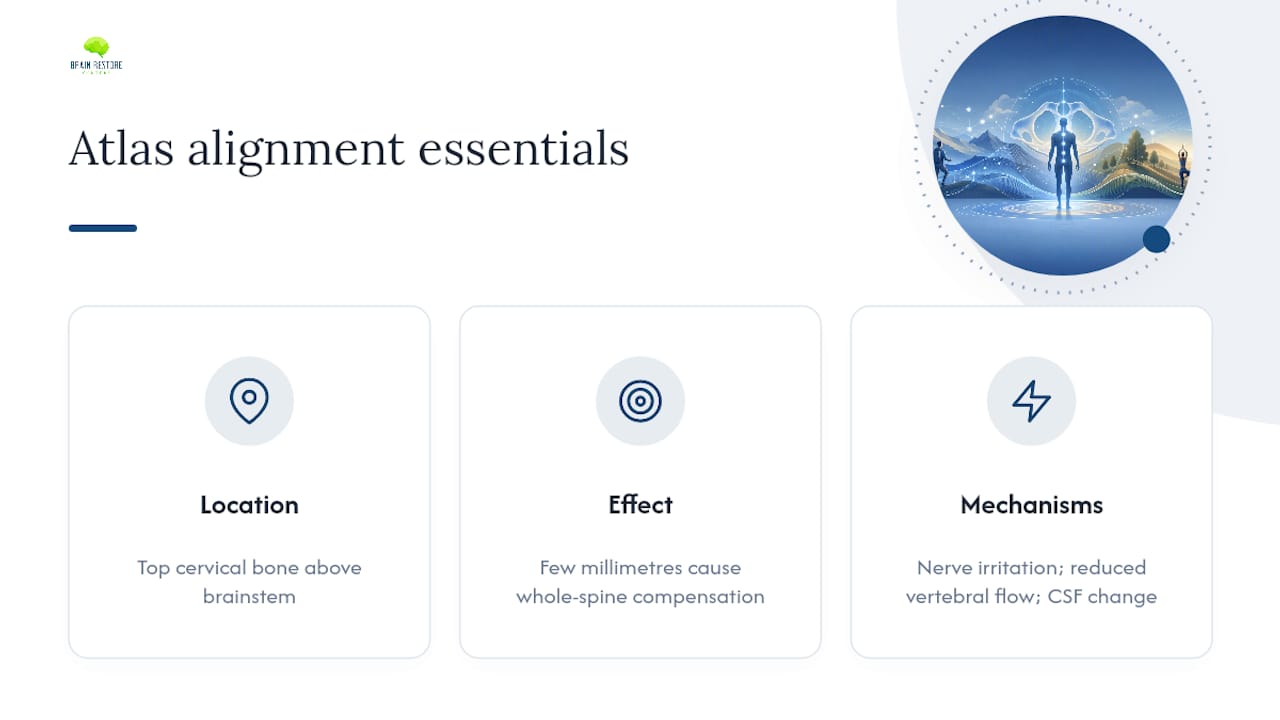
The atlas is the topmost bone in your spine, a small ring of bone that cradles the base of your skull and lets your head nod and rotate. It sits directly above the brainstem, the structure that governs breathing, heart rate, and much of your body’s automatic regulation. That location is exactly why atlas alignment gets so much clinical attention.
A shift in the atlas of even a couple of millimeters can throw off the entire spine’s balance. Think of it like the top block in a stack of children’s blocks: tilt it slightly, and every block below compensates to keep the tower standing. Your neck, shoulders, and lower back can all develop tension patterns trying to correct for one misaligned vertebra at the top.
Practitioners who focus on this joint argue that atlas misalignment can irritate nearby nerve pathways, restrict vertebral artery blood flow, and alter cerebrospinal fluid movement. Some of these mechanisms have real physiological support; others remain hypotheses that manual therapy research has not yet confirmed with imaging or controlled trials.
Several upper-cervical methods aim to correct atlas position, and they differ mainly in how much force they use and how precisely they measure the correction.
NUCCA (National Upper Cervical Chiropractic Association) uses detailed X-ray analysis to calculate the exact direction and degree of misalignment, then applies a light, controlled touch rather than a forceful thrust. Atlas Orthogonal takes precision further, using an instrument that delivers a percussive, sound-wave-based correction with no manual twisting at all. Other upper-cervical approaches blend hands-on assessment with measured, low-force adjustments.
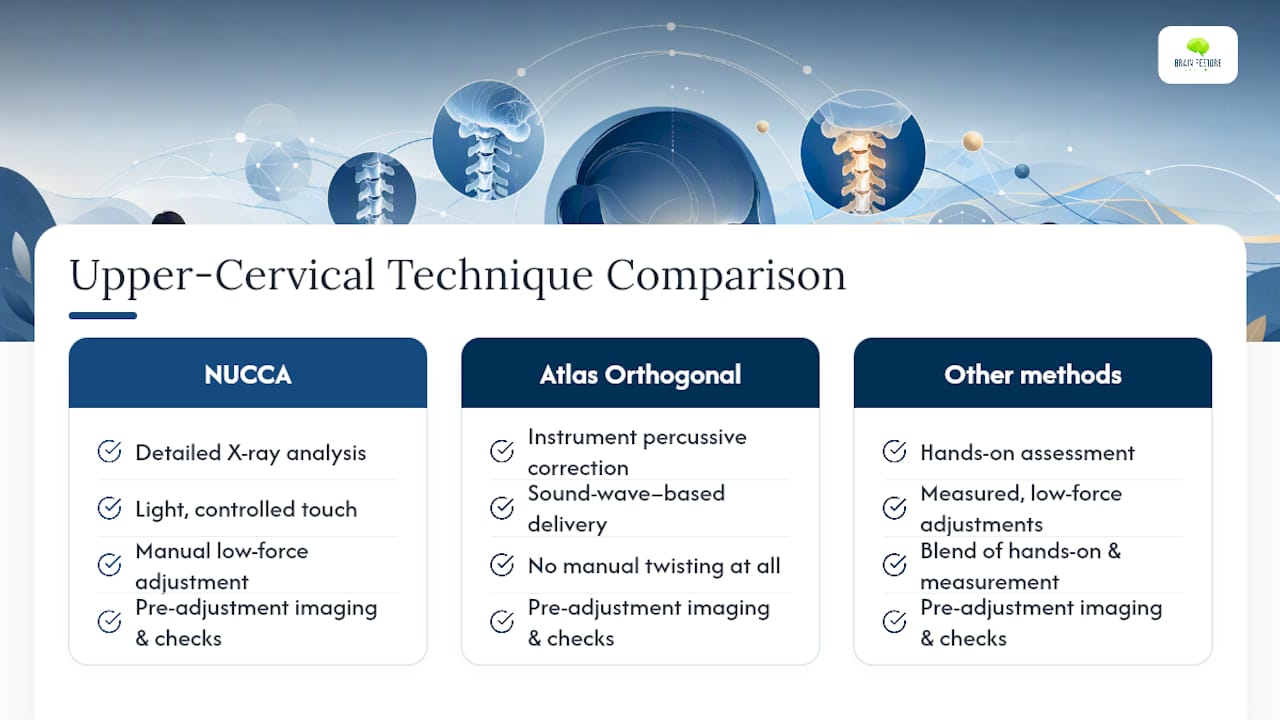
What unites these methods is restraint. Upper-cervical adjustments typically skip the high-velocity rotational thrusts associated with general neck manipulation, relying instead on measured positioning designed for accuracy over force. A typical evaluation includes postural analysis, leg-length checks, and imaging to pinpoint the misalignment before any adjustment happens. Only after that assessment does a practitioner decide whether, and how often, care is warranted.
The benefits patients report most often cluster around five areas, though the strength of evidence varies considerably from one to the next.
Headaches and migraines have the most direct research behind them. A small randomized trial found that upper-cervical manipulation reduced headache intensity in the short term for some participants, though the authors were clear that larger trials are still needed before drawing firm conclusions.
Neck and radicular pain relief has a straightforward biomechanical explanation: correcting the atlas position redistributes load across the cervical spine, which can lessen the strain that produces localized and radiating pain. This effect shows up consistently in clinical observation, even where controlled data lags behind.
Dizziness and vertigo improvements appear in multiple case series, plausibly tied to reduced pressure on brainstem and vestibular signaling pathways near the atlas. Randomized data here remains sparse, so this benefit sits closer to the observational end of the evidence spectrum.
Posture and mobility often improve as a downstream effect. When the head sits more evenly balanced on the spine, the compensatory muscle tension that built up around the misalignment has less reason to persist.
Nervous-system regulation claims, covering blood flow and cerebrospinal fluid circulation, represent the most speculative territory. A registry-style analysis of 504 patients reported that a majority experienced complete resolution of at least one symptom within a month, with a notable portion migraine-free at that point. That is a striking figure, but the authors themselves flagged methodological limitations, and no control group means the improvement can’t be isolated from other factors like natural symptom fluctuation or expectation effects.
A typical visit follows a predictable arc: intake and health history, a physical exam, imaging or measurements when the technique calls for it, the adjustment itself, and a brief reassessment before you leave.
Most patients feel little during the adjustment itself, sometimes describing a subtle click or pressure release rather than anything forceful. Mild soreness in the neck or shoulders for a day or two is common, similar to how muscles feel after correcting a long-held bad habit. Some people notice clearer thinking or eased tension within hours; others need several visits before changes stick.
Pro Tip: Skip strenuous neck exercise or heavy lifting for 24 to 48 hours after your first adjustment. Your spine is recalibrating, and giving it that window helps the correction hold.
Aftercare usually includes posture reminders for sitting and screen use, gentle mobility work, and avoiding sudden, forceful neck movements. Expect a monitored course of care rather than a single fix. Some patients notice a shift after one visit, but lasting change typically requires a series of adjustments spaced over weeks.
Serious complications from upper-cervical adjustment are reported rarely, and the gentler force profile used in techniques like NUCCA and Atlas Orthogonal is part of why. Still, this is a medical procedure, not a spa treatment, and it carries real contraindications.
Avoid atlas adjustment, or get medical clearance first, if you have an unstable cervical spine, known vascular disease affecting the neck arteries, recent major trauma, or certain inflammatory conditions. Before starting care, ask about your practitioner’s upper-cervical training and licensing specifically, not just general chiropractic credentials. Seek urgent medical attention, not chiropractic care, if you develop new neurological deficits, progressive weakness, or sudden severe headache.
Brainrestoremeridian treats upper-cervical alignment as one piece of a larger picture, not a standalone fix. Chiropractic care sits inside the clinic’s Brain Restore Program, where it can be paired with neurofeedback, photobiomodulation, hyperbaric oxygen, or progressive rehab depending on what your evaluation reveals.
A typical pathway starts with a structural and neurological assessment, moves into a personalized care plan, and adjusts as your response to treatment becomes clear. This kind of layered approach reflects why chiropractic care has been linked to improved brain function and clarity in patients whose symptoms extend beyond the neck itself.
Atlas adjustment is not a universal fix, but for the right patient, the shift in headache frequency or balance can feel significant. The honest position is that it works best as one piece of a broader plan, often alongside rehabilitative exercise or a medical workup when symptoms are complex or long-standing. Use the “what to expect” and safety sections above to vet any practitioner you’re considering.
— Chad
If headaches, neck tension, or balance issues have you wondering whether your atlas is part of the problem, an evaluation beats guessing. A multidisciplinary clinic can provide integrated care for various symptoms without needing separate specialists. Chiropractic care can be part of a broader multidisciplinary plan, potentially addressing related cognitive, sleep, or metabolic factors within a coordinated approach.
An initial chiropractic evaluation starts with a structural assessment of your neck and spine to see whether atlas misalignment is contributing to your symptoms. If your history points to broader cognitive or neurological concerns, a Brain Restore Program consultation folds chiropractic care into a plan built around your specific findings. Reach out to schedule your evaluation and find out what your atlas alignment says about your symptoms.
This article is general information, not a substitute for advice from a qualified doctor. Consult a qualified healthcare professional about your own circumstances before acting on anything here.
Atlas misalignment itself is rarely a medical emergency, but it can contribute to chronic headaches, neck pain, or balance problems that affect daily life. It becomes serious when combined with underlying instability or vascular issues, which is why a proper exam before treatment matters.
Yes, chiropractors trained in upper-cervical techniques like NUCCA or Atlas Orthogonal specialize in measuring and correcting atlas position using low-force, precisely calculated adjustments. Not every general chiropractor has this specific training, so ask about upper-cervical certification specifically before booking.
Evidence is mixed but not empty. A small randomized trial found short-term headache relief from upper-cervical manipulation, while broader reviews note that high-quality, large-scale data is still limited across most manual therapy claims.
Some practitioners report that patients feel calmer after atlas correction, theorizing a link to nervous-system regulation near the brainstem, but this connection is not established by controlled research. If anxiety is a primary concern, it deserves its own evaluation rather than being treated as a side effect of spinal alignment alone.