HBOT for Neuropathy: What 14 RCTs and 1,323 Patients Show
September 19, 2026


Hyperbaric oxygen therapy is a reasonable, evidence-supported option for certain neuropathy complications, especially diabetic foot ulcers and nerve damage tied to poor circulation, but it is not a universal fix. A 2024 meta-analysis of 14 randomized trials found meaningful gains in nerve conduction velocity and treatment response for diabetic peripheral neuropathy, yet the data is uneven across neuropathy types. Think of HBOT as a condition-dependent tool: strongest for healing and vascular-related nerve damage, promising but unproven for isolated tingling and numbness. Clinics offer HBOT as one option among several and can help you figure out if you’re a fit.
TL;DR:
- HBOT shows the most consistent benefit for neuropathy related to vascular issues, especially diabetic foot ulcers, with treatment protocols typically involving 20 to 40 sessions.
- Evidence suggests early HBOT application after nerve injury may prevent chronic pain development, but benefits for long-standing, isolated sensory neuropathy remain unproven.
- Nerve conduction improvements are usually measurable only after completing full treatment courses, with subjective symptom relief sometimes occurring earlier.
- Safety is generally good, with mild side effects like ear discomfort and rare risks such as oxygen toxicity, requiring proper screening and monitoring.
- Insurance coverage is limited to certain conditions, mainly wound-related, and treatment costs vary; thorough preauthorization helps determine eligibility prior to starting therapy.
At normal air pressure, your blood carries oxygen mostly bound to hemoglobin. Under pressure, oxygen also dissolves directly into your plasma, spinal fluid, and tissue in much higher amounts than your body ever sees while breathing room air.
You’ll find two chamber styles in clinical use. A monoplace chamber fits one person lying down inside a clear acrylic tube, pressurized with pure oxygen. A multiplace chamber holds several patients in a room-sized pressurized space, breathing oxygen through a mask or hood while breathing shared, pressurized air. Sessions typically run 60 to 90 minutes, and you might feel a fullness in your ears similar to a plane’s descent as pressure rises. Staff walk you through equalizing techniques before you start.
A few things to expect going in:
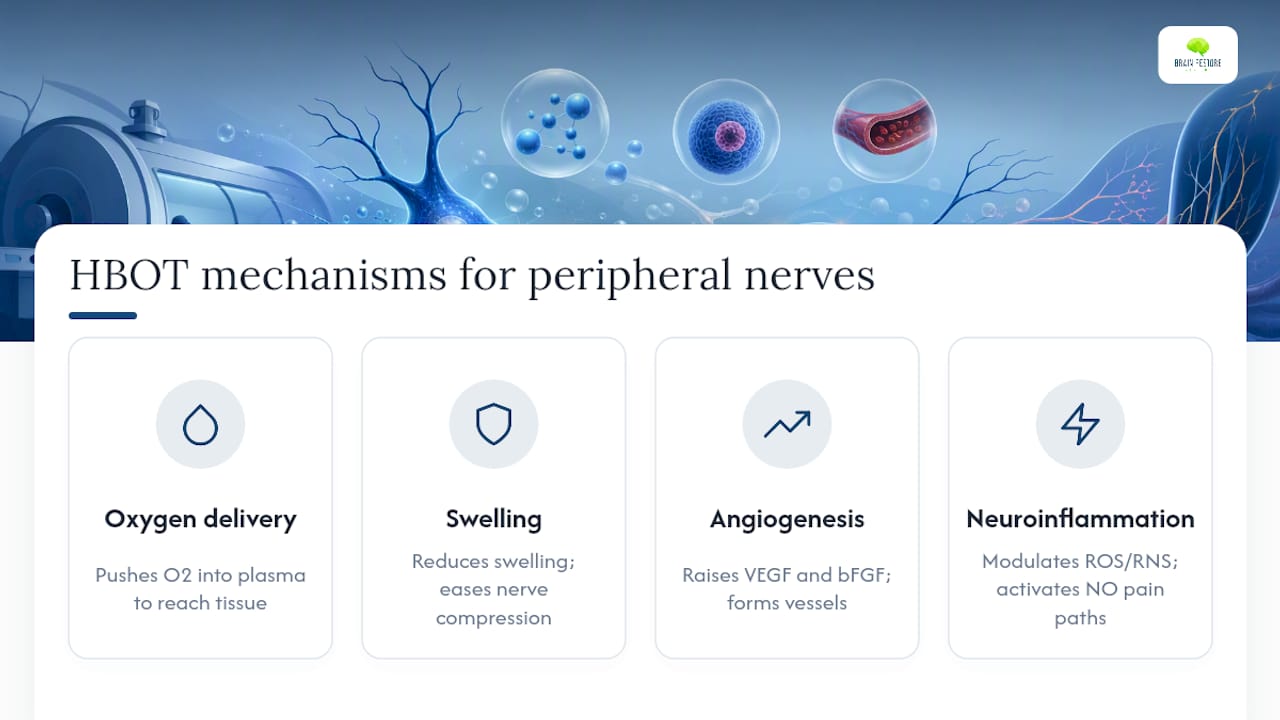
Peripheral nerves need a steady oxygen supply to function and repair themselves. When circulation is compromised, whether from diabetes, chemotherapy, or nerve compression, the surrounding tissue becomes chronically undersupplied. HBOT’s core mechanism is straightforward: pushing oxygen into plasma at levels high enough to reach tissue that damaged blood vessels can’t adequately serve on their own.
That hyperoxia does more than just deliver oxygen, though. It also reduces tissue swelling around compressed or inflamed nerve fibers, which can ease pressure-related pain and improve local blood flow indirectly.
Beyond the immediate oxygen boost, several secondary mechanisms appear to matter. HBOT stimulates angiogenesis, the formation of new blood vessels, by elevating growth factors like VEGF and bFGF. Better local circulation over time means better ongoing nerve nutrition, not just a one-session bump. Clinical data on HBOT’s angiogenic effects suggests this is especially relevant when neuropathy overlaps with slow-healing wounds, since the same vascular repair process supports both problems.
HBOT also appears to modulate neuroinflammation. Reactive oxygen and nitrogen species generated during treatment sound alarming, but at controlled therapeutic doses they seem to trigger healing signals rather than damage, including nitric-oxide dependent pain relief pathways.
Preclinical research goes further, and this is where things get genuinely interesting. One preclinical study on autophagy and the mTOR pathway found that HBOT reduced markers of cellular stress and apoptosis in the dorsal root ganglia after nerve injury. A separate study on chemotherapy-induced peripheral neuropathy found that HBOT given simultaneously with chemotherapy inhibited TLR4 and TRPV1 activation in animal models, suggesting a possible protective window during active treatment.
Pro Tip: Timing may matter more than most people assume. Preclinical evidence suggests early HBOT, closer to the onset of nerve injury, is more likely to prevent the transition from acute to chronic pain than treatment started years into established neuropathy.
None of this guarantees consistent nerve regeneration across every neuropathy type. A plausible mechanism in a rat model doesn’t automatically translate into predictable healing in a person with a decade of diabetic nerve damage. The mechanisms explain why researchers keep studying HBOT for nerve conditions. They don’t settle the clinical question on their own.
The strongest human evidence comes from a 2024 meta-analysis pooling 14 randomized controlled trials and 1,323 patients with diabetic peripheral neuropathy. HBOT significantly improved effective treatment rates and nerve conduction velocity, specifically motor and sensory conduction velocity, compared with standard therapy alone (P < .001). Researchers observed improvement across median, ulnar, peroneal, and tibial nerve measurements, which spans both upper and lower limb function.
That’s a real, statistically significant signal across more than a thousand patients. It’s also not the final word. The same analysis flagged meaningful heterogeneity between trials, meaning study protocols, patient populations, and outcome measures varied enough that pooling the results involves some interpretive caution. Publication bias, the tendency for positive results to get published more readily than null ones, was also noted as a possibility.
Here’s how the evidence breaks down by condition:
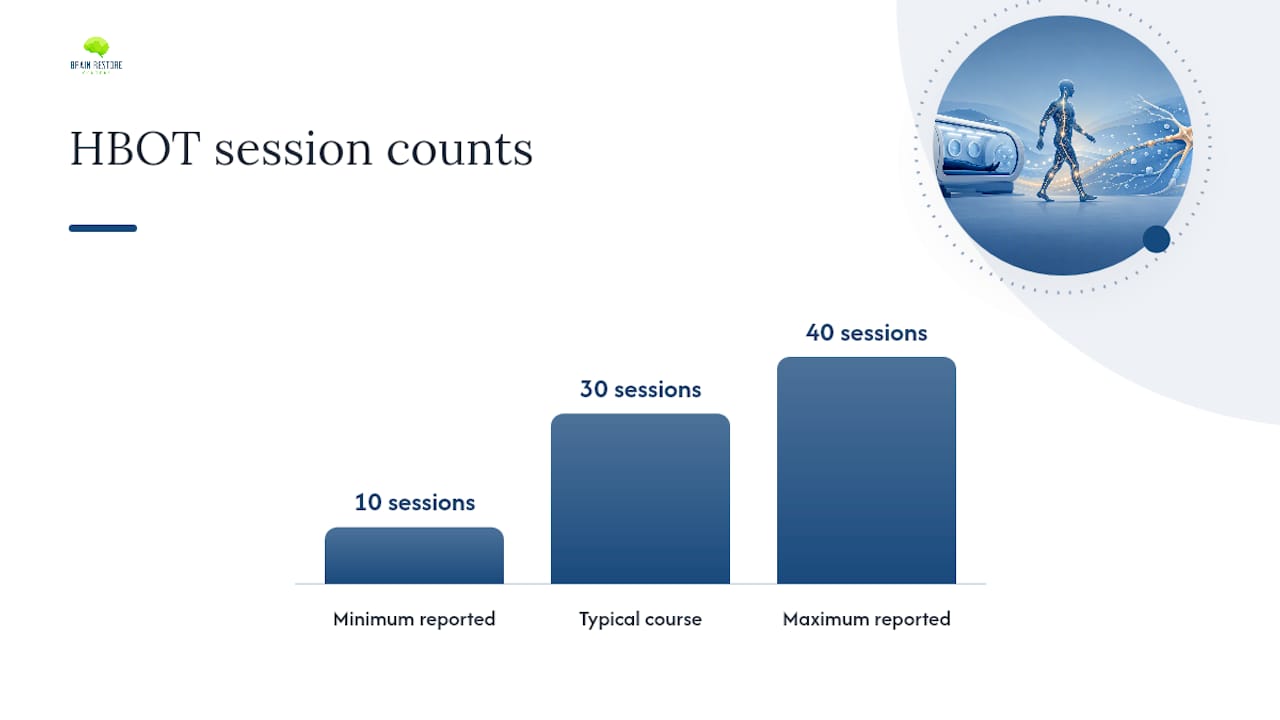
Individual RCTs feeding into that meta-analysis measured outcomes like pain scores on standard visual analog scales alongside motor and sensory nerve conduction velocity (MNCV and SNCV), the objective, quantifiable side of the picture. Typical regimens in these trials ran anywhere from 10 sessions up to a full 30 to 40 session course, which is one reason cross-study comparison gets messy. Sample sizes in individual trials tended to run small, and follow-up periods varied widely, so durability of benefit beyond a few months is not yet well mapped.
A meta-analysis of 14 randomized controlled trials involving 1,323 patients found HBOT produced statistically significant improvements in both effective treatment rate and nerve conduction velocity for diabetic peripheral neuropathy compared with standard care.
Safety data from these trials skews reassuring. Most adverse events reported were mild, ear discomfort or transient dizziness, with serious complications reported rarely. That safety profile is one reason clinical reviews call for standardized protocols and larger trials rather than dismissing HBOT outright. The consensus reads less like “this doesn’t work” and more like “this works for some people, under some conditions, and we need better trial design to say exactly who benefits most.”
Not every neuropathy diagnosis carries the same weight of evidence. Knowing where you fall on that spectrum changes how you should approach a candidacy conversation with a clinician.
Before starting, a thorough clinic will screen your pulmonary status, ask about ear and sinus history, check for seizure history, and confirm there’s no untreated pneumothorax, sometimes with prior chest imaging when your history warrants it. When you’re vetting a provider, ask directly about their credentials, their emergency protocols, the exact pressure and session count they’re proposing, and what objective measures, like nerve conduction studies, they’ll use to track whether it’s working.
HBOT carries a strong overall safety record, but pressurized oxygen isn’t risk-free. The most common side effect is ear or sinus fullness from pressure changes, similar to what you feel during airplane descent. Barotrauma, injury to the eardrum or sinuses from pressure changes, is the next most frequent complaint, followed by transient visual changes like temporary nearsightedness that typically resolves after treatment ends. Some people feel claustrophobic in a monoplace chamber, which is worth mentioning before your first session so staff can help you manage it.
Oxygen toxicity and seizures are rare but serious risks tied to extended high-pressure oxygen exposure. Untreated pneumothorax, a collapsed lung, is the one absolute contraindication that rules out HBOT entirely until it’s treated. Certain lung diseases and uncontrolled seizure disorders are relative contraindications, meaning your physician needs to weigh risk and benefit individually rather than ruling HBOT out automatically.
Good clinics minimize these risks through gradual pressurization, ear-clearing coaching before you ever enter the chamber, and continuous monitoring during sessions.
Pro Tip: If your ears feel clogged for a day or two after a session, that’s usually mild pressure-related congestion working itself out, not a sign something went wrong. Persistent pain, drainage, or hearing changes are different and deserve a call to your provider.
Session pressures in most studies range from 1.8 to 2.5 ATA, with individual sessions lasting 60 to 120 minutes depending on the protocol and facility. Total course length varies more than most patients expect walking in.
A practical checkpoint many clinics use is around session 20, a point to reassess whether you’re seeing measurable movement before committing to the full course. That’s a useful moment to sit down with your provider and look at the data on session ranges and progress checkpoints rather than pushing through blindly. Budget for the time commitment upfront: multiple sessions per week over several weeks is a real logistical and financial investment, and knowing that going in helps you plan realistically instead of getting discouraged partway through.
Brainrestoremeridian treats HBOT as one piece of a larger, coordinated care plan rather than a standalone fix. The clinic pairs hyperbaric sessions with complementary, evidence-based options like laser therapy and functional medicine, with an emphasis on tracking objective progress instead of guessing.
That starts with baseline testing before treatment begins, so your provider has real numbers to compare against as sessions progress. Protocols get tailored to your specific neuropathy type and severity rather than applied as a one-size regimen, and outcomes get tracked against those baselines at defined checkpoints.
If you’re weighing an evaluation, come prepared with your neuropathy history, current medications, and any prior nerve conduction studies. Insurance verification happens early in the process, and the clinic coordinates directly with referring physicians when you’re already under another provider’s care for diabetes, cancer treatment, or another underlying condition.
Medicare covers HBOT for 14 specific approved conditions, but neuropathy on its own is not automatically one of them. Coverage typically hinges on the underlying diagnosis and documentation, not the symptom of nerve pain by itself. If your neuropathy stems from a covered condition, like a diabetic foot ulcer that meets Medicare’s criteria, you have a much clearer path to coverage than if you’re seeking HBOT purely for tingling or numbness with no wound involved.
Private insurance follows a similar logic, generally covering HBOT for approved indications rather than as a general neuropathy treatment. That means the paperwork matters. Clinics experienced with insurance verification and preauthorization can help you figure out whether your specific diagnosis qualifies before you commit to a course of sessions.
Out-of-pocket costs vary widely by region, chamber type, and session count, and a full course of 20 to 40 sessions adds up. Before you start, ask your clinic for a written breakdown covering the per-session rate, expected total sessions, and what happens if you need a repeat course later. Understanding what a full HBOT treatment plan typically costs upfront prevents a lot of frustration halfway through treatment when the bills start arriving.
If cost is a barrier, ask directly whether your clinic offers payment plans or bundled pricing for a full course rather than paying session by session, since some facilities structure pricing differently for committed multi-session plans.
HBOT rarely stands alone as the only intervention worth considering, and it shouldn’t. Several other approaches have real evidence behind them and often work better in combination than any single therapy on its own.
Low-level laser therapy has RCT support specifically for diabetic neuropathy, typically delivered over 10 to 12 sessions, and works through a different mechanism, photobiomodulation, that can complement HBOT’s oxygen-driven effects rather than compete with it. Electrical stimulation approaches, including TENS units, are commonly used for symptomatic pain relief in the feet, though evidence for lasting nerve repair versus temporary symptom masking is mixed and depends heavily on the specific stimulation protocol used.
Functional medicine approaches addressing underlying drivers, like blood sugar control, vitamin B12 status, and thyroid function, matter enormously for diabetic and metabolic neuropathies since untreated root causes will undercut any therapy you layer on top. Nutritional support and, in some cases, targeted peptide therapies for tissue repair are worth discussing with your provider as adjuncts. Peptide-based recovery approaches are an area some clinics explore alongside HBOT for patients focused on tissue healing specifically.
A drug-free, evidence-first treatment plan that combines several of these approaches, rather than relying on any single intervention, tends to reflect how complex peripheral neuropathy actually is.
Nerve tissue doesn’t regenerate overnight, and setting realistic expectations upfront saves you from giving up too early or expecting too much too fast. Some patients notice subjective changes, less burning, better sleep, reduced pain, partway through a treatment course, sometimes as early as session 10 to 15. That’s a real signal worth noting, but it’s different from objective nerve healing.
Measurable changes in nerve conduction velocity, the kind picked up on formal nerve conduction studies, generally show up only after completing a full protocol, typically the 20 to 40 session range used in most clinical trials. This lag makes sense biologically. Angiogenesis and myelin repair are slow processes, and a single week of oxygen exposure isn’t going to reverse years of vascular damage.
It’s also worth being honest that not everyone responds at the same pace, or to the same degree. The heterogeneity flagged in the meta-analysis data reflects real variation between patients, not just noisy research. Diabetic patients with well-controlled blood sugar tend to see more consistent gains than those with ongoing metabolic dysregulation working against the treatment.
Plan for a full course before judging results, track objective measures alongside how you feel, and discuss with your provider whether a second course makes sense if your first round showed partial but incomplete improvement.
Severity and underlying cause matter more than the diagnosis label alone. A mild, early-stage diabetic neuropathy with intact circulation responds to a different calculus than advanced neuropathy complicated by nonhealing ulcers or significant vascular disease.
Type matters just as much as severity. Diabetic peripheral neuropathy, particularly when paired with wound-healing needs, sits on the strongest evidence base. Chemotherapy-induced peripheral neuropathy is an emerging area, backed mostly by preclinical data showing protective effects when HBOT runs alongside active treatment, which means oncology coordination is non-negotiable rather than optional. Idiopathic or purely sensory neuropathy with no vascular or inflammatory driver identified sits furthest from strong evidence, and that gap should shape how aggressively you pursue HBOT versus other options first.
Your overall health picture factors in too. Uncontrolled diabetes, active smoking, or unmanaged cardiovascular disease can all blunt how much benefit you get from HBOT, since the therapy works partly by amplifying a vascular repair process that these conditions actively work against. A thorough evaluation looks at your neuropathy’s duration, its cause, your vascular status, and any prior treatments you’ve tried, then uses that full picture to set expectations rather than promising a specific outcome based on diagnosis alone.
If you’ve had neuropathy for over a decade with no vascular component, that’s a different conversation than someone six months into diabetic nerve damage with early ulceration. Both might be reasonable candidates. Neither should walk in expecting identical results.
Completing a full course of sessions isn’t the finish line. It’s a checkpoint. Most clinical protocols call for reassessment through repeat nerve conduction studies and pain scale tracking several weeks to a few months after your last session, since some benefits continue consolidating even after active treatment stops.
Long-term data on how durable HBOT’s benefits are for neuropathy specifically remains limited, which is part of why the clinical literature keeps calling for longer follow-up periods in future trials. What clinics see in practice is that patients who maintain the underlying drivers of their neuropathy, blood sugar control for diabetics, avoiding neurotoxic exposures for others, tend to hold onto gains longer than those who don’t address root causes alongside HBOT.
Some patients need a repeat course down the line if symptoms plateau or partially return, particularly if the underlying condition driving their neuropathy remains active. This isn’t a sign the first course failed. It reflects that HBOT addresses a physiological process, not a one-time fix for an ongoing disease state like diabetes.
Follow-up care should also include monitoring for any delayed side effects, though these are uncommon once treatment ends, and a conversation with your treating physician about whether adjunctive therapies, like continued laser therapy or nutritional support, make sense to sustain what HBOT helped start. Staying in contact with whichever provider managed your course, rather than disappearing after session 40, gives you the best shot at catching a plateau early and deciding together whether more treatment or a different approach makes sense next.
People with neuropathy face a couple of side-effect considerations that don’t apply the same way to other HBOT patients. Reduced sensation in the feet, common in diabetic and other peripheral neuropathies, means you may not feel early warning signs of skin irritation or pressure injury from lying in the chamber for extended periods. Staff should check positioning carefully, and you should mention any numbness in areas that will be in contact with the chamber surface.
Blood sugar fluctuations are another neuropathy-specific concern, particularly for diabetic patients. HBOT can affect glucose metabolism during and after sessions, so monitoring blood sugar before and after treatment, and coordinating timing with meals or medication, matters more for this population than for HBOT patients without diabetes.
The general side-effect profile still applies on top of these considerations: ear fullness and pressure discomfort remain the most common complaints, transient visual changes can occur, and claustrophobia is worth flagging before your first session if it’s a concern. Rare but serious events like oxygen toxicity and seizures carry the same low probability for neuropathy patients as for anyone else undergoing HBOT, and the same safety protocols, gradual pressurization, continuous monitoring, apply regardless of your underlying diagnosis.
If you’re on medications that affect blood sugar or circulation, review them with both your prescribing physician and your HBOT provider before starting, since dosing needs can shift once you’re several sessions into a course.
HBOT deserves a place in the neuropathy conversation, not because it’s a cure, but because the mechanistic and clinical evidence is genuinely more substantial than most alternative therapies can claim. What frustrates me about how this topic gets discussed online is the pull toward two extremes: dismissing it as unproven, or overselling it as a fix for any nerve pain. Neither matches what the trial data actually shows.
The honest position sits in the middle. HBOT can help certain patients meaningfully, particularly those with vascular-driven nerve damage, but it works best as part of a broader plan with measurable checkpoints, not a solo intervention you try and hope for the best. Track your nerve conduction numbers. Talk to your treating physician throughout, not just at the start. Let the data, not the calendar, tell you whether to continue.
— Chad
Brainrestoremeridian gives you a coordinated path forward, not just a chamber and a schedule. Instead of treating HBOT as a standalone service, the clinic builds it into a broader care plan alongside functional medicine and laser therapy, so your nerve health gets addressed from multiple angles at once, all under one roof in Meridian.
An initial evaluation starts with your full neuropathy history, current medications, and any nerve conduction studies you’ve already had done. From there, baseline testing establishes where you stand before treatment begins, which gives your provider real numbers to measure progress against rather than relying on guesswork. Insurance verification is typically handled upfront to clarify financial considerations before committing to a full session course.
If you’re ready to find out whether HBOT fits your specific situation, schedule a brain health consultation or reach out through the clinic’s main page to start the evaluation process and get your questions about candidacy, cost, and coverage answered directly.
This article is general information, not a substitute for advice from a qualified doctor. Consult a qualified healthcare professional about your own circumstances before acting on anything here.
There is no universal cure for peripheral neuropathy, since outcomes depend heavily on the underlying cause and how much nerve damage has already occurred. Treatments including HBOT, laser therapy, and addressing root causes like blood sugar control can meaningfully improve symptoms and, in some cases, nerve function, but “cure” oversells what any single therapy can promise.
Yes, mild ear fullness or a clogged sensation after a session is common and usually resolves within a day or two, similar to the feeling after a flight. Persistent pain, drainage, or hearing changes are different and should be reported to your provider right away.
Electrical stimulation, including TENS therapy, is commonly used for symptomatic pain relief in diabetic and other peripheral neuropathies, though evidence on lasting nerve repair versus temporary symptom control is mixed. It’s often used as one piece of a broader plan rather than a standalone solution.
Refined sugars and highly processed carbohydrates are worth limiting since they contribute to blood sugar spikes that worsen diabetic neuropathy over time. Excess alcohol is another common trigger, since it can directly damage peripheral nerves and interfere with vitamin B12 absorption, which nerves need to function properly.
Wound-healing protocols in clinical studies commonly use 20 to 40 sessions, while some neuropathy-specific trials use shorter courses of 10 to 20 sessions. Many clinics use a checkpoint around session 20 to assess measurable progress before committing to a full course.
Medicare covers HBOT for 14 specific approved conditions, but neuropathy alone is not automatically included unless it’s tied to a covered diagnosis like a qualifying diabetic foot ulcer. Coverage depends on documentation and underlying indication, and clinics can assist with verification before you start treatment.