
How Functional Neurology Addresses PTSD: 2026 Guide
July 14, 2026


Functional neurology addresses PTSD by targeting the dysregulated brain circuits that keep trauma responses locked in place, rather than focusing solely on symptoms. The core problem is a measurable neurological imbalance: an overactive amygdala drives fear responses while an underactive prefrontal cortex fails to regulate them. Techniques like FDA-cleared neurofeedback and personalized neuromodulation give clinicians direct tools to retrain those circuits. Recent 2026 research confirms these functional approaches to PTSD produce sustained symptom relief, especially when combined with established psychotherapy. If you have tried conventional PTSD treatment options without full relief, understanding the neuroscience behind these methods is the first step toward a better path.
Functional neurology is defined as the clinical application of neuroscience to identify and correct measurable dysfunction in specific brain circuits, without relying on drugs as the primary intervention. The field draws on neuroplasticity, the brain’s proven ability to reorganize itself, to restore healthy signaling patterns. For PTSD, that means working directly on the circuits that generate and sustain trauma responses.
PTSD is not simply a psychological condition. Adverse life events recalibrate neural learning systems, biasing the brain toward maladaptive threat encoding that becomes self-reinforcing over time. That biological lock-in explains why talk therapy alone often falls short for many patients.

Functional neurological rehabilitation targets those locked patterns directly. The two primary tools are neurofeedback, which trains patients to self-regulate brain activity in real time, and neuromodulation techniques like transcranial magnetic stimulation (TMS), which use targeted electromagnetic pulses to shift circuit activity. Both methods are grounded in measurable brain data, not guesswork.
PTSD produces specific, measurable changes across multiple brain regions. Understanding those changes explains why functional neurology interventions are designed the way they are.
PTSD is driven by dynamic, interconnected brain networks rather than isolated symptoms or a single brain region. That network-level view is what makes functional neurology’s multi-target approach so well matched to the condition.
Neurofeedback is a form of neurotherapy for PTSD that trains patients to consciously influence their own brain activity. Think of it as exercise for your brain’s regulatory circuits. The process uses real-time EEG data to show patients what their brain is doing, then rewards them for producing healthier patterns.
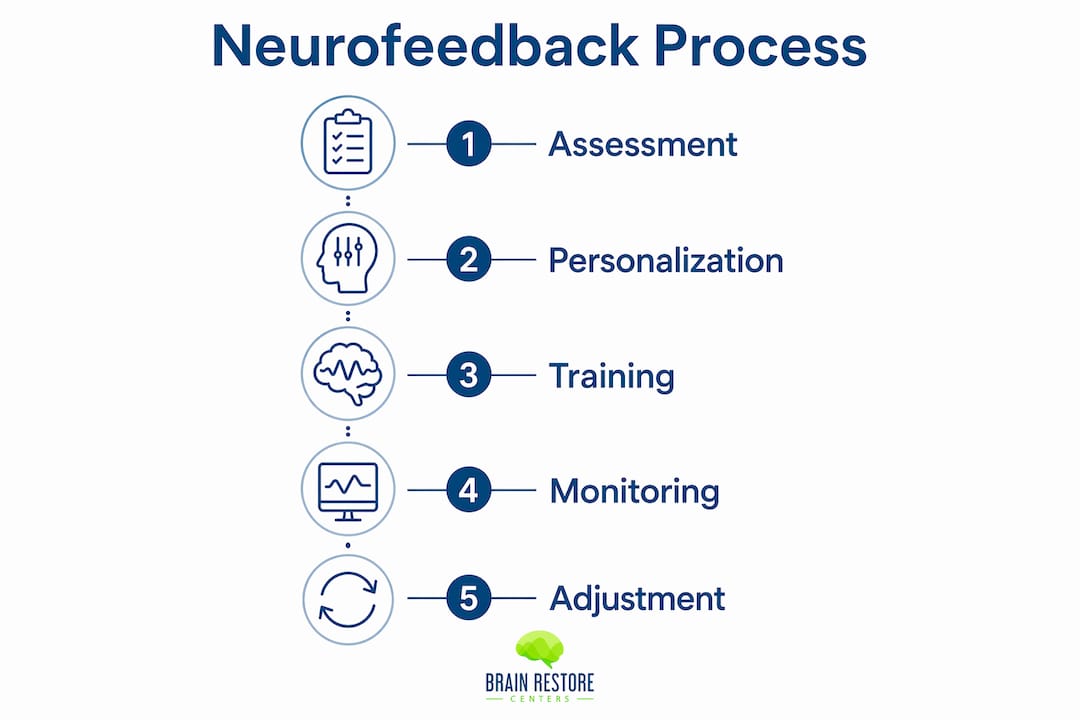
The most clinically advanced system currently available is the Prism neurofeedback system. Prism is FDA-cleared for PTSD treatment, using amygdala-derived EEG biomarkers to give patients real-time feedback on their threat-circuit activity. Sessions run approximately one hour: 15 minutes of setup and planning, 30 minutes of active training through an interactive audiovisual game, and 15 minutes of debriefing. The game format is not incidental. It keeps patients engaged while they practice downregulating the very circuits that drive their PTSD symptoms.
A key technical advancement behind Prism is the Electronic Fingerprint EEG-fMRI Pattern (EFP) biomarker. Machine learning models derive amygdala activity from EEG alone, eliminating the need for costly, inconvenient fMRI during every session. That makes precise amygdala-targeted training accessible in a standard clinical setting.
Alpha-rhythm EEG neurofeedback offers a complementary approach. A 38-participant randomized sham-controlled trial showed significant clinical and neural outcome improvements across a 20-week program, with symptom stabilization occurring by week 11. That timeline matters: it tells patients and clinicians that measurable neural change takes consistent effort over months, not days.
The numbered steps below outline what a typical neurofeedback program for PTSD looks like in practice:
Pro Tip: Patients who develop multiple personalized mental strategies, such as visualization, memory recall, and sensory anchoring, show stronger amygdala downregulation than those who rely on a single technique. Depth of strategy matters more than quantity.
Neuromodulation adds another layer to functional neurology for PTSD, targeting brain circuits from the outside using electromagnetic energy rather than training patients to self-regulate. The most evidence-backed method is personalized fMRI-guided transcranial magnetic stimulation (TMS).
Pro Tip: If you have not responded fully to trauma-focused CBT, ask your provider about adding rTMS as an adjunct. The 2026 WFSBP consensus specifically identifies this combination for patients who have plateaued on psychotherapy alone.
Functional neurology works best as a complement to established PTSD treatment options, not a replacement for them. Neuroscientifically informed interventions are most effective as adjuncts to trauma-focused psychotherapies like prolonged exposure or CBT. That framing matters because it sets realistic expectations and guides how you build a treatment plan.
Here is what practical integration looks like for most patients:
Therapies targeting maladaptive learning and neural recalibration can break the self-reinforcing loops that keep PTSD entrenched. That is the core promise of functional approaches to PTSD: not just managing symptoms, but changing the brain patterns that generate them. You can learn more about how these models work in practice through Brainrestoremeridian’s overview of functional neurology principles.
Functional neurology addresses PTSD most effectively by combining neurofeedback and neuromodulation as adjuncts to trauma-focused psychotherapy, targeting the amygdala and prefrontal circuits that sustain the condition.
| Point | Details |
|---|---|
| PTSD is a brain circuit disorder | Amygdala hyperactivity and prefrontal hypoactivation are measurable targets, not just symptoms. |
| Neurofeedback retrains circuits directly | FDA-cleared systems like Prism use EEG biomarkers to train amygdala downregulation in real time. |
| TMS adds targeted neuromodulation | Personalized fMRI-guided TMS reduces PTSD symptoms with effects sustained at 3–6 months. |
| Integration beats single-modality care | WFSBP 2026 guidelines confirm combining neuromodulation with trauma-focused CBT outperforms either alone. |
| Patient strategy depth drives outcomes | Personalized mental strategies developed during neurofeedback sessions improve clinical results significantly. |
The most important shift I have seen in PTSD treatment is the move from symptom management to circuit repair. For years, the conversation centered on coping skills and medication titration. Both have value. Neither addresses the underlying neural architecture that keeps a person locked in a trauma response.
What strikes me about the current research is how specific it has become. We are no longer talking about “calming the nervous system” in vague terms. We are talking about the right dorsolateral prefrontal cortex’s connectivity to the amygdala, measured with fMRI, targeted with TMS, and tracked over months. That specificity is what separates modern functional neurology from earlier, less rigorous iterations of the field.
The limitation I want to be honest about is access. Personalized fMRI-guided TMS and FDA-cleared neurofeedback systems are not yet available in every clinic. Patients in smaller markets may face real barriers. That is why I think it matters to understand what to ask for, not just what exists in research papers.
My practical advice: if you are exploring PTSD recovery techniques beyond standard therapy, prioritize providers who use objective brain data, whether qEEG or fMRI connectivity mapping, to guide treatment. Personalized targeting is not a luxury. It is what separates meaningful circuit change from generalized stimulation that may or may not reach the right networks.
— Chad
Brainrestoremeridian offers neurofeedback programs designed to address the brain circuit dysregulation at the core of PTSD and anxiety. The clinic’s approach pairs neurofeedback for anxiety relief with chiropractic care and functional medicine, creating a multi-modal plan built around your specific neurological profile.
If you are ready to move beyond symptom management and work directly on the brain patterns driving your PTSD, Brainrestoremeridian’s team in Meridian, Idaho can build a personalized care plan for you. Reach out to schedule a consultation and find out which combination of neurotherapy and functional medicine fits your recovery goals.
Functional neurology for PTSD is a clinical approach that identifies and corrects measurable brain circuit dysfunctions, particularly amygdala hyperactivity and prefrontal hypoactivation, using non-drug interventions like neurofeedback and TMS.
Research shows symptom stabilization in alpha-rhythm EEG neurofeedback programs occurs around week 11 of a 20-week protocol, suggesting consistent treatment over several months produces the most reliable neural change.
Neurofeedback is non-invasive and carries a low side-effect profile. FDA-cleared systems like Prism use real-time EEG monitoring without drugs, making them suitable for patients who cannot tolerate or have not responded to pharmacological PTSD treatments.
Functional neurology works best as an adjunct to trauma-focused psychotherapy, not a replacement. The 2026 WFSBP expert consensus confirms that combining neuromodulation with CBT produces superior outcomes compared to either treatment used alone.
Personalized fMRI-guided TMS maps each patient’s unique connectivity between the right dorsolateral prefrontal cortex and the amygdala before treatment begins, allowing precise targeting of the threat neurocircuitry that drives PTSD symptoms.
Questions about your next step?
Our Meridian team can help you understand the evaluation process and which care options may fit your needs.
Schedule a ConsultationPrefer to speak with our team? Call 208-639-1397